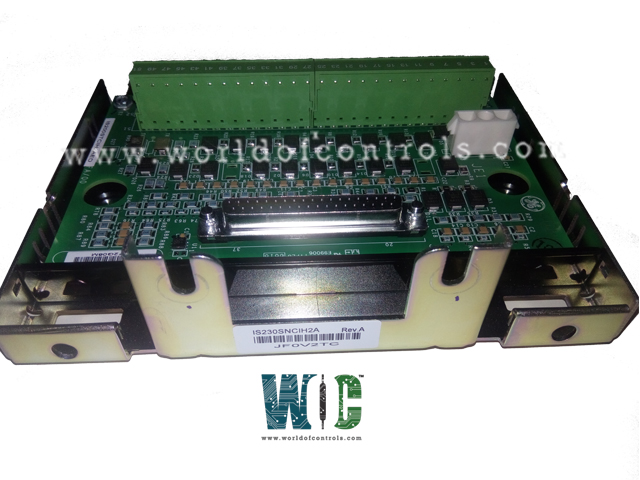
World Of Controls understands the criticality of your requirement and works towards reducing the lead time as much as possible.
IS230SNCIH2A, REV A - Discrete Contact Input Module is available in stock which ships the same day.
IS230SNCIH2A, REV A - Discrete Contact Input Module comes in UNUSED as well as REBUILT condition.
To avail our best deals for IS230SNCIH2A, REV A - Discrete Contact Input Module, contact us and we will get back to you within 24 hours.
TECHNICAL SPECIFICATIONS
Part Number: IS230SNCIH2A, REV A
Manufacturer: General Electric (GE)
Series: Speedtronic Mark VIe & Mark VIeS
Functional Acronym: SNCI
Product Type: Discrete / Contact Input DIN-Rail Module
Hardware Revision: REV A
Redundancy Configuration: Simplex I/O Pack Layout (interfacing with 1 PDIA I/O Pack)
Nominal Excitation Voltage: 24 V DC (System tolerance up to 25 V DC)
Input Interfacing Capacity: Multi-channel dry contact voltage tracking
Mounting Profile: Standard Integrated DIN-rail carrier design
Circuit Board Protection: High-grade Conformal PCB Coating
Network Interfacing: High-speed Ethernet connection to IONet fabric
Ambient Operating Temperature: -30°C to +65°C (-22°F to +149°F) continuous range
Terminal Board Compatibility: Pairs seamlessly with standard Mark VIe DIN-rail discrete terminal assemblies
Repair Lead Time: 3–5 Business Days
Availability: In Stock / Repair & Exchange Available
Country of Origin: United States
The IS230SNCIH2A, REV A is a Discrete Contact Input Module designed and manufactured by General Electric for the Distributed Mark VIe and Mark VIeS control platforms. This module acts as a dedicated industrial interface layer, capturing digital state and contact status signals from field-side dry switches, safety interlocks, sequence-of-events (SOE) monitors, and limit relays, then translating them into deterministic variables for the central processing framework.
DISCRETE SIGNAL SAMPLING & INTERFACING:
The module infrastructure relies on a highly regulated onboard power conditioning stage to supervise external contact behavior safely. It distributes a stable 24 V DC nominal excitation voltage (with a maximum operational system tolerance reaching up to 25 V DC) across the input field lines to wet the target dry contacts.
SIGNAL CONDITIONING & DIGITAL DEBOUNCING:
To maintain absolute control precision inside high-vibration power generation environments, the module incorporates robust front-end filtering logic directly on its hardware layer:
SIMPLEX OPERATION & SYSTEM CONTEXT:
The IS230SNCIH2A, REV A is uniquely configured for space-saving Simplex Redundancy Layouts within the Mark VIe and Mark VIeS distributed control typography. In this configuration, all localized contact acquisition hardware routes directly into a single input/output pack (typically a PDIA Discrete Input I/O Pack).
The module condenses high-channel discrete logic paths into an optimized, narrow-footprint DIN-rail carrier system. By transmitting serialized data blocks over a single deterministic 100 Mbps IONet link, it provides rapid update rates for non-triple modular redundant (TMR) applications. This makes it an ideal fit for balancing auxiliary infrastructure, package boilers, cooling tower subsystems, and motor control center (MCC) monitoring arrays.
WHY PARTNER WITH WORLD OF CONTROLS:
World of Controls provides the industry's most dependable logistics and technical infrastructure for critical turbine control networks. We maintain an extensive inventory of genuine OEM replacement parts for GE Distributed control setups, minimizing operational downtime during emergency outages. Every item, from certified unused surplus to fully rebuilt industrial components, is subjected to strict simulation profiling in our advanced electronics lab and is supplied with a comprehensive product warranty. Our global engineering support network operates 24/7 to deliver troubleshooting advice, component replacement guidance, and component testing evaluations. Contact the WOC sales team directly via phone or email for current pricing, hardware availability, or repair quotes.
What is the GE IS230SNCIH2A, REV A?
The GE IS230SNCIH2A, REV A is a Discrete Contact Input DIN-Rail Module manufactured by General Electric for its Speedtronic Mark VIe and Mark VIeS turbine control frameworks. This module serves as a localized, high-density hardware interface that processes digital state signals from field-side dry switches, safety interlocks, and limit relays, converting them into deterministic data blocks for the primary controller.
What nominal excitation parameters does the module apply to external loops?
The board distributes a stable 24 V DC nominal excitation rail with system tolerances up to 25 V DC to wet external field contacts.
How does the SNCI hardware protect core logic components from transient field overvoltages?
It integrates front-end opto-isolation barriers that convert electrical signals into light pulses, establishing a rigid galvanic isolation boundary that protects the low-voltage microprocessor core from field ground loops or spikes.
What dual-stage filtering infrastructure rejects signal noise and contact chatter?
Input processing runs an initial physical hardware RC low-pass filter to attenuate high-frequency interference, followed by programmable digital debounce timers inside the processor array to eliminate mechanical switch chatter.