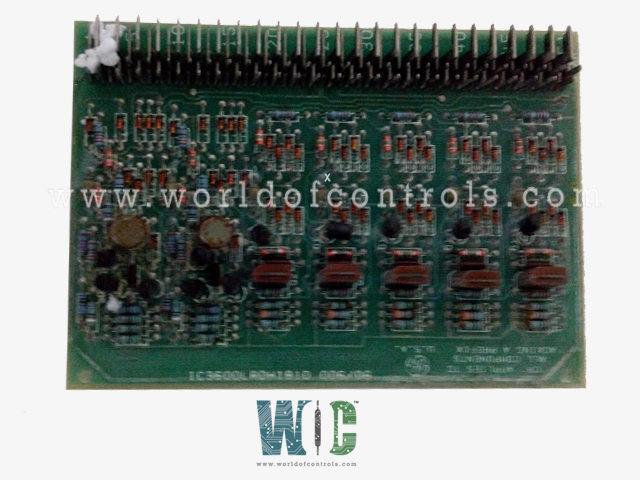
World Of Controls understands the criticality of your requirement and works towards reducing the lead time as much as possible.
IC3600LRDH1A1C - Load Reference Driver (LRD) card is available in stock which ships the same day.
IC3600LRDH1A1C - Load Reference Driver (LRD) card comes in UNUSED as well as REBUILT condition.
To avail our best deals for IC3600LRDH1A1C - Load Reference Driver (LRD) card, contact us and we will get back to you within 24 hours.
SPECIFICATIONS:
Part No: IC3600LRDH1A1C
Manufacturer: General Electric
Product Type: Load Reference Driver Card
Control Platform: Speedtronic Mark II
Input Power: 24 V DC
Output Accuracy: ±0.5%
Operating Temperature Range: -35°C to +65°C
Mounting: DIN/Control rack
Output Type: Current/Voltage
Signal Isolation: Backplane isolation
Output Resolution: 12-bit
Power Supply Voltage: 24 V dc
Board Size: 2.5 cm high x 8.5 cm
Weight: 0.48 kg
Availability: In Stock
Country of Origin: USA
FUNCTIONAL DESCRIPTION:
IC3600LRDH1A1C is a Load Reference Driver (LRD) card manufactured and designed by General Electric as part of the Mark II Series used in GE Speedtronic Gas Turbine Control Systems. The module functions as a digital-to-analog interface that receives load reference setpoints from the central control logic and converts these commands into precision analog output signals. These analog outputs are used to drive turbine load control actuators, governor systems, and other load control elements requiring continuous analog input. The card implements scaling, filtering, and rate limiting to ensure that load reference signals are delivered smoothly, avoiding abrupt changes that can destabilize turbine speed or load sharing.
During startup and load ramping, the IC3600LRDH1A1C provides controlled output transitions by applying configurable slew rate limits and output filtering. This ensures that load setpoint changes occur within defined ramp rates, preventing sudden actuator movements and reducing mechanical stress. In steady-state operation, the module maintains output accuracy through closed-loop reference tracking and compensates for signal drift or noise through internal conditioning circuitry. The card also monitors its own output integrity and detects fault conditions such as output saturation, loss of supply voltage, or signal deviation beyond predefined tolerance thresholds.
SIGNAL INTERFACES
OPERATION:
It receives load reference values from the control logic, scales them according to configured calibration parameters, and generates proportional analog output signals. During load ramping, the card ensures a smooth transition by controlling the output slew rate and limiting transient overshoot. During steady-state operation, it maintains load output stability and responds to control adjustments and feedback to preserve load accuracy.
CONTROL LOGIC & PROTECTION:
The module incorporates internal monitoring to detect abnormal conditions such as output saturation, loss of power, or signal deviation beyond tolerance limits. If a fault is detected, the card signals a status alarm and may disable output to prevent incorrect load control commands. It also supports compatibility with Mark II system interlocks, ensuring load output is only active when system permissives and safety conditions are met.
World of Controls maintains a comprehensive inventory of OEM GE Speedtronic Mark II replacement modules, including unused (new-old-stock) and rebuilt IC3600SASC1C1F cards, to support rapid replacement needs in turbine control systems. Rebuilt units undergo component-level inspection, fault isolation, and corrective rework, followed by functional testing against OEM specifications to verify signal accuracy, timing performance, and electrical tolerances. Repair services include diagnostic evaluation, solder joint repair, component replacement, and verification of power supply stability and I/O signal integrity to ensure compatibility with the Mark II control architecture. Technical support is available for troubleshooting, part identification, and integration guidance to restore reliable turbine control operation.
What is a Load Reference Driver (LRD) card?
A Load Reference Driver (LRD) card is a control module within the GE Speedtronic Mark II system that converts digital load setpoints into analog output signals. These analog signals are used by turbine governor actuators, fuel control systems, or load-sharing controllers to regulate power output. The card ensures precise load command delivery and maintains signal stability during transient and steady-state operation. It acts as a critical interface between digital control logic and analog actuator inputs.
How does the LRD card function in the Speedtronic Mark II system?
The LRD card receives load reference commands from the Mark II control logic and scales them using internal calibration parameters. It then outputs proportional analog signals that drive load control devices, ensuring the turbine operates at the desired power level. The card also monitors output integrity and can inhibit output if abnormal conditions are detected. It operates continuously during startup, load ramping, and steady-state load control.
What types of outputs does the LRD card provide?
The LRD card typically provides analog voltage or current outputs depending on the configured application and downstream control device requirements. Outputs are designed to support continuous control signals with high resolution and low noise. They may also include status or diagnostic signals to indicate operational health. Output scaling and limits are configured to match the turbine’s load control loop requirements.
What are common failure modes of an LRD card?
Common failures include output drift, loss of analog signal, incorrect scaling, or intermittent output due to connector issues or component degradation. Power supply instability or noise coupling can also affect output accuracy and stability. Faulty internal digital-to-analog conversion circuitry can lead to incorrect load reference signals. Diagnostic monitoring typically identifies these issues through abnormal output readings or status alarms.