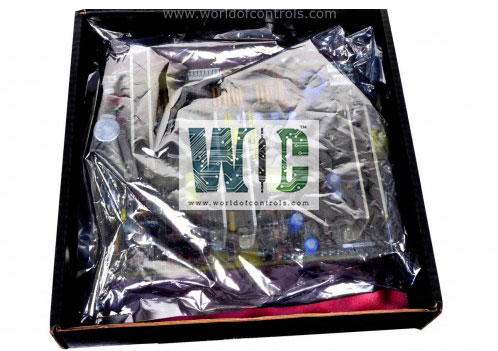
World Of Controls understands the criticality of your requirement and works towards reducing the lead time as much as possible.
8238-939 - Peak 150 Digital Control Module is available in stock which ships the same day.
8238-939 - Peak 150 Digital Control Module comes in UNUSED as well as REBUILT condition.
To avail our best deals for 8238-939 - Peak 150 Digital Control Module, contact us and we will get back to you within 24 hours.
TECHNICAL SPECIFICATIONS:
Part Number: 8238-939
Manufacturer: Woodward
Series: Peak 150 System Architecture
Application Type: Digital Steam Turbine Governor / Speed Control
Input Signal Range: Proportional 4-20mA positioning commands, dual high-frequency MPU speed inputs, and configurable discrete contacts
Output Type: Isolated 4-20mA actuator drive channels, programmable Form C signaling relays, and dedicated analog readout links
Operating Voltage: 24 VDC Nominal / Configurable AC mains operational profiles
Control Accuracy: ±0.05% of rated operating velocity bounds
Size: NEMA 4X / Industrial-grade remote mount wall enclosure
Operating Temperature: -20 °C to +60 °C (-4 °F to +140 °F) ambient tracking limits
Mounting: Vertical surface panel or bulkhead mount array
Repair: 3-7 days
Availability: In Stock
Weight: Approximately 4.5 kg (9.9 lbs)
Country of Origin: United States
The 8238-939 is a Peak 150 Digital Control Module designed and manufactured by Woodward as a standalone, micro-processor-driven governor for small to mid-sized industrial steam turbines. Housed in a ruggedized, element-resistant enclosure, this assembly regulates inlet valve positions via algorithmic proportional-integral-derivative (PID) tracking to govern shaft speed, system load, or process parameters over demanding operational runs.
REAL-TIME INTEGRATED SPEED GOVERNING:
The core computing architecture of the 8238-939 monitors turbine acceleration profiles through independent Magnetic Pickup (MPU) speed sensor arrays. By converting these raw high-frequency AC pulse cycles into precise digital timeline values, the module cross-checks real-time velocities against user-defined speed references. If dynamic variances occur due to shifting generator or mechanical loads, the system quickly adjusts its integrated PID calculations to maintain flat frequency synchronization.
FIELD-PROGRAMMABLE SYSTEM FLEXIBILITY:
The Peak 150 includes a front-panel interface featuring an integrated display and multi-button programming pad. Operators and field technicians can use this onboard matrix to configure start-up acceleration ramps, critical speed exclusion bands (to protect against resonance damage), overspeed trip thresholds, and auxiliary PID process configurations without requiring external laptops or software code packages.
WHY BUY FROM WOC:
World of Controls is a specialized global authority in the lifecycle extension of active Woodward and GE industrial control architectures, providing the 8238-939 in both UNUSED and REBUILT conditions to eliminate operational latency. Our legacy quality-assurance protocol involves extensive load-profile thermal testing, step-response signal analysis, component isolation barrier checks, and static-safe custom industrial packaging. By partnering with WOC, you secure reliable hardware solutions reinforced by 24/7 technical consultation and accelerated global logistics.
What is Woodward 8238-939?
The 8238-939 is a standalone, micro-processor-based Peak 150 Digital Control Module engineered by Woodward to govern small to mid-sized industrial steam turbines. Operating as a self-contained governor system, it acts as the primary analytical processing hub that reads high-frequency speed pulses from magnetic pickups and executes complex closed-loop PID math to regulate steam inlet valve positioning for stable acceleration and grid synchronization.
What is the exact role of the 8238-939 inside a closed-loop speed governing system?
The Digital Control Module functions as a dedicated proportional-integral-derivative (PID) tracking node. It samples high-frequency pulse trains from raw Magnetic Pickups (MPUs), converts the time-domain frequency components into an exact velocity vector, cross-references it with the software speed reference, and writes a real-time error correction value directly to the isolated 4-20mA actuator output driver.
How does this controller handle signal attenuation, harmonic noise, or tooth-profile irregularities on the incoming MPU lines?
The module features integrated internal signal conditioning circuitry. Raw AC voltages from the magnetic pickups are passed through an isolated hardware low-pass filter and an internal Schmitt-trigger network. This setup strips out high-frequency electromagnetic interference (EMI), cross-talk, and field noise, translating irregular sine waves into clean digital square waves for ultra-precise clock-cycle period processing.
What are critical speed exclusion bands, and how does the processing architecture handle them during turbine startup?
The Digital Control Module features field-programmable exclusion zones; when the acceleration curve intersects these parameters, the controller overrides the standard slow ramp rate. It alters the PID gating calculation to step the steam valve demand rapidly, driving the turbine through the resonance zone as quickly as possible to prevent mechanical fatigue.
Can the Peak 150 execute cascade loop control based on auxiliary external process parameters?
The Digital Control Module is configured to manage complex process variables alongside basic speed limiting. By wiring an auxiliary 4-20mA analog transmitter (such as boiler header pressure, suction pressure, or extraction flow limits) into its secondary analog input port, the internal firmware runs a dual-loop cascade algorithm, trimming the primary speed demand based on live plant conditions.