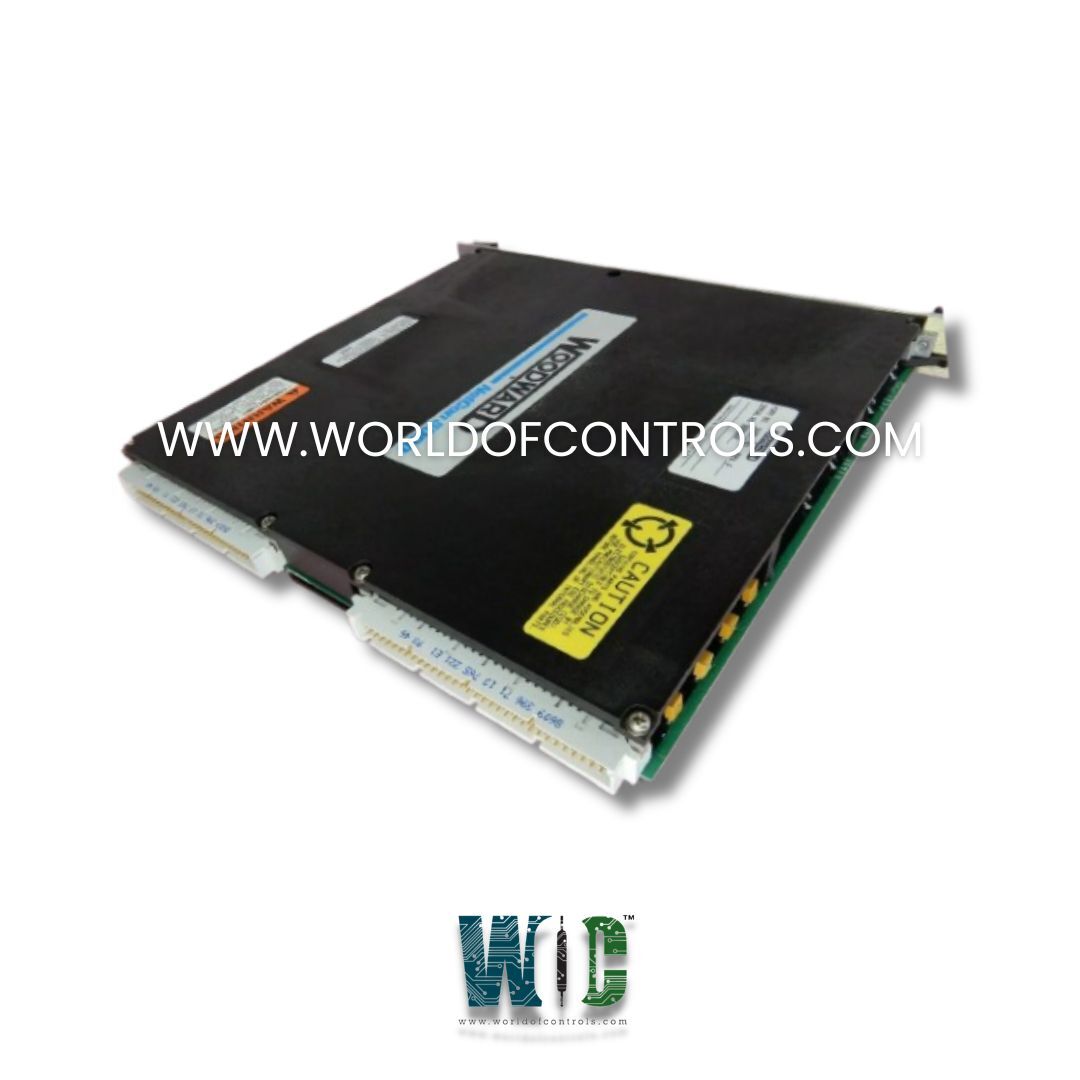
World Of Controls understands the criticality of your requirement and works towards reducing the lead time as much as possible.
5463-783 - NetCon 5000 24-Point Discrete Input Module is available in stock which ships the same day.
5463-783 - NetCon 5000 24-Point Discrete Input Module comes in UNUSED as well as REBUILT condition.
To avail our best deals for 5463-783 - NetCon 5000 24-Point Discrete Input Module, contact us and we will get back to you within 24 hours.
TECHNICAL SPECIFICATIONS:
Part Number: 5463-783
Manufacturer: Woodward
Series: NetCon 5000
Product Type: Discrete Input Module
Channel Density: 24 Channels
Nominal Operating Voltage: 24 VDC
Input Voltage Range: 18 VDC to 32 VDC
Maximum Input Surge Rating: 60 VDC (< 10 ms)
Sensing Current Per Channel: 5 mA to 7 mA at 24 VDC
Turn-On Voltage Threshold: ≥ 12 VDC
Turn-Off Voltage Threshold: ≤ 5 VDC
Galvanic Isolation Barrier: 1500 Vrms
Channel-to-Channel Isolation: ≥ 500 VDC
Transient Noise Immunity: IEEE C37.90.1
Analog RC Filter Time Constant: ~2.0 ms
Digital Logic Propagation Delay: < 1.0 µs
Backplane Bus Access Speed: < 250 ns
Front Panel Connectors: 2 x 37-Pin Female Sub-D
Rear Backplane Connectors: 2 x 96-Pin Type C DIN 41612
Form Factor Frame Type: Single-Slot VME 6U PCBA
Operating Temperature Limits: 0°C to +60°C (+32°F to +140°F)
Storage Temperature Range: -40°C to +85°C (-40°F to +185°F)
Relative Humidity Threshold: 5% to 95% (Non-condensing)
Diagnostic Indicators: 1 x Front Panel Red "FAULT" LED
Repair Time: 3-7 Days
Availability: In Stock
Weight: 1.36 kg (3.0 lbs)
Country of Origin: United States
The 5463-783 is a NetCon 5000 24-Point Discrete Input Module designed and manufactured to bridge raw binary field signals with the NetCon 5000 parallel VMEbus backplane. Operating strictly as a 24-point contact-sensing array, this module continuously monitors the open or closed status of critical remote field hardware, such as limit switches, pressure transmitters, breaker auxiliary contacts, and main fuel manifold trip contacts. Each of the 24 channels follows a dedicated, isolated signal path that translates high-voltage field transitions into low-latency, logic-level data bytes for the central processing unit.
OPTOCOUPLER TRANSISTOR GALVANIC BARRIER
To protect sensitive rack electronics from aggressive field transients, inductive flyback, or lightning strikes, each channel incorporates an independent optical isolation circuit. The incoming field voltage zeroes in on an internal light-emitting diode (LED) within the optocoupler, which illuminates and switches a matching phototransistor to signal the internal logic gates. This complete physical and electrical separation provides up to 1500 Vrms of galvanic isolation, ensuring that field-side electrical noise or catastrophic short circuits cannot cross over to the parallel VMEbus motherboard or degrade neighboring I/O modules.
FRONT-END INTERFACING & RC LOW-PASS FILTERING
Before reaching the isolation stage, raw field signals enter through the dual front-facing 37-pin female Sub-D connectors and pass through an onboard discrete conditioning network. Each input line is routed through a dedicated resistor-capacitor (RC) low-pass filter matrix designed to attenuate high-frequency electromagnetic interference (EMI) and radio frequency interference (RFI) picked up by long field cable runs. This analog filtering stage ensures that only genuine sustained voltage transitions are passed forward, protecting the downstream logic from false trip commands caused by plant background noise.
DIGITAL DEBOUNCE FILTERING & REGISTER LOGIC MAPPING
Because mechanical field contacts inherently exhibit physical contact bounce during a state change, the module uses internal digital debounce logic to verify signal stability. The filtered binary states are sampled over a fixed execution loop, and once verified, they are mapped directly into dedicated, onboard 16-bit registers. These storage registers interface directly with high-speed address decoding gates, allowing the main NetCon CPU to instantly read the synchronized channel states across the shared parallel backplane traces without processing delays.
WHY BUY FROM WOC
World of Controls specializes in critical lifecycle extension for Woodward turbine controls. Every 5463-783 undergoes automated I/O loop simulators, thermal breakdown testing under full channel loads, and physical connector evaluations on original NetCon test beds. We maintain immediate inventory stocks to bypass active system downtime, backed by comprehensive warranties and worldwide express shipping.
What is Woodward 5463-783?
The 5463-783 is an industrial 24-Point Discrete Input Module designed by Woodward for the legacy NetCon 5000 turbine control platform. It functions as a high-density digital interface that monitors the open or closed status of remote field switches, breakers, and trip contacts.
Why would a field contact toggle physically but fail to register on the module?
This is caused by a blown internal input resistor or a failed optocoupler channel. If field voltage is present at the front 37-pin plug but the logic register doesn't flip, that channel's optical isolation circuit has failed.
What causes a solid red front panel FAULT LED on this module?
It indicates a failed power-up self-test or a localized internal logic rail failure. For this specific input card, the light activates if the onboard address decoding logic or internal register chips fail to initialize.
How do you isolate field loop wiring issues from an internal card failure?
Unplug the front 37-pin Sub-D connectors and apply a clean external test voltage directly across the module's input pins. If the register updates during this test, the problem lies in the field switches, external wiring, or terminal blocks.
What happens if an external field wire shorts directly to the chassis ground?
The onboard optoelectronic galvanic isolation completely blocks the spike at the input stage. The specific channel's front-end components may burn out, but the destructive transient cannot propagate to the shared logic rails or cause adjacent cards to crash.
What causes erratic contact chatter across multiple channels simultaneously?
This is usually driven by loose pins on the front 37-pin plug or broken field cable shielding. These hardware issues introduce electromagnetic noise that overcomes the card's internal RC filter circuits, mimicking high-frequency contact bounce.
Why does a bent pin on the rear 96-pin connector disrupt other rack modules?
The NetCon 5000 backplane shares parallel address and data lines across the motherboard. If a pin on the 5463-783 bends and shorts adjacent traces, it corrupts the shared bus lines, causing communication faults for completely unrelated cards.