World Of Controls understands the criticality of your requirement and works towards reducing the lead time as much as possible.
IS215UCVDH9A - VME Controller Card is available in stock which ships the same day.
IS215UCVDH9A - VME Controller Card comes in UNUSED as well as REBUILT condition.
To avail our best deals for IS215UCVDH9A - VME Controller Card, contact us and we will get back to you within 24 hours.
SPECIFICATIONS:
Part Number: IS215UCVDH9A
Manufacturer: General Electric
Series: Mark VI
Product Type: VME Controller Card (UCVD)
Processor: Intel Celeron 650 MHz
Microprocessor: AMD-K6 300 MHz
Memory: 16 MB DRAM
Operating System: QNX Real-Time OS
Programming: 16-bit signed integer
Ethernet Interface: Twisted pair 10BaseT, RJ-45 connector
Communication Ports: Ethernet (IONet), RS-232, LPT, PS/2
VME Bus Interface: 21-Slot VME64 Compatible
Power Requirements: +5 V dc, 6 A
Operating Temperature: 0 °C to +50 °C
Availability: In Stock
Country of Origin: USA
FUNCTIONAL DESCRIPTION:
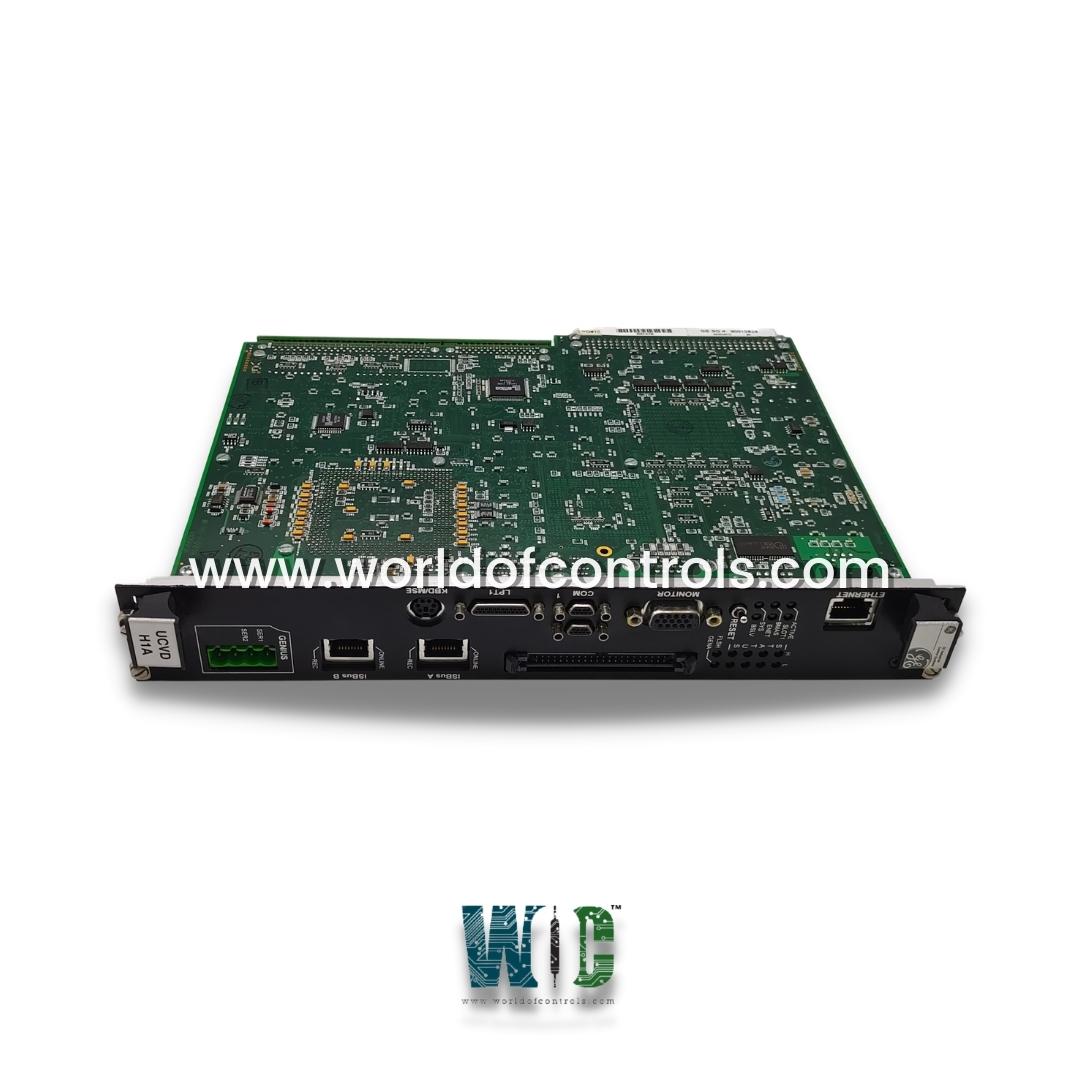
The IS215UCVDH9A is a high-performance VME Controller Card developed and designed by General Electric for the Mark VI Speedtronic turbine control system. The UCVD is a double-slot board using a 300 MHz AMD K6 processor with 8 MB of flash memory and 16 MB of DRAM. A single 10BaseT (RJ-45 connector) Ethernet port provides connectivity to the UDH. The UCVD contains a double column of eight status LEDs. These LEDs are sequentially turned on in a rotating pattern when the controller is operating normally. When an error condition occurs, the LEDs display a flashing error code that identifies the problem.
PROCESSOR ARCHITECTURE & COMPUTING POWER:
The VME Controller Card functions as the central logic engine for the Mark VI architecture. Powered by an Intel Celeron 650 MHz processor and equipped with 128 MB of SDRAM, it provides the robust computing power necessary to run the QNX real-time operating system. This hardware configuration enables the board to perform high-speed floating-point calculations and manage Triple Modular Redundant (TMR) voting logic. By processing synchronized data from the R, S, and T cores, the UCVD ensures fault-tolerant operation and prevents erroneous system trips.
HARDWARE INTERFACE & INTERCONNECTIVITY:
The physical layer of the IS215UCVDH9A is optimized for versatile industrial connectivity. The front faceplate features a variety of ports designed for both system-wide communication and localized maintenance:
DIAGNOSTIC & STATUS MONITORING:
To facilitate rapid troubleshooting in high-pressure power generation environments, the IS215UCVDH9A is equipped with a comprehensive diagnostic suite. A four-character alphanumeric LED display on the front panel provides real-time status codes, indicating the current stage of the boot sequence or specific fault conditions. These indicators allow operators to verify the operational health of the processor, memory, and VME bus interface at a glance, significantly reducing maintenance downtime and simplifying the identification of hardware or communication errors.
REAL-TIME OPERATING DYNAMICS:
Operating within the QNX Real-Time Operating System (RTOS) environment, the board ensures that critical control tasks are prioritized without interruption. This multi-tasking capability allows the controller to simultaneously handle background diagnostics, communication with the HMI, and primary turbine control logic without compromising the sub-millisecond precision required for fuel regulation or overspeed protection. The integration of high-speed SDRAM and a dedicated VME64 interface minimizes data bottlenecks, allowing for the rapid throughput of complex analog and discrete I/O data across the entire Mark VI rack architecture.
WHY BUY FROM WOC:
WOC maintains the largest inventory of OEM replacement parts for GE Speedtronic and Mark VI systems, ensuring that you have access to the components you need without delay. In addition to supplying unused and fully rebuilt boards, we also offer expert repair services to restore faulty boards to like-new condition, all backed by a reliable warranty for your peace of mind. Our experienced team is available 24/7 to provide guidance and support for any OEM or automation-related requirements, helping you minimize downtime and keep your systems running smoothly. For pricing, availability, or technical assistance with parts and repairs, simply reach out to our team via phone or email, and we’ll ensure you receive prompt, personalized support.
What is the IS215UCVDH9A?
It is a VME Controller Card (UCVD) manufactured by General Electric for the Mark VI turbine control system. It acts as the brain of the system, executing the control application code and managing the communication between the HMI and the field I/O packs. As an H9A revision, it is built to original OEM specifications to ensure direct mechanical and electrical compatibility with existing Mark VI VME racks.
How does the board handle system redundancy?
In a Triple Modular Redundant (TMR) configuration, three IS215UCVDH9A boards work in parallel across the R, S, and T cores. They independently process sensor data and exchange the results via the IONet to perform two-out-of-three software voting. This architecture ensures that if one controller fails or receives a deviant signal, the turbine continues to operate safely based on the median values of the remaining two controllers.
What is the function of the front-panel alphanumeric display?
The display provides a window into the controller's internal diagnostics. During power-up, it shows the progress of the BIOS and QNX OS loading sequences. Once operational, it displays health codes and alarm triggers, allowing maintenance personnel to diagnose processor or network faults without needing to connect an external computer or laptop.