SPECIFICATIONS
Part No.: IS200TRLYH1CBA
Manufacturer: General Electric
Country of Manufacture: United States of America (USA)
Max response time off: 25 ms typical
Contact material: Silver cad-oxide
Contact life Electrical operations: 100,000
Mechanical operations: 10,000,000
Size: 17.8 cm wide x 33.02 cm high (7.0 in x 13.0 in)
Temperature: -30 to + 65oC
Product Type: Relay Output Board
Availability: In Stock
Series: Mark VIe
Functional Description
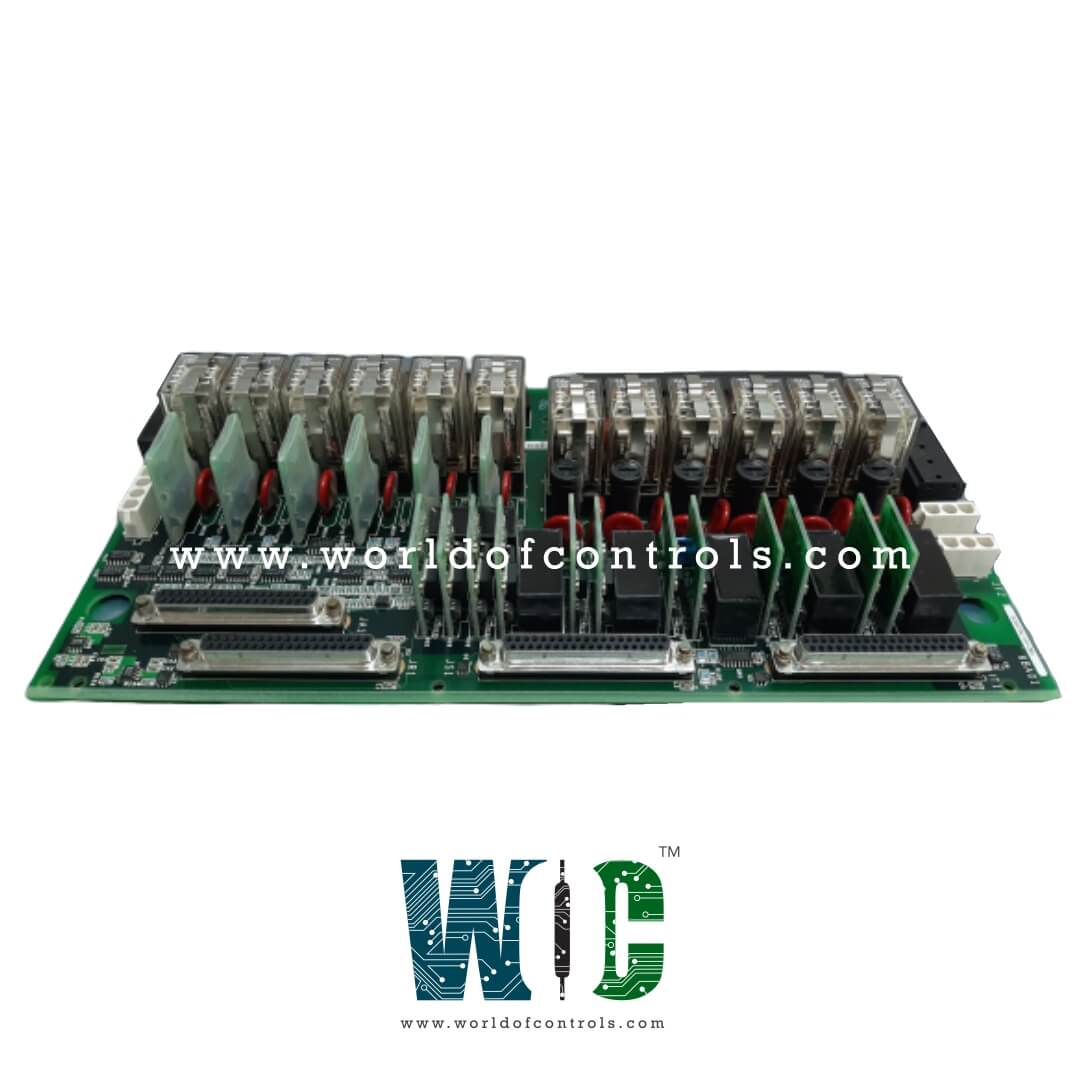
IS200TRLYH1CBA is a relay output with a contact sensing terminal board developed by GE. It is a part of Mark VIe control system. The terminal board is a sophisticated device designed to handle relay outputs with contact-sensing capabilities. It comes equipped with 12 plug-in magnetic relays, providing a reliable and flexible solution for various relay control applications. These relays provide versatile switching capabilities, allowing control over different circuits through normally open (NO), normally closed (NC), and common (COM) contacts. The board supports a standard 125 V DC or 115 V AC power source for field solenoid power, ensuring compatibility with various installation environments. Additionally, each relay circuit is safeguarded with fuses and equipped with onboard suppression to protect against overcurrent and electrical noise, enhancing the reliability and safety of the system.
Product Features
- It features 12 relay circuits, with the first six configured as Form-C contact outputs. These outputs include three contact terminals: common (C), normally open (NO), and normally closed (NC).
- This configuration enables the relays to either complete or break a circuit when energized, making them highly suitable for driving external solenoids. The use of magnetic relays ensures robust and durable switching performance, which is essential in demanding applications.
- The board supports a standard 125 V DC or 115 V AC power source, which is used to power field solenoids. This standardization ensures that the solenoids receive consistent and adequate power for their operation. Additionally, the terminal board is equipped with fuses to protect the circuit and connected devices from overcurrent conditions.
- On-board suppression mechanisms are also included to mitigate voltage spikes and electrical noise, enhancing the stability and longevity of the solenoids and relay circuits.
Compatibility
- Simplex Applications: In simplex systems, where a single I/O pack is used, the PDOA I/O pack plugs directly into the terminal board using the DC-37 pin connector labeled JA1. This setup is straightforward and efficient, making it suitable for applications where redundancy is not required. The simplicity of this configuration minimizes the complexity and potential points of failure, ensuring a reliable and cost-effective solution for less critical applications.
- TMR Applications: For systems requiring higher reliability and fault tolerance, the terminal boards support Triple Modular Redundancy (TMR) configurations. In TMR systems, three PDOA I/O packs are used to provide redundancy and ensure continuous operation even in the event of a failure in one of the I/O packs. The PDOA I/O packs in TMR systems plug into the DC-37 pin connectors labeled JR1, JS1, and JT1 on the terminal board.
- Connector Configuration:
- Simplex Systems: Utilize connector JA1.
- TMR Systems: Utilize connectors JR1, JS1, and JT1.
- These connectors ensure that the PDOA I/O packs are securely and correctly positioned, enabling reliable communication and coordination between the terminal board and the I/O packs. The use of specific connectors for simplex and TMR configurations ensures clarity and prevents misconfiguration, which is crucial for maintaining system integrity and performance.
Installation Procedure
- Wiring Relay Outputs: To begin the installation process, connect the wires for the 12 relay outputs directly to two I/O terminal blocks located on the terminal board. These terminal blocks are clearly labeled and positioned on the board for easy access and wiring. Each terminal block is secured with two screws to ensure a stable connection. With 24 terminals on each block, there's plenty of space to accommodate wires up to 12 AWG, offering flexibility in wiring configurations. Adjacent to each terminal block, a shield terminal strip attached to the chassis ground provides grounding for effective noise reduction and system integrity.
- Solenoid Power Connections: For solenoid power, connect the power for outputs 1-6 to connector JF1. This connector serves as the primary power source for these specific outputs. Additionally, if needed, utilize connector JF2 to daisy-chain power to other TRLYs, simplifying power distribution and reducing wiring complexity. Alternatively, power can be wired directly to TB3 when connectors JF1/JF2 are not used, providing flexibility in power management based on specific installation requirements. For the special solenoid Output 12, connect power to connector JG1, ensuring proper wiring to provide adequate power to this specific output.
- Final Checks: Before completing the installation, it's crucial to perform final checks to ensure everything is properly set up. Double-check all wire connections to ensure they are securely fastened to the terminal blocks and connectors. Tighten screws as needed to maintain a stable connection and prevent any loose connections that could cause issues later on. Verify that the shield terminal strips are properly connected to the chassis ground to minimize electrical noise and ensure system integrity. Additionally, confirm that the power supply configurations match the requirements of the relay outputs and solenoids being connected to avoid any potential issues during operation.
The WOC team is always available to help you with your Mark VIe requirements. For more information, please contact WOC.
Frequently Asked Questions
What is IS200TRLYH1CBA?
It is a relay output with contact sensing terminal board developed by GE under the Mark VIe series.
How do I connect wires to the terminal blocks on the board?
To connect wires to the terminal blocks, simply loosen the screws on the terminal blocks, insert the stripped ends of the wires into the appropriate terminals, and tighten the screws securely. Ensure that the wires are inserted into the correct terminals according to the wiring diagram provided with the terminal board.
Can I use different wire gauges for the relay outputs?
Yes, the terminal blocks on the board accept wires up to 12 AWG, providing flexibility in wire gauge selection. However, it's essential to ensure that the wire gauge used is suitable for the current and voltage requirements of the relay outputs to avoid overheating or electrical issues.
How do I ensure proper grounding of the shield terminal strips?
To ensure proper grounding, securely attach the shield terminal strips to the chassis ground using the provided screws. Make sure that the connections are tight and secure to minimize electrical noise and ensure system integrity. Double-check the grounding connections to ensure they are properly installed before powering on the system.
Can I use different power sources for the solenoids connected to outputs 1-6 and Output 12?
Yes, the terminal board provides flexibility in power source selection for the solenoids. Outputs 1-6 can be powered from connector JF1, while Output 12 can be powered from connector JG1. Alternatively, power can be daisy-chained from JF1 to other TRLYs using connector JF2, or directly wired to TB3 if JF1/JF2 are not used.