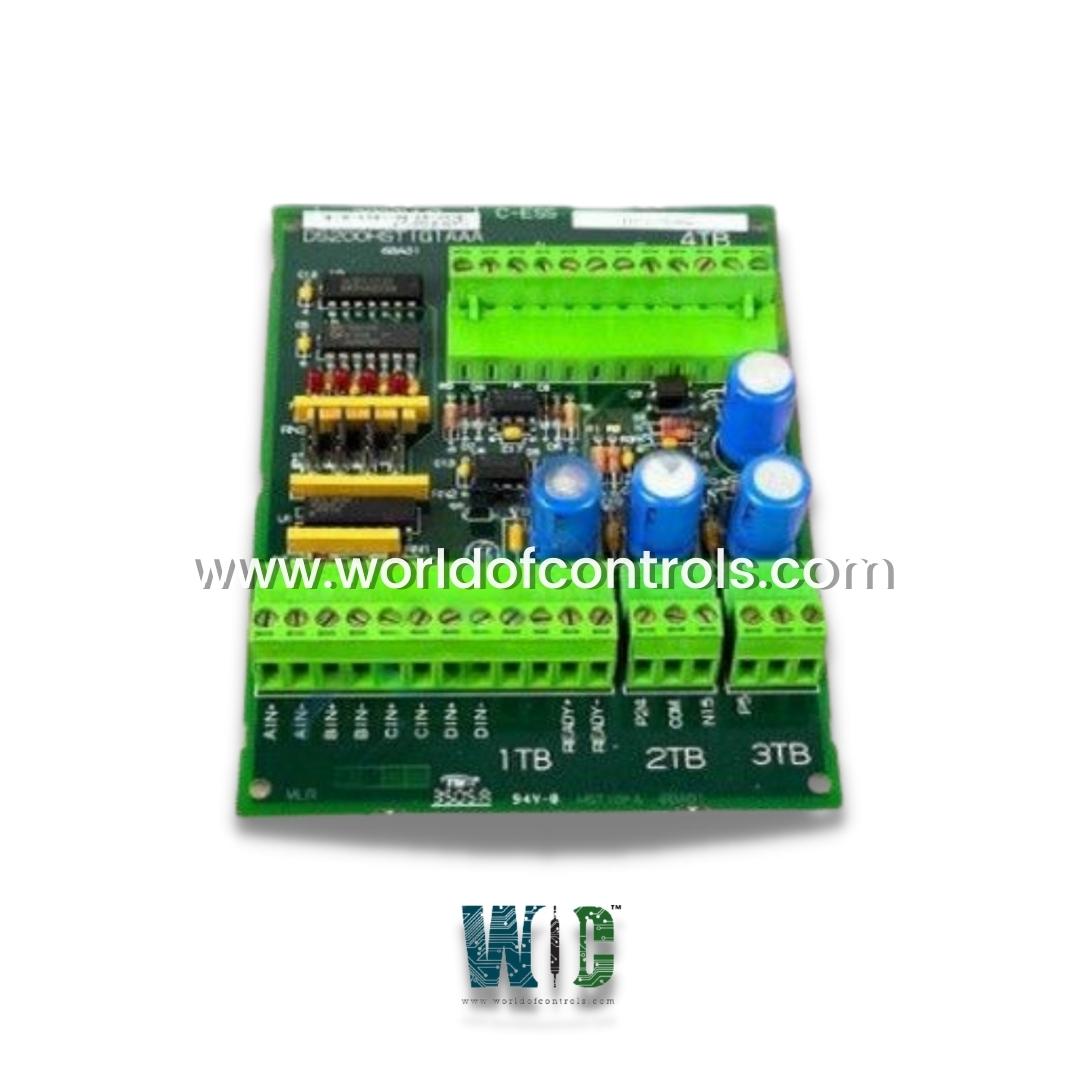
World Of Controls understands the criticality of your requirement and works towards reducing the lead time as much as possible.
DS200HSTIG1A - High Speed Trip Interface Module is available in stock which ships the same day.
DS200HSTIG1A - High Speed Trip Interface Module comes in UNUSED as well as REBUILT condition.
To avail our best deals for DS200HSTIG1A - High Speed Trip Interface Module, contact us and we will get back to you within 24 hours.
SPECIFICATIONS:
Part Number: DS200HSTIG1A
Module Type: High Speed Trip Interface (HSTI)
Compatible System: GE Speedtronic Mark V
Output Types: Deterministic trip outputs
Power Supply: 24 VDC nominal
Mounting: Rack-mounted
Configurations Supported: Simplex and redundant
LED Diagnostics: Individual channel indicators
Signal Protection: Galvanic isolation
Operating Temperature: 0�C to +70�C
Dimensions: 200 � 150 � 50 mm (8.2 � 6.0 inches)
Weight: 2.00 lbs
Country of Origin: USA
Availability: In Stock
FUNCTIONAL DESCRIPTION:
The DS200HSTIG1A High Speed Trip Interface (HSTI) Module is engineered to rapidly detect critical turbine events and deliver precise trip signals to the GE Speedtronic Mark V control system. It accepts discrete and analog inputs from overspeed switches, proximity sensors, and trip contacts, applying signal conditioning, galvanic isolation, and transient suppression to ensure accurate detection without interference. The module's low-latency circuitry, with response times typically under 5 milliseconds, enables immediate activation of trip outputs, protecting turbine mechanical and electrical systems from overspeed or other critical faults. Designed for both simplex and redundant configurations, it features LED indicators for real-time channel diagnostics and is rack-mounted for seamless integration into Mark V control cabinets.
SOFTWARE VOTING:
Software Implemented Fault Tolerant (SIFT) and hardware voting are used by the Mark V control system. At the beginning of each computing time frame, each controller independently reads its sensors and exchanges this data with the data from the other two controllers. The median values of each analog input are calculated in each controller and then used as the resultant control parameter for that controller. The diagnostic algorithm monitors a predefined deadband for all analog inputs to each controller. If one of the analog inputs deviates from this deadband, a diagnostic alarm is activated to alert maintenance personnel.
Contact inputs are voted similarly. Each of the contact inputs is connected to a single terminal point and is parallel-wired to three contact input boards. Each board optically isolates the 125 or 24 V DC input. A dedicated 80196 processor, located on each board, time stamps the input to within one millisecond resolution. These signals are then transmitted to the R, S, and T controllers for voting and execution of the application software. Redundant contact inputs for functions such as low lube oil pressure are connected to three separate terminal points and then voted individually. The SIFT technique enables the control system to accept multiple failures of contact or analog inputs without causing an erroneous trip command from any of the three controllers as long as the failures are not from the same circuit.
PROTECTION MODULE:
The protection module provides a secondary layer of protection for critical turbine and system functions, ensuring reliable operation under fault conditions. It is composed of three identical board sets, X, Y, and Z, each with its own dedicated power supply and processor, enabling independent and redundant operation. Each board set drives its own relays and relay drivers, which are connected to the R, S, and T controllers before interfacing with the hydraulic trip solenoids. This architecture ensures deterministic trip execution, even in the event of a board or channel failure.
In addition to high-speed trip logic, the P module integrates advanced monitoring and control functions, including flame detection for combustion safety and automatic synchronization to maintain generator alignment with the grid. Status and diagnostics are provided via onboard indicators for each board set, allowing operators to verify system health in real time. By combining redundancy, isolated relay outputs, and advanced control features, the P module delivers robust protection for both mechanical and electrical turbine subsystems.
POWER LOAD UNBALANCE MODULE:
The Power Load Unbalance (PLU) option is used on large steam turbines to protect the machine from overspeed under load rejection. It looks for an imbalance between mechanical and electrical power. This function initiates Control Valve (CV) and Intercept Valve (IV) fast closing actions under load rejection conditions where rapid acceleration could lead to an overspeed event. Valve actuation does not occur under stable fault conditions that are self-clearing (such as grid faults). The PLU module contains three sets of identical boards, the U, V, and W. Each has its own power supply and processor.
ANALOG INPUTS AND OUTPUTS:
Most of the analog inputs to the Mark V come directly from transducers on the turbine, such as vibration or speed sensors; however, 4-20 mA and 0-1 mA inputs are provided for other types of transducers. Each analog input can receive isolated 21 V dc excitation power for the transducer from the Mark V. Jumpers are provided for such selections as current or voltage input, burden resistor size, and grounding options. Some inputs can be used as either voltage or current inputs by selection of a jumper.
In the current input mode, a burden resistor produces a voltage from the transducer current. This voltage is then internally parallel-wired with ribbon cables to the R, S, and T controllers or just R in Simplex applications. Any discrepancy between the three controller inputs is annunciated as an internal diagnostic fault while the control and protection system continues to perform its normal calculations based on the median signal. Additional diagnostics monitor the inputs to ensure that they are within their proper range.
WHY BUY FROM WOC:
WOC maintains the largest inventory of OEM replacement parts for GE Speedtronic Gas Turbine Control Systems, ensuring that you have access to the components you need without delay. In addition to supplying unused and fully rebuilt boards, we also offer expert repair services to restore faulty boards to like-new condition, all backed by a reliable warranty for your peace of mind. Our experienced team is available 24/7 to provide guidance and support for any OEM or automation-related requirements, helping you minimize downtime and keep your systems running smoothly. For pricing, availability, or technical assistance with parts and repairs, simply reach out to our team via phone or email, and we�ll ensure you receive prompt, personalized support.
What is the DS200HSTIG1A?
The DS200HSTIG1A is a High Speed Trip Interface (HSTI) module designed for GE Speedtronic Mark V control systems. It detects critical turbine events, such as overspeed or mechanical faults, and sends precise trip signals to protect the turbine. The module supports both simplex and redundant configurations for reliable and fault-tolerant operation.
What types of inputs and outputs does it support?
The module accepts discrete and analog inputs from overspeed switches, proximity sensors, and trip contacts. Outputs are galvanically isolated deterministic trip signals for accurate control. It also supports 4�20 mA and 0�1 mA analog inputs for additional transducers.
How does the module achieve high-speed trip operation?
The board uses low-latency hardware logic with response times typically under 5 milliseconds. Galvanic isolation, transient suppression, and direct relay driver interfacing minimize delays. The design ensures deterministic trip execution independent of controller software load.