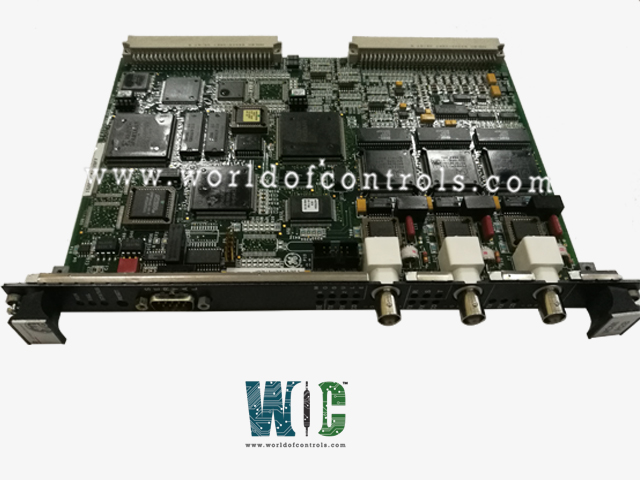
World Of Controls understands the criticality of your requirement and works towards reducing the lead time as much as possible.
IS215VCMIH2BF - VME Communication Interface Board is available in stock which ships the same day.
IS215VCMIH2BF - VME Communication Interface Board comes in UNUSED as well as REBUILT condition.
To avail our best deals for IS215VCMIH2BF - VME Communication Interface Board, contact us and we will get back to you within 24 hours.
TECHNICAL SPECIFICATIONS:
Part Number: IS215VCMIH2BF
Manufacturer: General Electric (GE)
Series: Mark VI
Product Type: VME Bus Master Controller Board
Board Form Factor: 6U High VME Board (0.787 in. Width)
Processor Architecture: 32-bit Digital Signal Processor
System Memory: 32 KB Dual-Port SRAM
Communication Interface: 3 × IONet Ports, 1 × RS-232C Serial Port
Frame Rate Support: 10 ms (Simplex Operation) / 40 ms (TMR Operation)
Status Diagnostics: RUN, FAIL, STATUS, and Network Port LEDs (TX, RX, CD)
Power Supply Requirements: 24 V DC
Conformal Coating: Yes
Operating Temperature: -30°C to +65°C
Storage Temperature: -40°C to +85°C
System Compatibility: GE Mark VI Turbine Control System
Availability: In Stock
Repair Lead Time: 3–7 Days
Country of Origin: United States
Manual Reference: GEH-6421H
The IS215VCMIH2BF is a VME Communication Interface Board designed and manufactured by General Electric as part of the Mark VI Series used in speedtronic turbine control systems. The VCMI board in the control and interface module communicates internally to the I/O boards in its rack, and to the other VCMI cards through the IONet. There are two versions, one with one Ethernet IONet port for simplex systems, and the other with three Ethernet ports for TMR systems. Simplex systems have one control module connected to one or more interface modules using a single cable. The VCMI with three separate IONet ports is used in TMR systems for communication with the three I/O channels Rx, Sx, and Tx, and with the two other control modules. This is shown in the following figure. Software Implemented Fault Tolerance (SIFT) voting is implemented in the VCMI board. Input data from each of the IONet connections is voted in each of the R, S, and T VCMI boards. The results are passed to the control signal database in the controllers (labeled UCVx in the diagram) through the backplane VME bus.
IONET:
The IONet connection on the VCMI is a BNC for 10Base2 Ethernet. The interface circuit is high impedance, allowing T tap connections with 50 terminal at the first and last node. The cabling distances are restricted to 185 meters per segment with up to eight nodes, using RG-58C/U or equivalent cable. The Link Layer protocol is the IEEE 802.3 standard Ethernet. The application layer protocol uses Asynchronous Device Language (ADL) messaging with special adaptations for the input/output handling and the state exchanges. The VCMI board acts as IONet Master and polls the remote interface module for data. The VCMI Master broadcasts a command to all slave stations on a single IONet, causing them to respond with their message in a consecutive manner. To avoid collisions on the media, each station is told how long to delay before attempting to transmit. Utilizing this Master/slave mechanism, and running at 10 Mb/s, the IONet is capable of transmitting a 1000-byte packet every millisecond (8 MHz bit rate).
I/O BOARDS:
The central processing unit (CPU) is a high-speed processor designed for digital filtering and for working with data in IEEE 32-bit floating-point format. The task scheduler operates at 1 ms and 5 ms rates to support high-speed analog and discrete inputs. The I/O boards synchronize their input scan to complete a cycle before being read by the VCMI board. Contact inputs in the VCCC and VCRC are time-stamped to 1 ms to provide a sequence of events (SOE) monitor. Each I/O board contains the required sensor characteristic library, for example, thermocouple and RTD linearizations. Bad sensor data and alarm signal levels, both high and low, are detected and alarmed. The I/O configuration in the toolbox can be downloaded over the network to change the program online. This means that I/O boards can accept tune-up commands and data while running. Certain I/O boards, such as the servo and turbine board, contain special control functions in firmware. This allows loops, such as valve position control, to run locally instead of in the controller. Using the I/O boards in this way provides fast response for a number of time-critical functions. Servo loops can be performed in the servo board at 200 times per second.
NETWORK REDUNDANCY & IONET COMMUNICATION:
Equipped with three dedicated IONet ports on its front faceplate, the IS215VCMIH2BF supports flexible network configurations ranging from simplex to Triple Modular Redundant (TMR) architectures. Each IONet connection features individual status indicators (TX, RX, CD) to provide immediate diagnostic visibility into network activity. In TMR setups, the three ports correspond to the separate R, S, and T communication channels, ensuring high fault tolerance and continuous control system availability during single-point network disruptions.
DIAGNOSTIC MONITORING & BUS MASTERING:
The board incorporates onboard supervisory circuits to monitor internal operational health and power rail status, including +5 V DC, ±12 V DC, ±15 V DC, and 28 V DC buses. Front panel LED indicators clearly communicate system status (RUN, FAIL, STATUS) alongside digital status indicators for system troubleshooting. A front-accessible reset pushbutton allows manual system cycling, while an RS-232C serial port enables direct local diagnostic access via Toolbox software. Onboard memory and high-speed processing logic ensure precise frame rate synchronization across all connected I/O channels.
WHY BUY FROM WOC:
World of Controls maintains an extensive global inventory of OEM components for GE Speedtronic and Mark VI turbine control systems. The VCMIH2BF VME communication board is available in UNUSED surplus and professionally REBUILT conditions, backed by comprehensive warranty coverage. Every module undergoes rigorous inspection and functional testing according to manufacturer specifications to confirm bus master performance, communication link stability, power rail tolerances, and signal integrity prior to dispatch. We also provide complete repair and exchange solutions with quick turnaround times to support scheduled maintenance and emergency outage recovery. Contact our technical team today to check live stock, confirm pricing, review repair options, and arrange rapid worldwide shipping.
What is GE IS215VCMIH2BF?
The GE IS215VCMIH2BF is a VME Communication Interface Board used in Mark VI turbine control systems. It acts as the primary communication bridge between the central controller processor and system I/O boards, managing real-time data flow over IONet and overseeing rack ID assignments.
What is the difference between the H1 and H2 versions of the VCMI board?
The H2 version (such as the VCMIH2BF) features three IONet ports on the front faceplate, compared to single-port configurations on H1 versions. This allows the H2 board to directly interface with Triple Modular Redundant (TMR) network channels (R, S, and T) or multi-rack expanded setups.
What control frame rates does the VME Communication Interface Board support?
The module supports standard execution frame rates down to 10 ms in simplex system configurations and 40 ms in Triple Modular Redundant (TMR) configurations.
What diagnostic LEDs are located on the front faceplate?
The front faceplate includes general status LEDs for RUN, FAIL, and STATUS, system diagnostic LEDs (labeled 1, 2, 4, and 8), as well as dedicated Transmit (TX), Receive (RX), and Carrier Detect (CD) LEDs for each of the three IONet ports.
Can World of Controls repair a faulty IS215VCMIH2BF module?
Yes, World of Controls offers complete repair and exchange services for GE Mark VI control modules. Customers can submit their unit for complete diagnostic evaluation, component repair, full function re-testing, and rapid return to minimize operational downtime.