IS215UCCCH5A - UCCC Controller Module
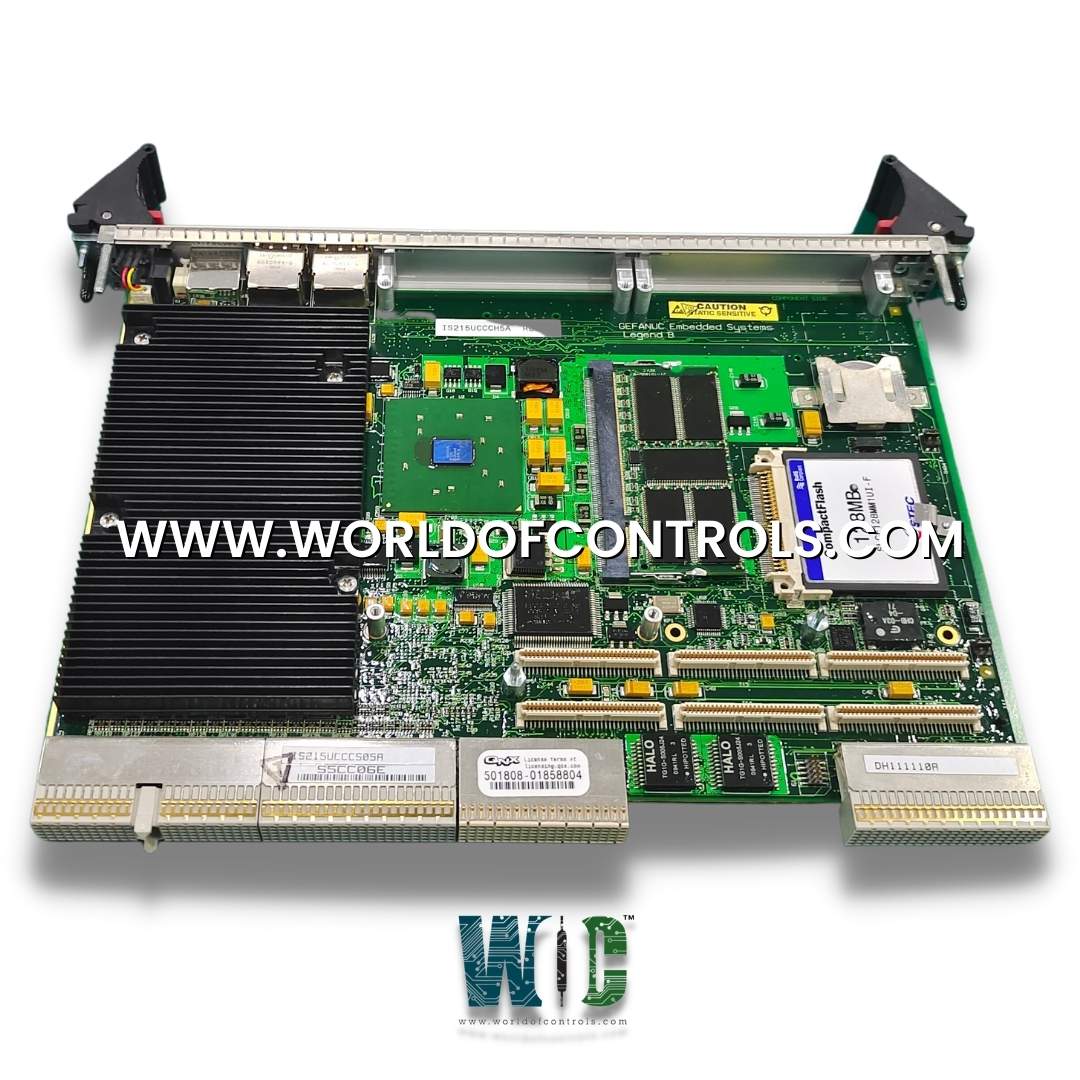
World Of Controls understands the criticality of your requirement and works towards reducing the lead time as much as possible.
IS215UCCCH5A - UCCC Controller Module is available in stock which ships the same day.
IS215UCCCH5A - UCCC Controller Module comes in UNUSED as well as REBUILT condition.
To avail our best deals for IS215UCCCH5A - UCCC Controller Module, contact us and we will get back to you within 24 hours.

Featured Product
TECHNICAL SPECIFICATIONS:
Part Number: IS215UCCCH5A
Manufacturer: General Electric (GE)
Series: Mark VIe
Module Type: UCCC Controller (CompactPCI)
Processor: High-speed Intel Pentium-based
Memory: 64 MB SDRAM / Onboard Flash Storage
Operating System: QNX Real-Time OS
Communication: Dual 10/100 Ethernet (UML / IONet), RS-232 / RS-485 Serial
Form Factor: 6U CompactPCI (cPCI)
Slot Width: Single Slot
Operating Temp: 0 °C to +50 °C (+32 °F to +122 °F)
Dimensions: 26.16 cm x 3.00 cm x 16.00 cm
Availability: In Stock
Origin: United States
Manual: GEH-6721G
FUNCTIONAL DESCRIPTION OF IS215UCCCH5A:
The IS215UCCCH5A is a UCCC Controller Module designed and manufactured by General Electric as a core component of the Mark VIe Distributed Turbine Control System. The UCCCH5A controller is a single-board computer that runs the application code. The controller mounts in a CompactPCI (CPCI) enclosure and communicates with the I/O packs through on-board I/O network interfaces. The CPCI enclosure typically consists of a 6U high rack, one or two 3U high power supplies, a 6U high single board, and a cooling fan. The rack backplane is CPCI compliant, but is used only to provide power from the power supply(s) to the controller and cooling fan. The CPCI power supply converts the bulk incoming power to ±12 V dc, 5 V dc, and 3.3 V dc. These voltages are distributed to the controller(s) and fan through the backplane.
The CPCI power supply takes the incoming bulk power from the CPCI backplane and creates ±12, 5, and 3.3 V DC. This power is supplied to the backplane via one or two Mate-N-Lok connectors for use by the power supply(s), controller(s), and cooling fan. The power supply is a CPCI hot-swap-compliant 3U unit using the standard CPCI 47-pin connector. Two power supplies can be used to provide power supply redundancy in an optional rack.
UCCCH5A MOUNTING AND INSTALLATION:
The CPCI rack provides an enclosure for the controller, an enclosure for the power supplies, and a cooling system. The rack backplane is only used to connect the power supplies to the controller and cooling fans. The enclosure contains (at a minimum) a controller and a four-slot CPCI rack with either one or two power supplies. The primary controller must be placed in the left-most slot (slot 1). A second, third, and fourth controller can be placed in a single rack. If the slot 1 controller is removed, the other controllers will stop operating. The CPCI rack is designed to be wall-mounted. Use the following drawing to determine the placement of the mounting hardware and the enclosure space required.
The CMOS battery is disconnected using a processor board jumper during storage to extend the life of the battery. When installing the board, the battery jumper must be reinstalled. Refer to the specific UCCx module drawing for jumper location. The battery supplies power to the CMOS RAM settings and the internal date and real-time clock. There is no need to set CMOS settings since the settings are defaulted to the proper values through the BIOS. Only the real-time clock must be reset. The initial date and time can be set using a system NTP server or ToolboxST application.
SYSTEM REDUNDANCY AND IONET INTERFACE:
The UCCCH5A Controller Module supports Simplex, Dual, and Triple Modular Redundant (TMR) configurations. In TMR setups, three UCCC modules operate in parallel, utilizing hardware-based 2-out-of-3 voting to ensure that a single processor fault does not result in a turbine trip. Communication is handled via redundant Ethernet ports (IONet) for I/O interaction and the Unit Data Highway (UDH) for HMI and DCS connectivity.
POWER REQUIREMENTS
Bulk incoming power is supplied to the rack using one or two power connectors. The CPCI power supply converts the bulk input to ±12 V dc, 5 V dc, and 3.3 V dc. These voltages are distributed to the controllers and fans through the backplane. The P1 version contains an on/off switch located in the upper right panel. The switch is connected to the disable outputs pin of the power supply, which turns off power to the controllers and fans. The P2 version does not have a switch, so power is removed by ejecting the power supplies, disconnecting the incoming bulk power plugs, or using a remote disconnect.
UCCCH5A OPERATION:
The controller is loaded with software specific to its application, which includes but is not limited to steam, gas, and land-marine Aero-derivative (LM), or balance-of-plant (BOP) products. It can run on rungs or blocks. The IEEE 1588 protocol is used through the R, S, and T IONets to synchronize the clock of the I/O packs and controllers to within ±100 microseconds. External data is transferred to and from the control system database in the controller over the R, S, and T IONets. In a simplex system, this includes process inputs/outputs to the I/O packs.
WHY BUY FROM WOC:
World of Controls maintains one of the industry’s most extensive inventories of OEM replacement components for GE Mark VIe Distributed turbine control systems, ensuring fast availability for critical maintenance and system upgrades. We supply both UNUSED and professionally REBUILT GE UCCCH5A modules, each supported by a comprehensive warranty for added reliability and peace of mind. Every unit is subjected to rigorous functional and performance testing in live cPCI rack environments to verify communication port integrity, processor stability, and real-time algorithm execution under operating conditions. This thorough validation process helps ensure seamless integration and dependable performance in your control system. Backed by a team of experienced automation specialists available 24/7, World of Controls delivers trusted technical support, fast worldwide shipping, and expert guidance to meet the demanding needs of industrial and power generation facilities across the globe.
FREQUENTLY ASKED QUESTIONS:
What is GE IS215UCCCH5A?
It is a UCCC Controller Module for the General Electric Mark VIe distributed control system. It serves as the primary controller responsible for running turbine governing logic and managing communication between the turbine's I/O and the operator interface.
How does the UCCC Controller Module maintain time synchronization across the TMR network?
The H5A utilizes the IEEE 1588 protocol via the R, S, and T IONets to synchronize the internal clocks of all controllers and I/O packs. This ensures that the entire control system remains synchronized to within ±100 microseconds, which is critical for accurate Sequence of Events (SOE) time-stamping and deterministic execution of control rungs.
What is the significance of the CMOS battery jumper during installation?
To maximize battery life during storage, the onboard CMOS battery is physically disconnected via a processor board jumper. During installation, this jumper must be re-engaged to provide power to the CMOS RAM and the internal real-time clock. While BIOS settings are automatically defaulted, the real-time clock must be synchronized via a system NTP server or the ToolboxST application to ensure correct data logging.
What happens to the rack operation if the Slot 1 controller is removed?
In a multi-controller CompactPCI rack, the module in Slot 1 (the left-most slot) acts as the primary bus arbiter for power distribution signals. If the UCCCH5A in Slot 1 is removed or fails, all other secondary controllers in the same rack (Slots 2, 3, or 4) will cease operation. For redundant configurations, it is essential to ensure Slot 1 integrity to maintain the operational status of the entire enclosure.