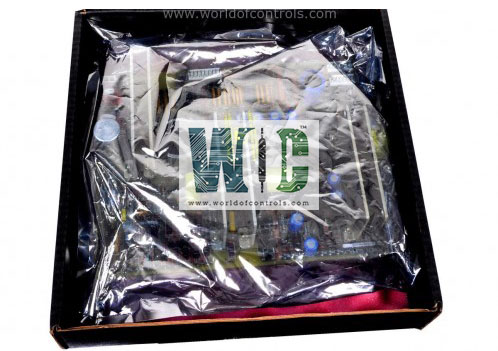
World Of Controls understands the criticality of your requirement and works towards reducing the lead time as much as possible.
IS210DVIBH1B - Vibration Monitor Interface Module is available in stock which ships the same day.
IS210DVIBH1B - Vibration Monitor Interface Module comes in UNUSED as well as REBUILT condition.
To avail our best deals for IS210DVIBH1B - Vibration Monitor Interface Module, contact us and we will get back to you within 24 hours.
SPECIFICATIONS:
Part Number: IS210DVIBH1B
Manufacturer: General Electric (GE)
Series: Mark VIe
Module Type: Vibration Monitor Interface
Number of Channels: 13
Proximity: 5 to 200 Hz
Probe power: -24 V dc
Inputs: Supports Proximity, Velocity, and Accelerometer Probes
Channels: Multi-channel High-speed Sampling
A/D Resolution: 16-Bit
Communication: Ethernet Interface (Mark VIe IONet)
Hardware Revision: H1B
Coating: Conformal Coating
Operating Temp: 0 °C to +60 °C (32 °F to 140 °F)
Size: 33.0 cm high x 17.8 cm
Availability: In Stock
Origin: United States
Manual: GEH-6421I
FUNCTIONAL DESCRIPTION:
IS210DVIBH1B is a Vibration Monitor Interface Module manufactured and designed by General Electric as part of the Mark VIe Series used in GE Distributed Turbine Control Systems. The DVIB board is a compact vibration terminal board for DIN-rail mounting. It is designed to meet UL 1604 specification for operation in a 65 °C Class 1, Division 2 environment. The board accepts 13 vibration probes, eight vibration, four position, and one keyphasor input. It connects to the VVIB processor board with a 37-pin cable. These cables are identical to those used on the larger TVIB terminal board. VVIB accommodates two DVIB boards.
VIBRATION FUNCTIONS:
The vibration probe inputs are normally used for four protective functions in turbine applications as follows:
INSTALLATION:
The DVIB board slides into a plastic holder, which mounts on the DIN-rail. The vibration probes are wired directly to the terminal block, which has 42 terminals. Typically, #18 AWG shielded twisted triplet wiring is used. There are two screws for the SCOM (ground) connection, which should be as short a distance as possible.
OPERATION:
The eight vibration inputs on each terminal board can be applied as either a proximitor, an accelerometer, a seismic (velocity), or velomitor inputs. Jumpers on the terminal board are used to assign a specific vibration sensor type to each input point, with the seismic type assigned to point (S), the velomotor type assigned to point (V), and the proximitor and accelerometer types sharing point (P/A). The proximitor reads a shaft keyway to generate a once per revolution keyPhasor input for phase angle reference. On DVIB, the high-frequency decoupling to ground on all signals is the same as on TVIB. An on-board ID chip identifies the board to VVIB for system diagnostic purposes.
WHY BUY FROM WOC:
World of Controls supports the reliability of your GE Mark VIe infrastructure by providing the IS210DVIBH1B in both UNUSED and REBUILT conditions. Every vibration module is subjected to rigorous signal simulation tests, verifying frequency response, A/D accuracy, and IONet communication stability. We maintain a robust global inventory of Mark VIe interface modules to ensure rapid deployment during critical maintenance outages. With global logistics and 24/7 technical expertise, WOC is your trusted partner for high-precision turbine monitoring hardware.
What is the GE IS210DVIBH1B?
The IS210DVIBH1B is a Vibration Monitor Interface module for the GE Mark VIe system. It processes dynamic signals from vibration probes to monitor the mechanical health of rotating equipment.
Which types of sensors are compatible with this module?
It is compatible with standard industrial vibration sensors, including Proximity probes (for radial displacement and eccentricity), Velocity probes, and Accelerometers (for high-frequency seismic monitoring).
How does the Vibration Monitor Interface module handle signal noise?
The module utilizes a combination of local hardware filtering and high-speed digital sampling. By converting analog signals to digital data near the terminal point and transmitting them via Ethernet (IONet), the risk of electromagnetic interference (EMI) corrupting the data is greatly reduced.
Is the Vibration Monitor Interface module suitable for TMR systems?
Yes, the IS210 series is designed to integrate into Mark VIe architectures that utilize TMR for high-reliability protection, allowing for 2-out-of-3 voting on critical vibration trip signals.
Does this board require manual calibration?
The Vibration Monitor Interface module is largely a software-configured device. Calibration and sensor scaling are handled through the Mark VIe ToolboxST software, eliminating the need for physical potentiometers or hardware jumpers on the board itself.