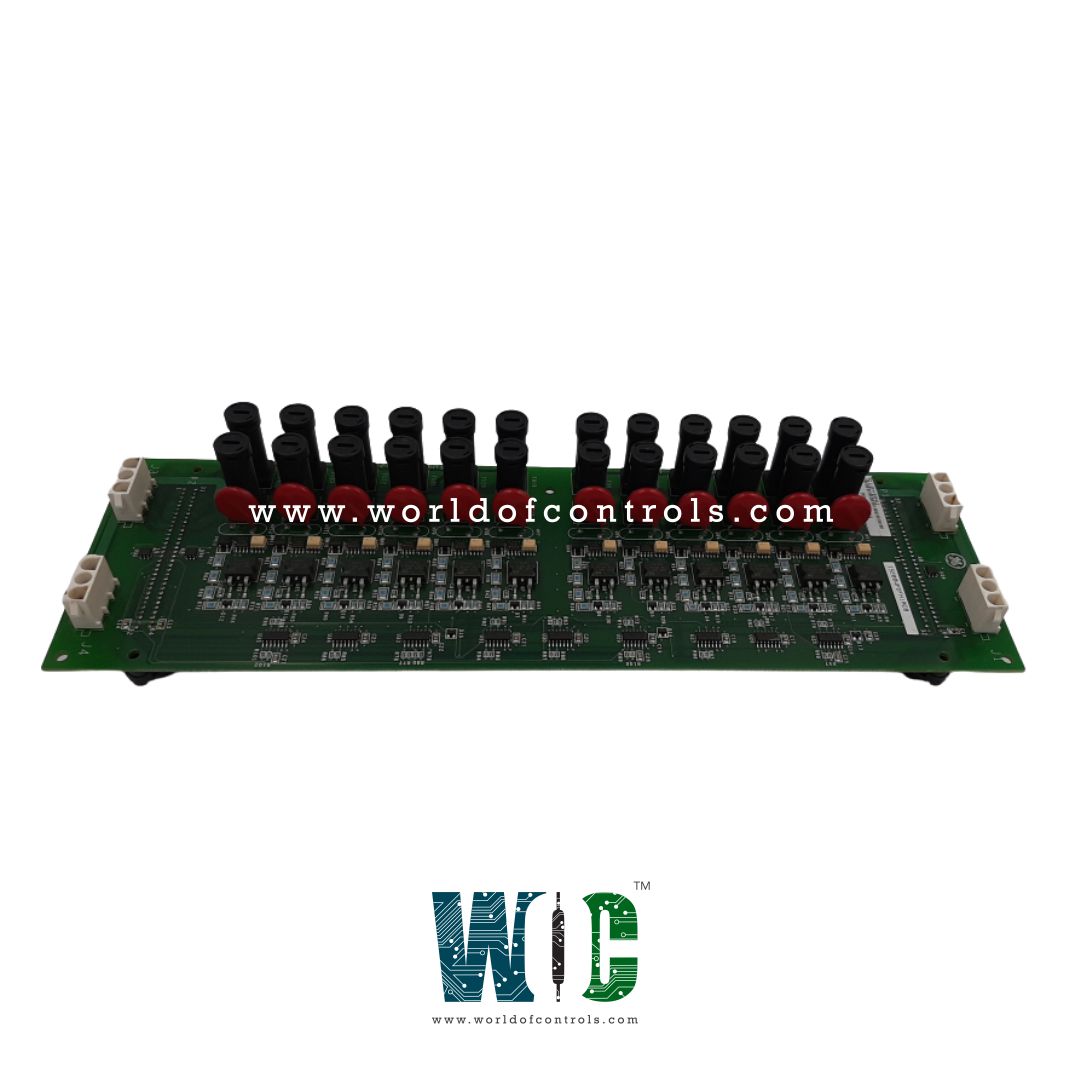
World Of Controls understands the criticality of your requirement and works towards reducing the lead time as much as possible.
IS200WPDFH1ACC - Optional Power Distribution Daughterboard is available in stock which ships the same day.
IS200WPDFH1ACC - Optional Power Distribution Daughterboard comes in UNUSED as well as REBUILT condition.
To avail our best deals for IS200WPDFH1ACC - Optional Power Distribution Daughterboard, contact us and we will get back to you within 24 hours.
TECHNICAL SPECIFICATIONS:
Part Number: IS200WPDFH1ACC
Manufacturer: General Electric (GE)
Series: Mark VI
Product Type: Optional Power Distribution Board (Daughterboard)
Hardware Variant: H1A
Number of Channels: 12 independent channels
Number of Output Relay Channels: 12 channels
Number of Fused Branches: 12 total
Fuse Rating: 3.15 A at 25°C
Input Span Support: 4-20 mA
Analog Output Current: 0-20 mA
Common Mode Voltage Range: ±5 V
Maximum Lead Resistance: 15Ω
Voltage Monitor Diagnostics Threshold: 16 V DC
Technology Type: Surface Mount Technology (SMT)
Board Dimensions: 10.16 cm wide x 3.02 cm high
Operating Temperature: -30°C to +65°C (-22°F to +149°F)
Repair / Evaluation Lead Time: 3–7 Business Days
Availability: In Stock
Country of Origin: United States (USA)
Manual Reference: GEH-6421H
The IS200WPDFH1ACC is a Power Distribution Daughterboard designed and manufactured by General Electric as part of the Speedtronic Mark VI turbine control systems. Operating structurally as an auxiliary daughterboard, the WPDFH1ACC card is designed to attach directly to a TRLYH#F Relay Terminal Board. Because base-model TRLY terminal blocks lack native power distribution circuitry for driving heavy field instrumentation, the Daughterboard seamlessly introduces a dedicated, fuse-protected routing layer to deliver safe, highly reliable loop power directly to the operator's external turbine trip solenoids and field-side actuator components.
DUAL INDEPENDENT POWER DISTRIBUTION CIRCUITS:
The module hosts two entirely distinct Power Distribution Circuits (PDCs) rated up to 10 A nominal. These tracks can be supplied independently with 125 V DC, 115 V AC, or 24 V DC power profiles, allowing engineers to partition diverse solenoid sub-networks across a single hardware footprint. For specialized Alternating Current (AC) field systems where a fuse on the neutral return line is strictly undesired, the board features a single high-side fuse layout located cleanly on pin 1 of the primary power interconnect interfaces (J1 through J4).
FIELD SOLENOID POWER OPTION:
WPDFH1ACC is a daughterboard for TRLYH#F solenoids. WPDF holds two power distribution circuits, which can be independently used for standard 125 V dc, 115 V ac, or 24 V dc sources. Each section consists of 6 fused branches that provide power to the TRLYH#F terminal board. Each branch has its own voltage monitor across its fuse pair secondary. Each of these voltage detectors is fanned out to three independent open-collector drivers for feedback to each of the I/O processors R, S, T. The WPDF should not be used without TRLYH#F. Fused power flows through this board down to the TRLY terminal board points. Fuse power feedback is controlled by the TRLY.
REAL-TIME VOLTAGE MONITORING & DIAGNOSTIC FEEDBACK
To maintain the strict fail-safe parameters required of primary turbine trip mechanisms, the WPDFH1ACC contains built-in diagnostic voltage detection tracks placed across the secondary side of every fuse pair. If any individual branch circuit suffers a blown fuse or drop in supply voltage below 16 V DC / 72 V AC, the onboard monitoring circuit flags the error within a 60 ms response delay. This fault status is immediately split out to three isolated open-collector hardware drivers, providing simultaneous, independent logic feedback down the backplane lines directly to the triple-redundant R, S, and T I/O control processors.
COMPACT DAUGHTERBOARD INTEGRATION
The Power Distribution Board must not be mounted standalone within an enclosure rack. It must be paired and mechanically locked directly over the TRLYH#F terminal board assembly using the designated multi-pin plug connectors. Due to the high degree of trace interrogation between these two-layered components, maintenance guidelines state that the combined TRLY and WPDF board stack must be categorized as a single Lowest Replaceable Unit (LRU) and replaced as a complete matched set if cross-board communication errors or trace degradation occur.
WHY PARTNER WITH WORLD OF CONTROLS
World of Controls provides the industry's most dependable logistics and technical infrastructure for critical turbine control networks. We maintain an extensive inventory of genuine OEM replacement parts for GE Speedtronic control setups, minimizing operational downtime during emergency outages. Every item, from certified unused surplus to fully rebuilt industrial components, is subjected to strict simulation profiling in our advanced electronics lab and is supplied with a comprehensive product warranty. Our global engineering support network operates 24/7 to deliver troubleshooting advice, component replacement guidance, and component testing evaluations. Contact our sales team directly via phone or email for current pricing, hardware availability, or repair quotes.
What is the GE IS200WPDFH1ACC?
It is an Optional Power Distribution Daughterboard designed and manufactured by General Electric for its Mark VIe turbine control series. It functions as an auxiliary daughterboard that mounts directly onto a TRLYH#F relay terminal board to supply safe, fuse-protected electrical paths for external field solenoid configurations.
Can the board run different types of power simultaneously?
Yes. The board features two separate Power Distribution Circuits (PDCs) that operate independently from one another. This allows one side of the board to distribute a 125 V DC power source while the opposing side runs a 115 V AC or 24 V DC profile, depending on the requirements of your field devices.
Why is it recommended to replace the WPDF and TRLY boards together?
The WPDF and TRLY boards are highly interactive, mating closely via multi-pin plug channels. To maximize system stability and minimize troubleshooting time during an outage, the two boards are treated as a single Lowest Replaceable Unit (LRU) and should be swapped out as a complete set if a system fault involves either board.
How does the VCO / processor track a blown fuse on the WPDF board?
Every fused branch features a local voltage monitoring circuit positioned right across the secondary side of its fuse pair. If a fuse opens and voltage drops below the detection limit, the onboard circuit splits the alarm to three independent open-collector lines, sending a diagnostic flag directly to the R, S, and T I/O processors within a typical 60 ms response delay.
How does the H1ACC version prevent component damage when using alternating current inputs?
The board layout features single-fuse protection paths configured precisely on the high side of each power circuit track. This ensures that when deploying AC power sources, the neutral return wire is left unfused, avoiding open-neutral fault scenarios that could pose safety hazards or compromise diagnostic tracking.