World Of Controls understands the criticality of your requirement and works towards reducing the lead time as much as possible.
IS200TTURH1BAA - Primary Turbine Protection Terminal Board is available in stock which ships the same day.
IS200TTURH1BAA - Primary Turbine Protection Terminal Board comes in UNUSED as well as REBUILT condition.
To avail our best deals for IS200TTURH1BAA - Primary Turbine Protection Terminal Board, contact us and we will get back to you within 24 hours.
TECHNICAL SPECIFICATIONS:
Part Number: IS200TTURH1BAA
Manufacturer: General Electric
Series: Speedtronic Mark VI
Functional Acronym: TTUR
Number of Outputs: 24
Power supply voltage: 125 V dc
MPU pulse rate range: 2 Hz to 20 kHz
MPU input circuit sensitivity: 27 mV pk
Product Type: Primary Turbine Protection Terminal Board
Hardware Revision: REV A (Functional Revision H1B, Artwork Revision AA)
Redundancy Configuration: Supports Simplex and Triple Modular Redundant (TMR) systems
Overspeed Inputs: 4 channels for passive magnetic pickups (MPUs) or active proximity sensors
Flame Detector Interface: Inputs for up to 4 Geiger-Mueller type flame detectors
Potential Transformer Inputs: 2 analog channels for generator and bus voltage tracking
Trip Solenoid Interfacing: 3 heavy-duty breaker/solenoid control outputs
Circuit Board Protection: High-grade Conformal PCB Coating
Ambient Operating Temperature: -30°C to +65°C (-22°F to +149°F)
Repair Lead Time: 3-5 Business Days
Availability: In Stock
Size: 33.0 cm high x 17.8 cm
Country of Origin: United States
Manual: GEH-6721D
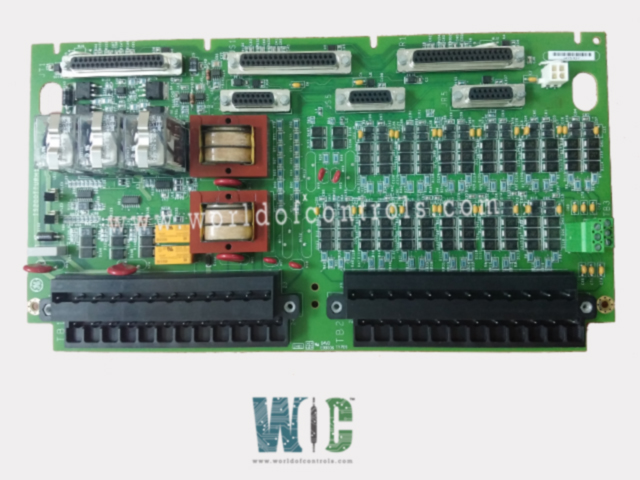
The IS200TTURH1BAA is a Primary Turbine Protection Terminal Board (TTUR) designed and manufactured by General Electric for the Speedtronic Mark VI control system. The turbine terminal board TTURH1C operates with the PTUR as part of the Mark VIe system, providing critical turbine control, protection, and synchronization functions. It supports inputs and outputs such as twelve pulse rate devices that sense a toothed wheel for accurate turbine speed measurement, generator and bus voltage signals received from potential transformers, and a 125 V dc output to the main breaker coil for automatic generator synchronization. The board also accepts inputs from shaft voltage and current sensors to monitor induced shaft voltage and current, along with three overspeed trip signals directed to the trip board and additional I/O signals exchanged with the trip board. The TTUR includes three relays, K25, K25P, and K25A, which must all close together to supply 125 V dc power for closing the main breaker 52G. In simplex systems, communication signals to the PTUR are routed through the PR3 and JR4 connectors, while in TMR systems, these signals are distributed across the PR3, PS3, PT3, JR4, JS4, and JT4 connectors for redundancy and enhanced reliability.
INSTALLATION:
Pulse rate pick-ups, shaft pick-ups, potential transformers, and the breaker relay are wired to the two terminal blocks TB1 and TB2. Each block is held down with two screws and has 24 terminals accepting up to #12 AWG wires. A shield terminal strip attached to chassis ground is located immediately to the left of each terminal block. Jumpers JP1 and JP2 select either simplex or TMR for relay drivers K25 and K25P. Removing wire jumper WJ1 isolates the K25A control line to the TRPX board. TB3 is for optional TTL connections to active speed pickups; these devices require an external power supply. Simplex systems use cable connectors PR3 and JR4. TMR systems use all six cable connectors.
OPERATION:
PTUR turbine control packs plug into TTURH1BAA. Either one or three can be used. The TRPX trip board connects to the J4 connectors. In the simplex application, up to four pulse rate signals may be used to measure turbine speed. Generator and bus voltages are brought into TTUR for automatic synchronizing in conjunction with PTUR, the turbine controller, and the excitation system. TTUR has permissive generator synchronizing relays and controls the main breaker relay coil 52G. In TMR applications, all inputs, except speed, fan to the three PTUR packs. Control signals coming into TTUR from R, S, and T are voted before they actuate permissive relays K25 and K25P. Relay K25A is controlled by the PPRO and TREG boards through J8.
TURBINE FREQUENCY SCANNING & INTERFACING
The board architecture is structurally optimized to capture, isolate, and route raw shaft speed waveforms without introducing processing latency. The termination block supports up to four speed pulse input loops connected to passive magnetic pickups (MPUs) or active proximity probes tracking a toothed gear on the main turbine rotor shaft. High-impedance onboard hardware filters condition these raw alternating current inputs to secure accurate zero-crossing detection while safeguarding the internal logic rails from common-mode electrical transients.
FLAME DETECTION & SYNCHRONIZATION MATRIX
The TTURH1BAA card interfaces directly with up to four Geiger-Mueller-type flame detector sensors located around the turbine combustion chambers. Simultaneously, the board accommodates automated generator-to-grid auto-synchronization sequences. It tracks phase angle, frequency matching, and voltage amplitudes across separate Potential Transformer (PT) analog input lines that continuously monitor the live utility grid bus and generator output terminals.
RESILIENT TRIP CIRCUIT EXECUTIONS
To enforce fail-safe turbine shutdown paths, the board links directly to structural emergency trip circuits and downstream relay terminal boards (such as the TRPG block). The on-board hardware layer manages the power distribution to three heavy-duty trip solenoids or breaker circuits. When an overspeed event, flameout condition, or external emergency stop parameter registers in the microcode, hardwired safety paths drop power to the trip string loops instantly, forcing the steam or gas fuel control valves into a fail-safe closed position.
WHY PARTNER WITH WORLD OF CONTROLS
World of Controls provides the industry's most dependable logistics and technical infrastructure for critical turbine control networks. We maintain an extensive inventory of genuine OEM replacement parts for GE Distributed control setups, minimizing operational downtime during emergency outages. Every item, from certified unused surplus to fully rebuilt industrial components, is subjected to strict simulation profiling in our advanced electronics lab and is supplied with a comprehensive product warranty. Our global engineering support network operates 24/7 to deliver troubleshooting advice, component replacement guidance, and component testing evaluations. Contact the WOC sales team directly via phone or email for current pricing, hardware availability, or repair quotes.
What is the GE IS200TTURH1BAA?
The GE IS200TTURH1BAA is a Primary Turbine Protection (TTUR) terminal board developed for the Speedtronic Mark VI control platform. It serves as a specialized field termination module that gathers and conditions turbine shaft speed, combustion flame readings, and potential transformer synchronization data before routing them to the core VME control racks.
What is the primary operational function of the IS200TTURH1BAA?
The board functions as the critical safety interface that monitors passive or active speed sensors, tracks flame intensity markers, and oversees primary turbine trip circuit executions. It consolidates these essential protection parameters onto a single rugged card to enforce hardware-level emergency trip responses and prevent catastrophic overspeed or flameout hazards.
Why are dedicated high-impedance filtering circuits built into the speed input tracks?
High-impedance filtering circuits are integrated to eliminate high-frequency electromagnetic noise, line cross-talk, and signal chatter generated by the rotating shaft environment. This hardware-level wave conditioning guarantees clean zero-crossing pulse streams for the processing logic, which prevents false overspeed tripping while accurately distinguishing a stop condition from a broken field wire.
How to configure the board for Simplex versus Triple Modular Redundant (TMR) system applications?
Configuration is managed via internal cabling and termination block routing. In a Simplex setup, the terminal card feeds data directly to a single VTUR processor board inside the VME rack. In TMR modes, the field signals landing on the TTUR board are split and fanned out in parallel across three independent cables to connect with three separate VTUR boards (designated R, S, and T cores) for voter fault tolerance.
How to diagnose an open-circuit fault or line drop on the flame detector circuits?
Circuit monitoring logic continuously tracks the loop excitation currents running to the Geiger-Mueller sensors. If an ignition probe fails or if a field conductor is severed, the drop in continuous current consumption is immediately detected by the automated diagnostics and logged as a system alarm within the Toolbox software platform.