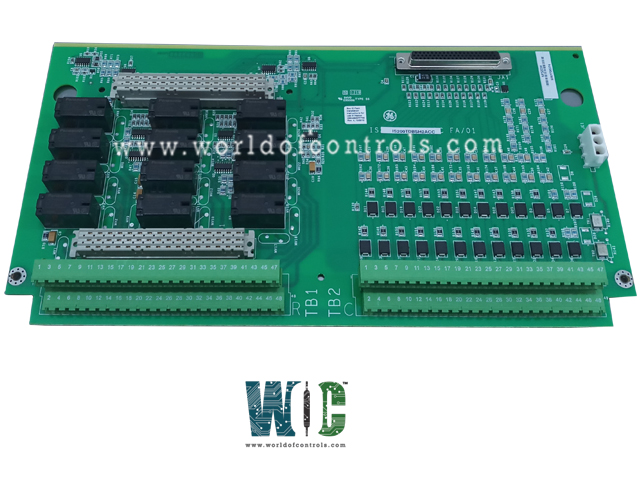
World Of Controls understands the criticality of your requirement and works towards reducing the lead time as much as possible.
IS200TDBSH2ABC - Simplex Contact Input/Relay Output Terminal Board is available in stock which ships the same day.
IS200TDBSH2ABC - Simplex Contact Input/Relay Output Terminal Board comes in UNUSED as well as REBUILT condition.
To avail our best deals for IS200TDBSH2ABC - Simplex Contact Input/Relay Output Terminal Board, contact us and we will get back to you within 24 hours.
SPECIFICATIONS:
Part Number: IS200TDBSH2ABC
Manufacturer: General Electric
Series: Mark VIe
Product Type: Simplex Contact Input/Relay Output Terminal Board
Technology: Surface mount
Mounting: DIN-rail
Contact Inputs: 24 group-isolated inputs
Input Voltage: 24 V DC (16-32 V DC)
Relay Current Rating: 5 A per relay
Relay Voltage Clearance: 250 V AC
Option Cards: JW1 and JW2 connectors
Input Protection: Noise Suppression
Relay Outputs: 12 Form-C relays
Wetting Voltage Connector: JE1 3-pin Mate-N-Lok
Operating temperature: 0 to 60°C
Size: 8.6 cm wide x 16.2 cm high
Repair: 3-7 Days
Availability: In Stock
Country of Origin: United States
Manual: GEH-6721D
FUNCTIONAL DESCRIPTION:
IS200TDBSH2ABC is a Simplex Analog Input/Output Terminal Board manufactured and designed by General Electric as part of the Mark VIe Series used in GE Distributed Control Systems. The TDBSH2ABC board is a simplex contact input/output terminal board designed for DIN-rail or flat mounting. The board accepts 24 group isolated contact inputs that are supplied with a nominal 24, 48, or 125 V dc wetting voltage from an external source. The contact inputs have noise suppression to protect against surge and high- frequency noise. It provides 12 form-C relay outputs and accepts different option cards to expand relay functions.
INSTALLATION:
The TDBSH2ABC, plus a plastic insulator, mounts on a sheet metal carrier that then mounts on a DIN rail. Optionally, the TDBS plus insulator mounts on a sheet metal assembly that then bolts into a cabinet. The connections are wired directly to two sets of 48-point terminal blocks, typically using #18 AWG wires. The upper set of terminals, TB1, connects to the relay portion of the board, and the lower set of terminals, TB2, connects to the contact input circuits. Screw assignments for the two sets of terminals are identical to those found on the SRLY relay board and the STCI contact input terminal board. Shields should be terminated on a separate bracket. If a relay option board is used, it plugs onto TDBSH2ABC connectors JW1 and JW2 and is held in place by the force of the connectors. The following table identifies the function of each relay terminal point grouped as TB1, as it relates to the presence of an option board. If external power is to be supplied, it is wired to a connector provided on the option board.
OPERATION:
The contact input function and on-board signal conditioning are the same as those on STCI; they are scaled for 24, 48, and 125 V dc wetting voltage. The input wetting voltage range is 16 to 32 V dc, 32 to 64 V dc, and 100 to 145 V dc, respectively. The threshold voltage is 50% of the wetting voltage. The contact sensing circuits are shown in the I/O pack description. Contact input currents are resistance-limited to 2.5 mA on the first 21 circuits, and 10 mA on circuits 22 through 24. The 24 V dc supply on TDBSH2ABC is current-limited to 0.5 A using polymer positive temperature coefficient fuses that can be reset. Filters reduce high-frequency noise and suppress surge on each input near the point of signal entry. The discrete input voltage signals go to the I/O processor, which passes them through optical isolators, converts them to digital signals, and transfers them to the controller.
RELAY OUTPUTS:
TDBSH2ABC uses pluggable type terminals and has connectors JW1 and JW2 supporting the option board connection. The relay portion of TDBS does not change between groups H2, H4, and H6; only the contact input circuits change. TDBS relays may be used at any specified AC or DC voltage without regard to board group.
WOC is your dependable partner for GE Distributed Turbine Control Systems, providing complete support to ensure reliable and efficient operations. We offer one of the largest inventories of genuine OEM replacement parts, helping reduce downtime and maintain seamless performance. Our range includes high-quality new and professionally rebuilt boards, along with comprehensive repair services for faulty or damaged components, all backed by a strong warranty. Supported by a team of experienced technical experts available 24/7, we deliver prompt troubleshooting, system upgrades, and tailored automation solutions. Whether you need urgent repairs or hard-to-find parts, we are committed to keeping your turbine control systems running at peak performance. For pricing, availability, or assistance, please contact us via phone or email.
What is the input voltage range for the IS200TDBSH2ABC?
The IS200TDBSH2ABC supports multiple wetting voltage ranges to accommodate different system requirements. It can handle 16–32 V DC, 32–64 V DC, and 100–145 V DC depending on whether the nominal input is 24 V, 48 V, or 125 V DC. This flexibility allows it to be used in various industrial control applications. Proper voltage selection ensures accurate signal detection and stable performance.
What is the input current for the contact circuits?
The board limits input current to protect both the circuitry and connected devices. Circuits 1 through 21 are limited to approximately 2.5 mA, while circuits 22 through 24 allow up to 10 mA. This variation supports different sensing requirements across input channels. The current limiting also enhances long-term reliability and prevents damage from overcurrent conditions.
How is input signal isolation achieved?
Input signal isolation is achieved through group isolation at the terminal board level. Additionally, signals are passed through optical isolators within the I/O processor to prevent electrical interference. This dual-layer isolation improves system safety and reduces noise-related errors. It ensures stable communication between field devices and the control system.
What type of relay outputs are provided?
The board includes 12 Form-C relay outputs, which offer both normally open (NO) and normally closed (NC) contacts. These relays provide flexible switching capabilities for a wide range of control applications. They are suitable for both monitoring and actuation tasks in industrial environments. The design ensures reliable switching under various load conditions.
What is the relay switching capacity?
Each relay on the IS200TDBSH2ABC is rated for up to 5 A of current. It also supports voltage levels up to 250 V AC, making it suitable for industrial-grade switching tasks. This capacity allows the relays to handle moderate electrical loads safely. Proper usage within these limits ensures long operational life.