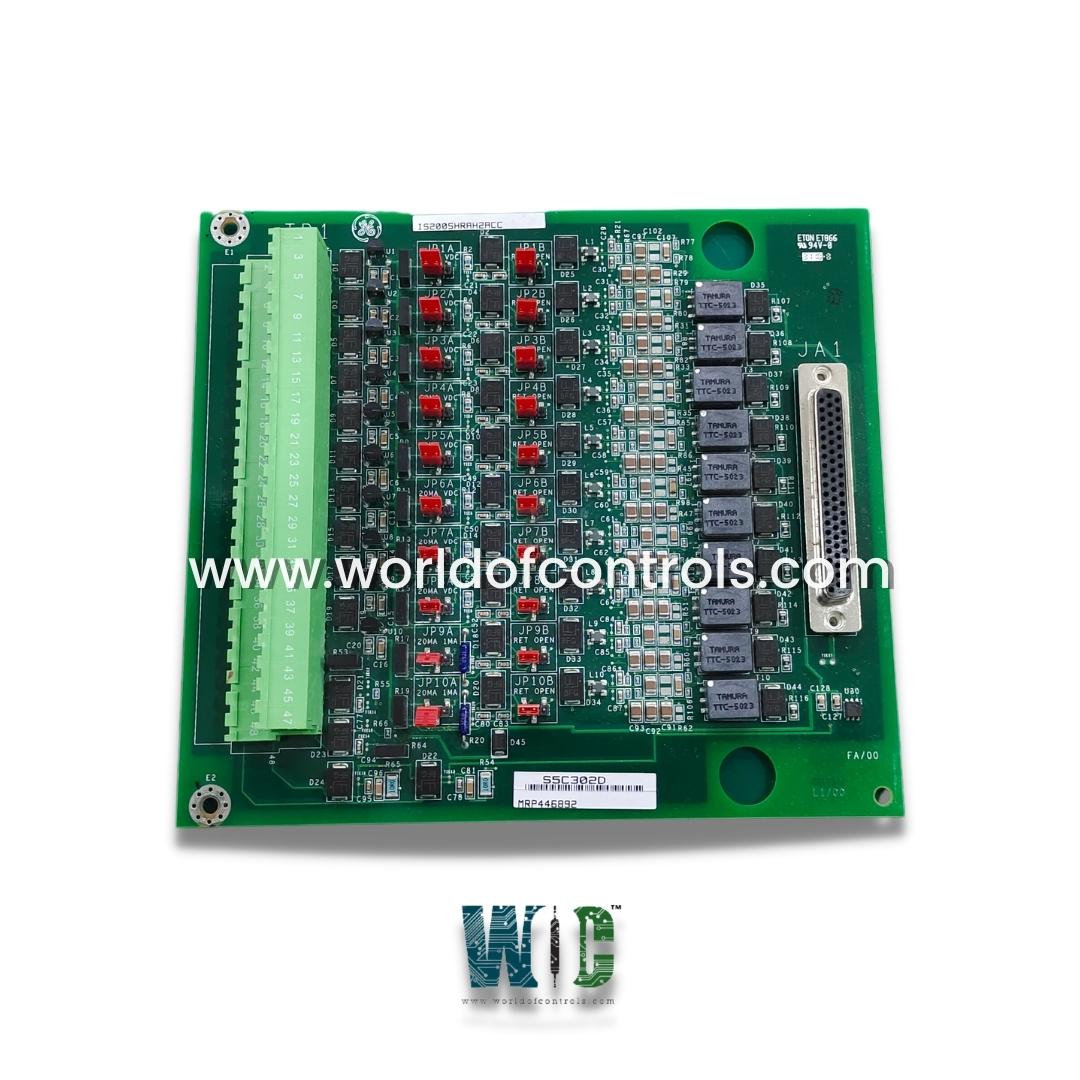
World Of Controls understands the criticality of your requirement and works towards reducing the lead time as much as possible.
IS200SHRAS2A - HART Enabled Analog Input/Output Terminal Board is available in stock which ships the same day.
IS200SHRAS2A - HART Enabled Analog Input/Output Terminal Board comes in UNUSED as well as REBUILT condition.
To avail our best deals for IS200SHRAS2A - HART Enabled Analog Input/Output Terminal Board, contact us and we will get back to you within 24 hours.
SPECIFICATIONS:
Part Number: IS200SHRAS2A
Manufacturer: General Electric
Series: Mark VIe
Product Type: HART Enabled Analog Input/Output Terminal Board
Number of channels: 12
Input span, transmitters: 1 - 5 V dc
Outputs: 24 V dc
Load on output currents: 800 Ohms
Maximum lead resistance to transmitters: 15 Ohms
Mounting: DIN-rail mounting
Technology: Surface mount
Operating temperature: 30 to 65°C
Size: 15.9 cm high x 17.8 cm
Availability: In Stock
Country of Origin/Manufacturer: United States
Manual: GEH-6721_Vol_II V
FUNCTIONAL DESCRIPTION:
IS200SHRAS2A is a HART Enabled Analog Input/Output Terminal Board manufactured and designed by General Electric as part of the Mark VIe Series used in GE Distributed Turbine Control Systems. The Highway Addressable Remote Transducer (HART) Enabled Analog Input/Output (SHRA) terminal board is a compact analog input terminal board that accepts 10 analog inputs and two analog outputs, and connects to the PHRA I/O pack. It allows HART messages to pass between the I/O pack and a HART enabled field device. The 10 analog inputs accommodate two-wire, three-wire, four-wire, or externally powered transmitters. The two analog outputs are 4-20 mA. Only a simplex version of the board is available. High-density Euro-block type terminal blocks are used. An on-board ID chip identifies the board to the PHRA for system diagnostic purposes.
INSTALLATION:
The PHRA I/O pack works with the SHRA. The I/O pack plugs into the D-type connector and communicates with the controller over Ethernet. Only simplex systems are supported. The SHRA, plus a plastic insulator, mounts on a sheet metal carrier that then mounts on a DIN-rail. Optionally, the SHRA plus insulator mounts on a sheet metal assembly and then bolts directly to a cabinet. There are two types of Euro-block terminal blocks available as follows:
Typically, #18 AWG wires (shielded twisted-pair) are used. I/O cable shield termination is provided adjacent to the terminal blocks. The following types of analog inputs/outputs can be used:
OPERATION:
The terminal board provides a 24 V DC power supply to all connected transmitters and transducers, allowing flexible configuration for either current or voltage inputs via selectable jumpers. This flexibility ensures compatibility with a wide range of sensors. However, HART communication is only supported when the inputs are configured as 4-20 mA; it will not function with inputs set to ±5 V DC or ±1 mA.
The board also includes two analog output circuits, both operating on 4-20 mA signals, ensuring reliable integration with standard control and monitoring systems. With only a single cable connection, the terminal board does not support Triple Modular Redundancy (TMR) applications, making it suitable for standard single-channel implementations but not for redundant or safety-critical systems.
DIAGNOSTICS:
The IS200SHRAS2A terminal board measures the voltage drop across a series resistor to determine the output current. If either of the two analog outputs becomes unhealthy, the PHRA I/O pack generates a diagnostic alarm (fault) to notify the control system of the issue, ensuring prompt attention to potential problems.
Each cable connector on the terminal board is equipped with its own ID device, which is a read-only chip containing critical information, including the terminal board’s serial number, board type, revision number, and the JR, JS, and JT connector location. During operation, the PHRA interrogates this ID device to verify the board’s identity. If the PHRA detects any mismatch between the expected and actual data, it flags an error, enabling accurate system diagnostics and maintaining the integrity of the control system.
WOC offers the largest stock of OEM replacement parts for GE Distributed Control Systems, including unused and professionally rebuilt boards, all backed by a full warranty. In addition to supplying parts, we provide expert repair services for faulty boards and round-the-clock technical support from our team of automation specialists. Whether you need troubleshooting, system upgrades, or guidance on selecting the right components, WOC is committed to keeping your operations running smoothly. For pricing, availability, or service inquiries, contact our team by phone or email.
What is IS200SHRAS2A?
It is a HART Enabled Analog Input/Output Terminal Board from GE Mark VIe Series, used in Distributed Control Systems to connect analog field devices to the PHRA I/O pack.
How many inputs and outputs does it support?
It supports 10 analog inputs and 2 analog outputs. Inputs can be two-wire, three-wire, four-wire, or externally powered transmitters; outputs are 4-20 mA.
Can HART communication be used with all inputs?
No, HART communication only works when inputs are set to 4–20 mA. It is not supported for ±5 V DC or ±1 mA input configurations.
Does it support redundant or TMR systems?
No, the IS200SHRAS2A is a simplex board. It cannot be used for Triple Modular Redundancy (TMR) or other redundant system configurations.