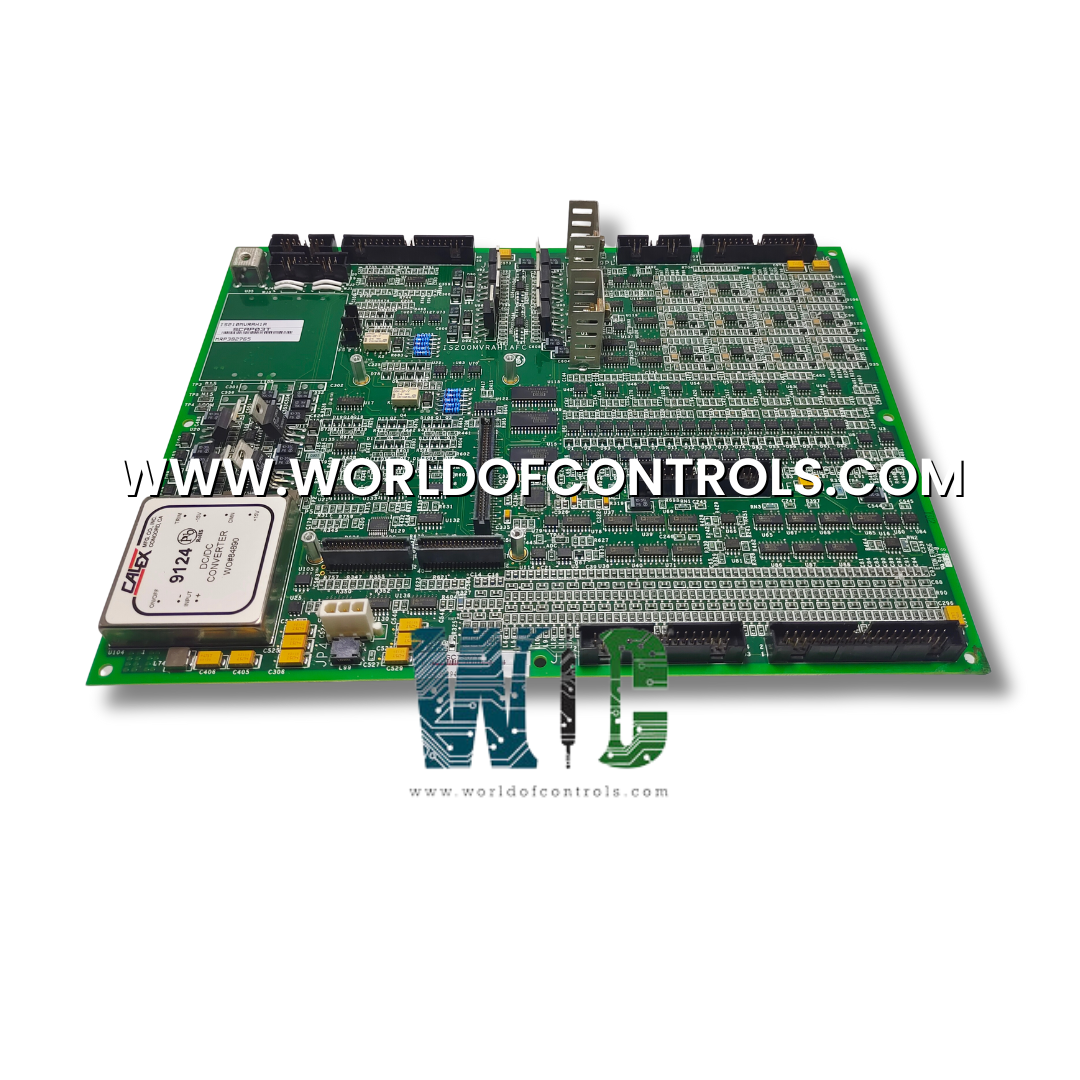
World Of Controls understands the criticality of your requirement and works towards reducing the lead time as much as possible.
IS200MVRAH1A - I/O Interface Board is available in stock which ships the same day.
IS200MVRAH1A - I/O Interface Board comes in UNUSED as well as REBUILT condition.
To avail our best deals for IS200MVRAH1A - I/O Interface Board, contact us and we will get back to you within 24 hours.
SPECIFICATIONS:
Part Number: IS200MVRAH1A
Manufacturer: General Electric
Series: Mark VIe
Product Type: I/O Interface Board
Communication Link: High-Speed Serial Link (HSSL)
Replaces: TCQA, IOMA
Thermocouple Inputs: Simplex
Supported I/O: Servos, LVDTs, Pulse Rates, Proximeters, Analog Inputs, Analog Outputs, PTR Relays
Additional Inputs: Bus Voltage, Generator Voltage, CPD, Megawatt
Data Transfer Rate to MVRA: 5 ms
Power Supply: MVRPH1A
External Data Network: IONet
Operating temperature: -30 to 65°C
Size: 33.0 cm high x 17.8 cm
Repair: 3-7 Days
Availability: In Stock
Country of Origin: United States
Manual: GEH-6800_Vol_II
FUNCTIONAL DESCRIPTION:
IS200MVRAH1A is an I/O Interface Board manufactured and designed by General Electric as part of the Mark VIe Series, which is used in GE Distributed Turbine Control Systems. The MVRAH1A is an I/O board on the PMVE using the high-speed serial link (HSSL). The PMVE contains specialised code for the MVRAH1A that communicates and controls the MVRAH1A analog and digital I/O. Configuration parameters customise MRVA operation. The MVRAH1A is a functional replacement for the Mark VIe TCQA and IOMA boards. MVRA analog and digital I/O is as follows:
INSTALLATION:
OPERATION:
The PMVE contains configuration parameters specific to the MVRA. External data is transferred to and from the control system database in the controller over the IONets. The PMVE propagates the control and data to each of its I/O boards. Data is transferred to the MVRA across the HSSL every five milliseconds. Through internal ribbon cables, other interface boards supply additional input and output as follows:
SYNC CHECK I/O MODULE:
The MVRA functions much like the TCQA and includes sync check functionality. The MVRA writes the control limits and enables the sync check logic in the FPGA. The FPGA controls the relay enable permissive when all conditions are satisfied. The MVRA uses a time-based algorithm, which improves speed and acceleration. This algorithm collects the number of tooth pulses and 25MHz tics that occurred between those pulses within a specified time interval.
The MVRA uses an enhanced speed algorithm (ESA) for speed wheels and gear tooth pulse rate sensors. Variability in the gear tooth wheel spacing causes variability in the speed measurement and acceleration. The ESA measures and corrects this spacing. However, it does not introduce latencies or correct for electronic or sensor abnormalities. If the ESA cannot correct for the speed anomalies, it defaults to the evenly spaced algorithm. The ESA should not be used for critical overspeed functions. The only requirement for this mapping to occur is to enable the ESA and set the teeth per revolution to the correct value. This can be used for any pulse device that has multiple pulses generated per revolution, but it must be an integer number. With a multi-gear box, the ESA is only required to know the number of gear teeth on the sense gear. The scaling can accommodate the gearing ratios.
RECALIBRATION:
The recalibration of a PSVO, PSVP, or PCAA servo is required when a new terminal board is used on a system. The controller saves the barcode of the terminal board and compares it against the current terminal board during reconfiguration load time. Any time a recalibration is saved, it updates the barcode name to the current board.
WOC maintains the largest inventory of OEM replacement parts for GE Distributed Turbine Control Systems, providing immediate access to critical components. Our stock includes unused parts, refurbished boards, and specialised components, all curated to meet stringent quality standards. In addition to supplying parts, we offer expert repair and refurbishment services for malfunctioning boards, with every unit backed by a warranty to ensure reliability and long-term performance.
Our team of experienced professionals is available 24/7 to support OEM requirements and maintain seamless operation of your automation systems. We provide guidance on part selection, troubleshooting, and repair solutions, delivering responsive and knowledgeable assistance. For detailed information on pricing, availability, or specific service requests, please contact our team via phone or email for prompt, personalised support tailored to your operational needs.
What is the IS200MVRAH1A?
The IS200MVRAH1A is an I/O Interface Board used in GE’s Mark VIe Distributed Control System. It manages a wide range of analog and digital signals and communicates through a high-speed serial link. The board works closely with the PMVE processor to process and control field I/O reliably.
What types of I/O does the MVRA support?
It supports thermocouples, servos, LVDTs, proximeters, pulse rate sensors, analog inputs, analog outputs, and PTR relays. The board also handles bus and generator voltage inputs, as well as CPD and megawatt signals. This broad coverage makes it a central component for turbine instrumentation.
How does the MVRA communicate with the system?
The MVRA communicates with its host PMVE via a high-speed serial link (HSSL). Data is exchanged every 5 ms to ensure timely control actions. System-level data moves through the IONet to the controller for processing and coordination.