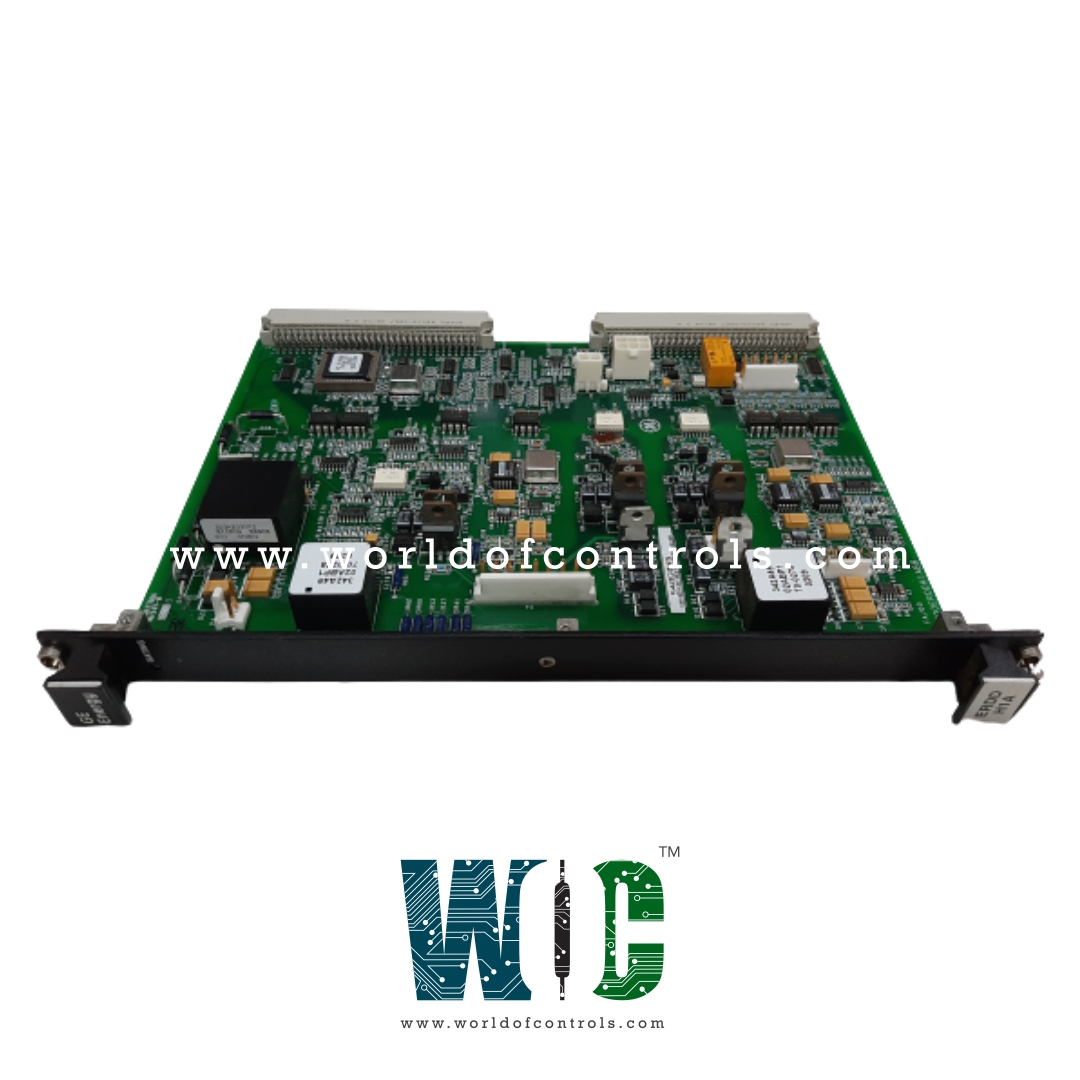
World Of Controls understands the criticality of your requirement and works towards reducing the lead time as much as possible.
IS200ERDDH1A - Exciter Regulator Dynamic Discharge Board is available in stock which ships the same day.
IS200ERDDH1A - Exciter Regulator Dynamic Discharge Board comes in UNUSED as well as REBUILT condition.
To avail our best deals for IS200ERDDH1A - Exciter Regulator Dynamic Discharge Board, contact us and we will get back to you within 24 hours.
TECHNICAL SPECIFICATIONS:
Part Number: IS200ERDDH1A
Manufacturer: General Electric (GE)
Control System Series: EX2100 Excitation Controller / Speedtronic Mark VI
Product Type: Exciter Regulator Dynamic Discharge Board (ERDD)
Primary Function: IGBT Gate Drive Control and Excessive DC Link Voltage Regulation
Operating Configurations: Simplex or Redundant Application Profiles
Simplex Mounting Interface: Main ERBP Backplane
Redundant Mounting Interface: ERBP Backplane (M1 Position) and ERRB Backplane (M2/C Position)
Hardware Interlock Control: K3 Charging Relay (Simplex) / K41 De-Excitation Relay (Redundant)
Onboard Form Factor: Single-Slot, Double-Height (6U) PCB Configuration
Temperature Tracking Input: 1 Onboard RTD Channel (Scaled 0–140°C via 0–10 VDC Loop)
Repair Time: 3-5 Days
Availability: In Stock
Weight: 0.36 kg (0.79 lbs)
Country of Origin: United States
The IS200ERDDH1A is an Exciter Regulator Dynamic Discharge (ERDD) board designed and manufactured by General Electric for the EX2100 Excitation Control series. The IS200ERDDH1A IGBT Exciter Regulator Interface and Dynamic Discharge board (ERDD) is used in the EX2100 Regulator Control, simplex and redundant applications. For simplex applications, one ERDD is mounted in the IS200ERBP Exciter Regulator Backplane (ERBP) and interfaces with the Exciter Regulator I/O board (ERIO) and the Exciter Regulator Static Converter board (ERSC). In redundant applications, one ERDD is mounted in ERBP (M1), and a second ERDD is mounted in the Exciter Regulator Redundant Backplane (ERRB, M2/C) and interfaces with the ERIO, ERSC, and the Exciter Regulator Redundant Relay board (ERRR). The ERDD provides the following major functions:
The system provides gate drive control for field excitation and enables dynamic discharge to regulate excessive DC link voltage. It also incorporates bridge feedback monitoring for critical parameters, including DC link voltage, output shunt current, output field voltage, bridge temperature, and IGBT gate drive status, such as power supply conditions and desaturation faults. Additionally, it controls the de-excitation relay (K41) in simplex applications or the charging relay (K3) in redundant applications.
BRIDGE HEATSINK TEMPERATURE SENSING
The regulator bridge incorporates an advanced bridge (heatsink) temperature sensing system designed to ensure reliable thermal monitoring and protection during operation. A dedicated resistive temperature device (RTD) input continuously measures the temperature of the regulator bridge heatsink, helping maintain optimal operating conditions and preventing overheating. The RTD input is precisely scaled to monitor a temperature range from 0 to 140 °C, allowing accurate detection of temperature variations across the bridge assembly. For integration with external monitoring and control systems, the measured temperature is converted into a proportional analog output signal ranging from 0 to 10 VDC. This feature enables real-time temperature supervision, improves system safety, supports preventive maintenance, and enhances the overall reliability and performance of the excitation control system.
CONTROL POWER DISTRIBUTION
Both control and DC link voltages are present on ERDD. There is isolation between the control power and any circuit or component connected to the IGBT bridge. Non- isolated ERDD control circuits are supplied directly from the IS200EPSMG2A Exciter Power Supply Module (EPSM) input through the P1 and P2 backplane connectors. Power for IGBT gating is also derived from the EPSM input. Dynamic discharge (DD) is powered from two sources: the EPSM input and a redundant power source. The redundant power source is derived directly from the DC link bus and contained on the ERDD. The DD circuits directly monitor the DC link voltage and apply control when necessary (independent from the control processor).
K41/K3 PILOT RELAY AND AUXILIARY CONTACT:
The ERDD contains one pilot relay driver and one relay feedback monitor. Power for the pilot relay is derived from the respective control power (M1 or M2/C) and is referenced back to PCOMB of that same supply. To energize the relay coil requires only one logic signal from the ERIO card. Voltage at the pilot relay contacts is clamped at 30 V dc. The ERDD contains one auxiliary contact input for the K41/K3 relay. The contacts are wetted with a nominal 70 V dc (-10 %/+20%) at 4 mA from EPSM. The state of the contact is monitored using a current-limiting, optically isolated circuit. The current limit circuit maintains a contact wetting current of 4 mA (±1 mA) that is used to drive the opto-coupler.
IGBT GATE DRIVE CIRCUITS:
There are three isolated IGBT gate drive circuits per ERDD. The gate drive circuits control the leg U upper, leg V lower, and leg W (dynamic discharge) lower IGBTs of the IGBT bridge module. Each IGBT gate drive circuit includes an optically isolated, hybrid gate drive module and discrete components. Isolated power for this module is derived from the control power to produce the necessary gate drive voltages, VCC and VEE. Applying a valid gate command to the IGBT module drives the IGBT gate between VCC and VEE. Gate command logic for leg U and leg V operation is controlled by ERDD.
The hybrid IGBT gate drive offers short-circuit protection using the desaturation method. When the module is commanded to turn the IGBT on, the module monitors the voltage drop between the emitter and collector of the IGBT. If this voltage exceeds preset voltage and time parameters, the module will turn off the IGBT (avoiding IGBT short-circuit destructive effects) and annunciate a desaturation fault. The gate drive module also monitors the voltage between VCC and VEE using an internal undervoltage lockout (UVLO) mechanism. If the UVLO detects insufficient gate voltage, a UV fault will occur. These two fault modes are ANDed together with the gate input to disable IGBT gating. Gate faults are passed on to the main control for system-level detection. A gate drive fault is latched, forcing the IGBT(s) to remain off until manually reset by the control.
REDUNDANT CONTROL OUTPUT VOLTAGE AND CURRENT INTERFACE:
In redundant applications, the M2/C control receives its output voltage and output current VCO signals from ERRR, through ERDD. The ERDD provides three additional output voltage and output current feedback paths for these redundant signals. The ERRR VCO signals are processed through the ERDD signal conditioning circuits and sent through the backplane to the M2/C control. The ERDD conditioning circuits consist of optically isolated inputs and buffers with standard level outputs.
WOC offers one of the largest inventories of OEM replacement parts for GE Excitation Control Systems, helping industrial facilities minimize downtime and maintain reliable operations. In addition to supplying high-quality replacement components, we provide expert repair services for faulty boards and modules, along with unused and professionally rebuilt parts backed by warranty. Our experienced automation specialists are available 24/7 to assist with part identification, sourcing, repairs, technical support, and urgent OEM requirements. Whether you need a hard-to-find legacy component, a replacement board, or a cost-effective repair solution, our team is committed to delivering fast, dependable service. Contact us by phone or email for current pricing, availability, lead times, and repair assistance tailored to your automation needs.
What is the Woodward IS200ERDDH1A?
The IS200ERDDH1A is an Exciter Regulator Dynamic Discharge (ERDD) board manufactured by General Electric for the EX2100 Excitation Control series. It manages gate drive pulses for field excitation bridges, evaluates running bridge diagnostics, and regulates excessive DC-link overvoltage trends to secure power infrastructure.
What is the difference between Simplex and Redundant mounting for the IS200ERDDH1A?
In Simplex setups, a single card sits within the ERBP backplane to manage the system and command the K3 charging relay. In fully redundant architectures, two identical cards are deployed across the ERBP and ERRB backplane slots to coordinate safety voting and command the K41 de-excitation loop.
How does the bridge temperature tracking path operate on this board?
The board includes a dedicated analog conditioning loop that links directly to a resistive temperature device (RTD) situated on the bridge heatsink. It transforms sensor variations across a 0 to 140°C thermal scale into a linear 0–10 VDC tracking signal that the control processor evaluates to prevent over-temperature faults.
How does the IS200ERDDH1A handle current telemetry and track overcurrent faults?
The board accepts a 100 mV input loop from external isolation shunts via terminal connection P6. Internal amplifiers process this signal to power a localized Voltage-Controlled Oscillator (VCO). If the frequency passes full-scale limit parameters, the board's hardware gates trigger an overcurrent diagnostic flag.
What happens if the card loses communication with the master control processor?
The dynamic discharge logic loops are engineered to run autonomously on isolated circuitry powered directly by the DC-link bus. If system communication is severed, the board retains its capability to independently track DC-link voltage thresholds and trigger energy discharge sequences to shield components.
How does World of Controls verify a replacement IS200ERDDH1A board before shipping?
Every board is integrated into a live EX2100 system test bench. We measure individual IGBT gate switching waveforms on an oscilloscope, run full-scale loop testing on the voltage and current VCO paths, and verify relay contact switching speeds under full industrial loads.