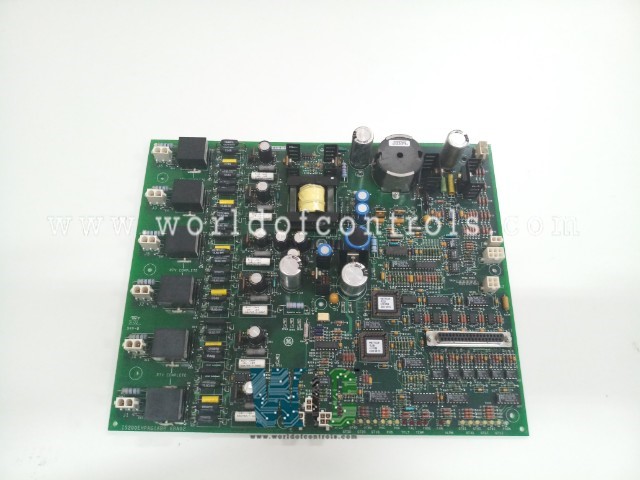
World Of Controls understands the criticality of your requirement and works towards reducing the lead time as much as possible.
IS200EHPAG1C - Exciter Gate Pulse Amplifier Board is available in stock which ships the same day.
IS200EHPAG1C - Exciter Gate Pulse Amplifier Board comes in UNUSED as well as REBUILT condition.
To avail our best deals for IS200EHPAG1C - Exciter Gate Pulse Amplifier Board, contact us and we will get back to you within 24 hours.
SPECIFICATIONS:
Part Number: IS200EHPAG1C
Manufacturer: General Electric
Function: Exciter Gate Pulse Amplifier Board
Series: EX2100
Voltage Feedback VCO Range: 0�20 MHz
Power Supply: 17.7 VAC or 5 VDC
Supply Output: 5 VDC, max. 500 mA
Conduction Current Inputs: 3-phase Hall Effect sensors
Bridge Temperature Inputs: RTD
Operating Voltage Supply: Nominal 125 VDC
SCR Gate Channels: 6
Dimensions: 11.00 � 9.00 � 3.00 inches
Availability: In Stock
Country of Manufacture: United States (USA)
Manual Reference: GEI-100266
FUNCTIONAL DESCRIPTION:
IS200EHPAG1C is an Exciter Gate Pulse Amplifier Board manufactured and designed by General Electric as part of the EX2100 Series used in GE Excitation Control Systems. The EHPAG1C is used in 100 mm EX2100 Excitation Control. It takes the gate commands from the ESEL and controls the gate firing of up to six SCRs (Silicon Controlled Rectifiers) on the Power Bridge. It is also the interface for current conduction feedback, and bridge airflow and temperature monitoring. The EHPA functional model with the major I/O is shown in the following figure. A nominal 125 V dc power source from the EPDM supplies an on-board dc/dc converter that provides power for SCR gating over the full range of input supply voltage. LEDs provide visual indication of the status of the EHPA power supply, input gate commands from ESEL, EHPA outputs to the SCRs, currents into the bridge, line filter, cooling fan rotation, bridge temperature, alarms, or fault conditions.
GATE COMMAND INPUTS:
The EHPAG1C receives a total of six gate commands from the ESEL through a twisted pair, multiconductor, shielded cable. Gate commands over the differential pair are optically coupled, filtered, ac-coupled, and sent to the Gate Pulse Amplifier (GPA). There are six GPAs, one for each SCR. EHPA provides galvanic isolation between individual SCR gates.
Conduction currents are sensed on all three phases of the bridge input. The EHPA acts as an interface between Hall Effect sensors located on the EXCS boards and the system control. The EHPA provides power to the EXCS, receiving a signal from EXCS indicating the status of current flow through each leg of the three-phase bridge input. These status signals are delivered to the EHPA at J9 � J10. The EHPA then conditions these signals and sends the bridge status out to the controller.
BRIDGE TEMPERATURE
It is sensed through an RTD (thermistor) sensor input or a temperature switch input. For new exciters, only the RTD input is used, and jumpers on the EHPA disable the temperature switch inputs. If a bridge is being retrofitted with an EX2100 control, the two temperature switch inputs are used to interface with the temperature switches already mounted on the bridge. In this case, the RTD input is left open to disable it. Both the RTD and temperature switch inputs are connected to EHPA at J13.
SENSOR FEEDBACK LOGIC:
EHPAG1C fault and alarm conditions are generated in a logic circuit, and the resulting signals are sent to the control. An alarm is generated on a signal from the line filter, fans, temperature switch 170, temperature switch 190, or if the RTD exceeds an alarm threshold. A temperature trip is generated on a signal from both thermal switches, or if the RTD exceeds a fault threshold. Two failure modes cause the bridge to be shut down a temperature trip or a GPA failure. If either one of these occurs in the single or parallel bridge configurations, the GPA stops gating unless coolant trips are manually disabled.
World of Controls offers one of the largest inventories of GE Excitation Control System replacement parts, ensuring quick and reliable availability for critical industrial operations. In addition to supplying high-quality components, we specialize in repairing faulty boards, helping you restore performance, extend equipment lifespan, and reduce costly downtime. Our inventory includes both unused and professionally rebuilt parts, each thoroughly inspected, tested, and backed by a warranty to guarantee performance and reliability. Supported by a team of experienced professionals available 24/7, we provide expert assistance for all your OEM and automation requirements, from troubleshooting to part selection. For pricing, availability, or repair inquiries, feel free to get in touch with our team via phone or email�we are always ready to deliver prompt and dependable support.
What is the IS200EHPAG1C?
The IS200EHPAG1C is an Exciter Gate Pulse Amplifier Board from General Electric�s EX2100 Series. It interfaces between the ESEL and the SCR power bridge, controlling gate firing and monitoring critical feedback signals. The board ensures reliable excitation system operation by managing currents, bridge temperature, and airflow, and provides logic outputs for alarms and fault detection. It is essential for the stable operation of GE EX2100 Excitation Control Systems.
How does the IS200EHPAG1C control SCRs?
The board receives six differential gate commands from the ESEL, which are optically coupled, AC-coupled, and filtered. Each signal is routed through a dedicated Gate Pulse Amplifier (GPA) to control an individual SCR. This ensures galvanic isolation between SCR gates and prevents cross-interference. The amplified pulses precisely control SCR firing, maintaining correct excitation output.
What feedback does the board provide to the controller?
The IS200EHPAG1C conditions conduction current signals from Hall Effect sensors across all three bridge phases. It also monitors bridge temperature and airflow, sending alarm and status signals to the controller. This allows real-time monitoring of SCR performance, thermal conditions, and system health. The board ensures a timely response to abnormal events and system protection.
How does the board monitor bridge temperature?
Temperature monitoring is performed via an RTD input for new exciters or temperature switches for retrofitted bridges. The board generates alarms if the temperature exceeds warning thresholds and triggers a trip to stop SCR gating if fault thresholds are reached. Jumper settings allow selection between RTD and switch inputs depending on the bridge configuration. This prevents overheating and ensures safe operation.