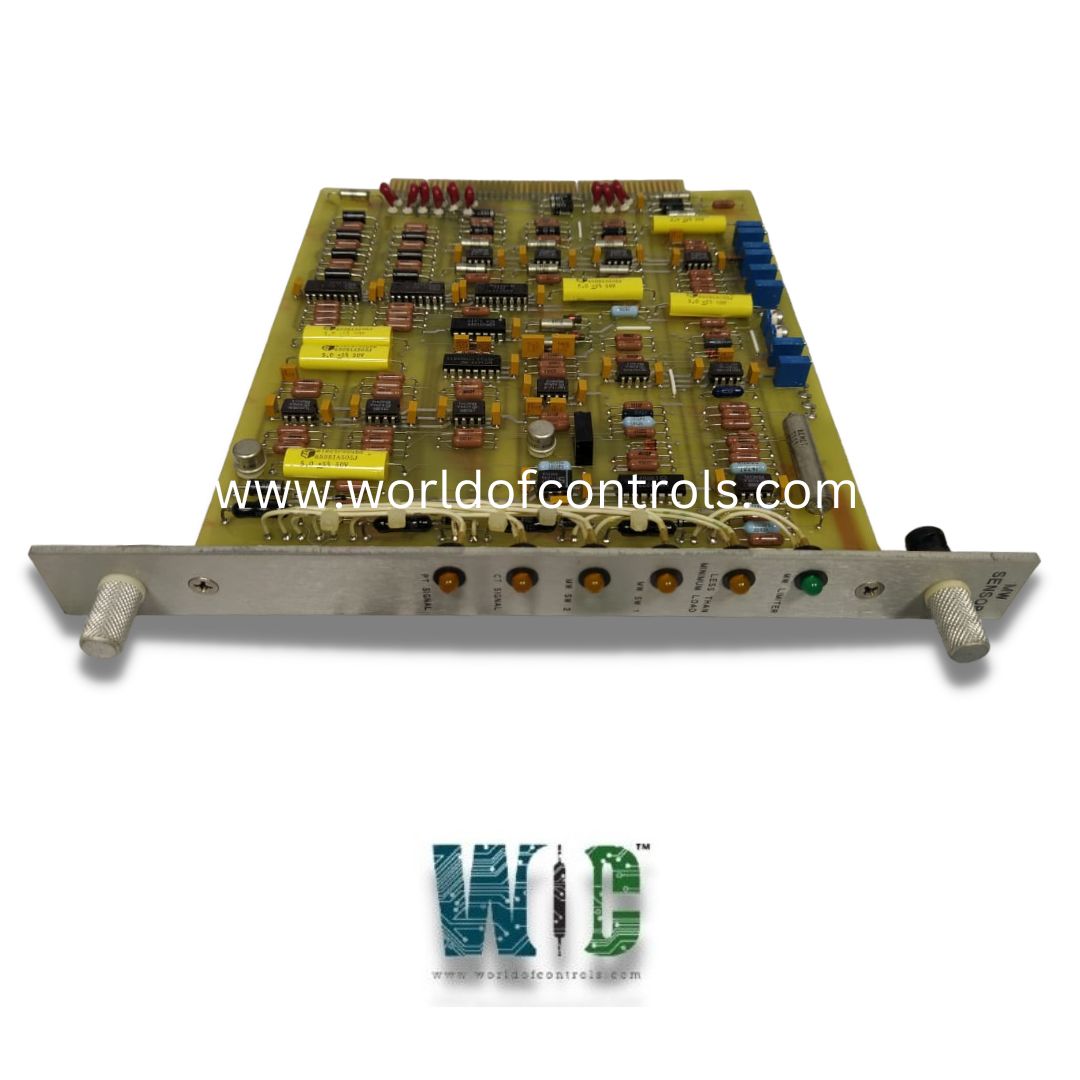
World Of Controls understands the criticality of your requirement and works towards reducing the lead time as much as possible.
5463-333 - Woodward MW Sensor Unit is available in stock which ships the same day.
5463-333 - Woodward MW Sensor Unit comes in UNUSED as well as REBUILT condition.
To avail our best deals for 5463-333 - Woodward MW Sensor Unit, contact us and we will get back to you within 24 hours.
TECHNICAL SPECIFICATIONS:
Part Number: 5463-333
Manufacturer: Woodward
Product Type: MW (Megawatt) Sensor Unit
Input Signal: PT/CT Secondary Inputs
Output Range: 4–20 mA (Proportional to Power)
Accuracy: ±0.5% of Full Scale
Isolation: 500 Vdc
Operating Temp: -20 °C to +70 °C
Series Compatibility: NetCon / MicroNet
Mounting: Rack / Chassis Mounted
Availability: In Stock
Origin: United States
FUNCTIONAL DESCRIPTION:
The 5463-333 is an MW Sensor Unit designed and manufactured by Woodward for industrial control systems. It is specifically designed to measure real power (Megawatts) by interfacing with Potential Transformers (PTs) and Current Transformers (CTs) on the electrical grid or generator output. By converting these high-voltage/high-current signals into a standard 4–20 mA analog feedback loop, it allows the Woodward NetCon or MicroNet system to perform accurate load sharing, speed governing, and power management.
LOAD SENSING AND TRANSDUCTION
The primary role of the MW Sensor Module is to provide a reliable digital or analog representation of the electrical load on the prime mover. It processes phase-accurate voltage and current inputs to calculate real power, ensuring that the control system can respond to load changes with minimal delay. This speed of transduction is critical for maintaining grid stability and preventing frequency excursions during sudden load rejections or additions.
SIGNAL CONDITIONING AND ISOLATION
Operating in the vicinity of high-voltage switchgear requires robust electrical protection. The MW Sensor Unit incorporates 500 Vdc galvanic isolation to shield the internal control logic from the electrical noise and transients common in power generation environments. Integrated filtering circuitry ensures that the output signal is free from harmonic distortion, providing the Master CPU with a clean and stable power measurement for its governing algorithms.
INDUSTRIAL DURABILITY AND CALIBRATION
The MW Sensor Module features a rugged chassis designed to withstand the thermal stress and vibration found in power plants and marine engine rooms. The module is factory-calibrated to high standards of accuracy (±0.5%), ensuring that the power feedback remains linear and dependable over its entire service life. This long-term stability is essential for applications requiring precise load division between paralleled generator sets.
WHY BUY FROM WOC:
World of Controls supports the maintenance and longevity of your Woodward assets by providing the 5463-333 in both UNUSED and REBUILT conditions. Every sensor unit is subjected to rigorous validation on specialized simulation racks to verify power calculation accuracy and isolation performance. We maintain a robust inventory of Woodward components to ensure rapid deployment during critical maintenance cycles or emergency failures. With global shipping and 24/7 technical assistance, WOC is your trusted source for high-integrity power sensing hardware.
What is the Woodward 5463-333?
The 5463-333 is an MW Sensor Unit used to measure the real power output of a generator. It converts signals from PTs and CTs into a standard 4–20 mA signal for use in Woodward control systems like the MicroNet or NetCon series.
How does the MW Sensor Module contribute to load sharing?
In a multi-generator system, the MW Sensor Module provides the feedback needed for the control system to determine exactly how much power each unit is producing. This data allows the governor to adjust each engine's output so they share the total electrical load proportionally and efficiently.
What are the PT and CT input requirements for this module?
It is designed to work with standard industrial PT and CT secondary outputs. Users should verify that the secondary levels match the specific input ratings of the 5463-333 to ensure accurate power transduction and avoid overloading the internal sensing circuits.