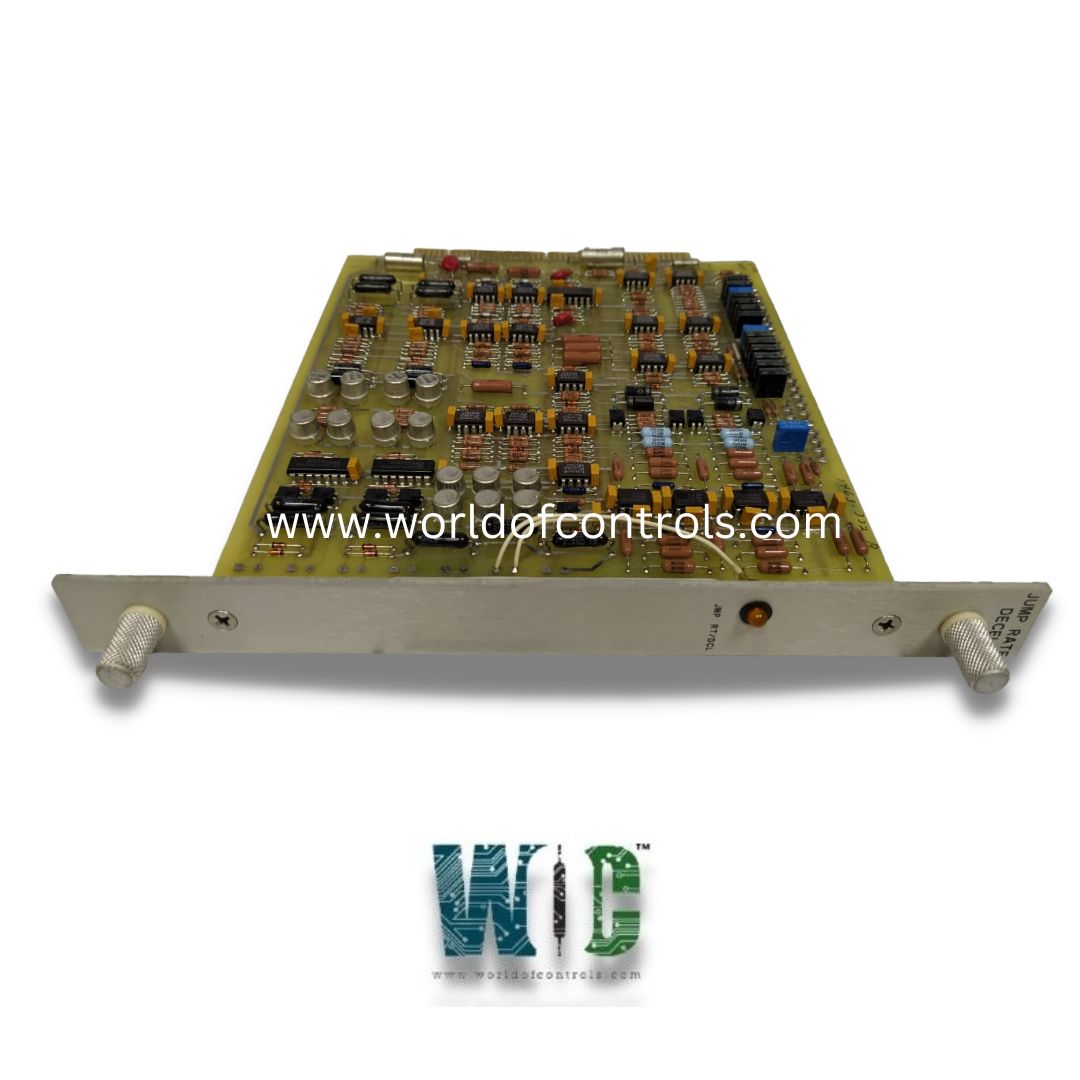
World Of Controls understands the criticality of your requirement and works towards reducing the lead time as much as possible.
5463-332 - Jump Rate Decelerate Module is available in stock which ships the same day.
5463-332 - Jump Rate Decelerate Module comes in UNUSED as well as REBUILT condition.
To avail our best deals for 5463-332 - Jump Rate Decelerate Module, contact us and we will get back to you within 24 hours.
SPECIFICATIONS:
Part Number: 5463-332
Manufacturer: Woodward
Series: 5463
Module Type: Jump Rate Decelerate Unit
Input Voltage Range: 0�5 V DC
Speed Sensor Input: 0�10 kHz
Output Current Range: 4�20 mA
Isolation Voltage: 1500 V RMS
Operating Temperature: -40�C to +70�C
Max Power Consumption: 5 W
Mounting: Plug-in card
Power Supply: 24 V DC
Repair: 3�7 days
Availability: In Stock
Weight: 0.6 kg
Country of Origin: United States
FUNCTIONAL DESCRIPTION:
5463-332 is a Jump Rate Decelerate Module manufactured and designed by Woodward as part of the 5463 Series used in Woodward Control Systems. It is designed to interface with turbine, generator, or engine control systems, providing precise monitoring and regulation of analog and digital signals. It functions by receiving input signals from field devices, such as sensors or transducers, processing these signals internally, and generating accurate control outputs to maintain system stability and performance. The module ensures reliable communication between the control system and actuators, delivering consistent, high-fidelity outputs for critical operations such as speed regulation, load sharing, or process control. Built for integration into modular control racks, it offers robust electrical isolation, signal conditioning, and fault protection, making it suitable for demanding industrial environments where precision and reliability are paramount.
INPUTS AND SIGNAL INTERFACES:
It accepts speed reference inputs from the main controller, typically as analog voltage (0�5 V DC) or current (4�20 mA) signals, as well as actual speed feedback from sensors such as magnetic pickups, tachometers, or other RPM transducers. The module may also incorporate discrete inputs for enabling or disabling functions, fault acknowledgment, or mode selection.
All inputs are internally conditioned and filtered to eliminate noise, transients, and spikes, and are galvanically isolated from the output circuitry to ensure robust operation in electrically noisy industrial environments. With high input impedance and wide frequency acceptance, the module ensures accurate monitoring of commanded and actual speed signals, providing a reliable foundation for controlled deceleration and stable system performance.
RATE-LIMITING AND DECELERATION LOGIC:
The module continuously samples both the commanded speed reference and the actual speed feedback, performing real-time computation of the permissible deceleration vector. Its rate-limiting algorithm constrains the instantaneous change in output per unit time, effectively generating a controlled ramp-down that mitigates mechanical shock, torsional oscillations, and overshoot in coupled rotating machinery. Internally, high-bandwidth signal conditioning circuits and low-pass digital filters suppress sensor noise and high-frequency transients, ensuring that output commands maintain sub-millisecond stability and accuracy. Configurable jump-rate parameters allow fine-tuning for specific prime mover dynamics, load inertia, and system response requirements, while the module�s feedback loop continuously adapts to transient disturbances and varying operational loads.
ELECTRICAL ISOLATION AND PROTECTION:
Each input and output channel is independently isolated via precision transformer and opto-coupler interfaces, preventing ground loops and mitigating the effects of electrical noise from adjacent power circuits or field devices. The module incorporates active surge suppression and high-speed transient absorbers to handle voltage spikes caused by switching transients, load dumps, or inductive kickback.
Isolation barriers are rated for continuous operation at 1500 V RMS, ensuring compliance with industrial safety standards and protection against inadvertent short circuits. Internal monitoring circuits continuously detect overvoltage, undervoltage, and short-circuit conditions, triggering status flags or protective command inhibition to downstream actuators, preserving both module and system integrity.
AVAILABILITY AND SUPPORT:
WOC maintains the largest inventory of genuine Woodward control system OEM replacement parts, ensuring fast and reliable availability for all your automation needs. We specialize in sourcing, supplying, and repairing critical components, including unused and fully rebuilt boards, all backed by a comprehensive warranty for peace of mind. Our experienced technical team is available 24/7 to provide expert support, whether you need assistance with part selection, system troubleshooting, or emergency repairs. We understand the importance of minimizing downtime in industrial operations, and our dedicated specialists work closely with you to ensure that your Woodward control systems remain fully operational and efficient. For detailed information on pricing, availability, or repair services, please contact our team directly by phone or email, and receive prompt, professional guidance tailored to your automation requirements.
What is 5463-332?
The Woodward 5463-332 is a Jump Rate Decelerate Module used in engine, turbine, and generator control systems. It controls the deceleration rate by monitoring commanded speed and actual speed feedback, applying rate-limiting logic, and generating conditioned outputs to maintain smooth, safe, and stable speed reduction.
What types of speed feedback signals are supported?
Supports magnetic pickup, tachometer, or voltage/frequency transducer signals, with input ranges up to 10 kHz and impedance optimized for high-fidelity measurement. The module conditions these signals via low-pass filtering and isolation to suppress noise and prevent aliasing errors.
How is jump-rate deceleration configured?
Jump-rate parameters are user-configurable to define the maximum deceleration per second. These parameters can be set via onboard DIP switches, jumpers, or a digital control interface, allowing precise tuning for engines with varying inertia and load dynamics.
How does it handle sensor signal latency?
The module compensates for latency through predictive filtering and high-frequency sampling, ensuring the deceleration profile remains accurate despite minor sensor delays.