World Of Controls understands the criticality of your requirement and works towards reducing the lead time as much as possible.
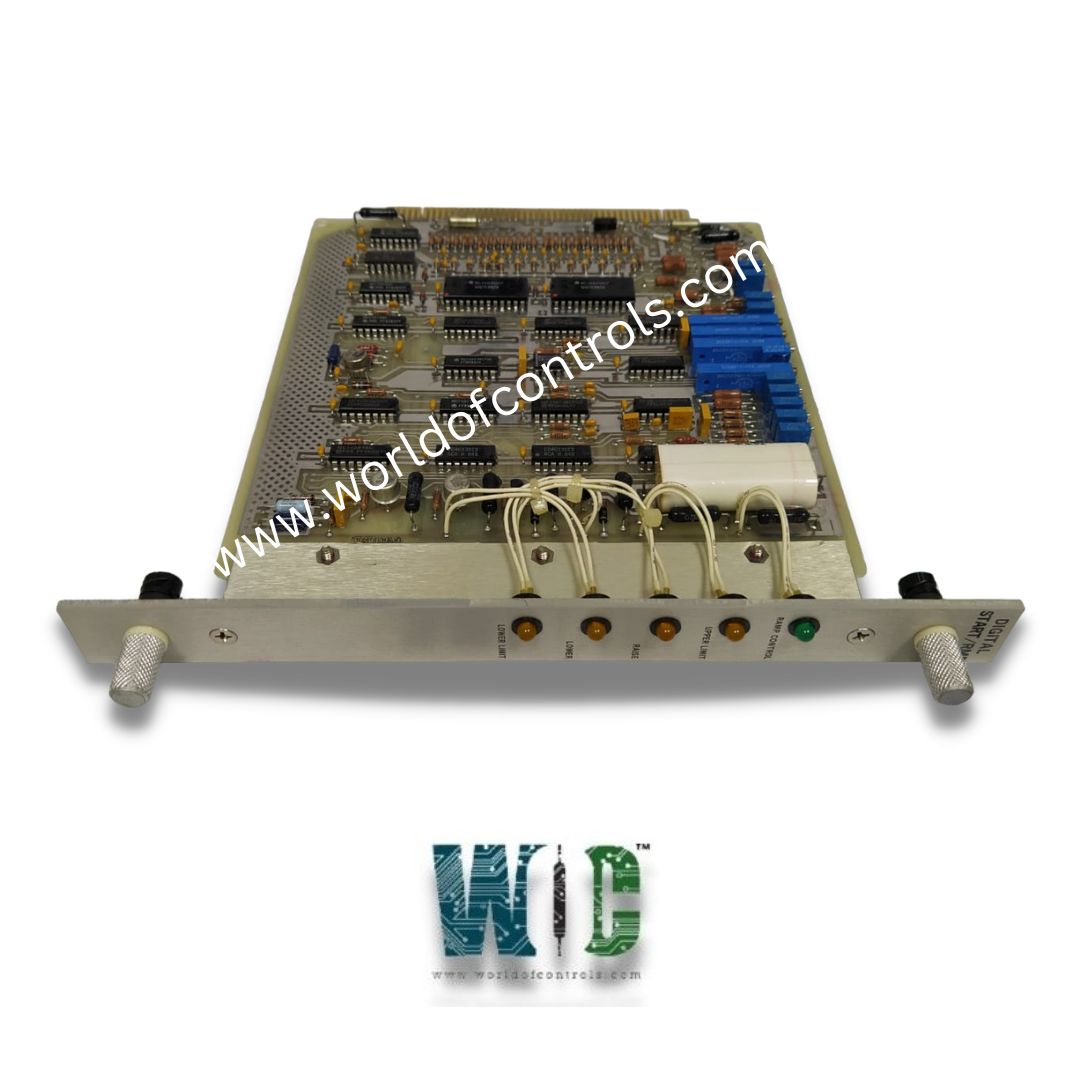
5463-330 - Digital Start / RMP Module is available in stock which ships the same day.
5463-330 - Digital Start / RMP Module comes in UNUSED as well as REBUILT condition.
To avail our best deals for 5463-330 - Digital Start / RMP Module, contact us and we will get back to you within 24 hours.
SPECIFICATIONS:
Part Number: 5463-330
Manufacturer: Woodward
Product Type: Digital Start / RMP Module
Input Signals: Multi-channel discrete
Input Voltage: 24 V DC
Output Signals: Discrete logic outputs
Input Isolation: High-integrity galvanic
Communication Interface: Backplane
Processing: Logic Embedded microprocessor
Fault Detection: Input integrity
ESD Immunity: IEC 61000
Redundancy Support: Dual-redundant logic
Operating Temperature: -20�C to +70�C
Repair: 3-7 Days
Availability: In Stock
Weight: 1.82 kg
Country of Origin: United States
FUNCTIONAL DESCRIPTION:
The Woodward 5463-330 Digital Start / RMP Module is a real-time, deterministic digital control unit designed for integration into distributed turbine and engine governor systems. It continuously samples and conditions multi-channel digital inputs and high-resolution RPM signals from magnetic pickups, proximity probes, or encoders, applying anti-aliasing, noise rejection, and scaling algorithms to ensure high-fidelity measurement of rotational speed. The embedded firmware executes microsecond-level logic cycles to evaluate start permissive conditions, interlock sequences, acceleration/deceleration ramps, and overspeed/underspeed trip thresholds. Fault detection routines monitor sensor integrity, signal anomalies, and communication health, providing redundant status flags for upstream CPUs or peripheral modules.
Processed RPM and start logic signals are transmitted over the backplane or high-speed serial network, enabling coordinated, system-wide start-up, load synchronization, and speed control across multiple governor modules. Discrete outputs are driven deterministically to actuators, enable chains, and trip logic circuits, with precise timing to enforce controlled machine start sequences and prevent mechanical stress or unsafe operation. The 5463-330 supports redundancy-aware logic execution, maintaining fail-safe operation under sensor, module, or communication faults.
SIGNAL PROCESSING AND LOGIC EXECUTION:
High-resolution RPM signals from magnetic pickups, proximity probes, or encoder outputs are sampled at microsecond intervals and passed through digital anti-aliasing filters, noise rejection algorithms, and scaling routines to ensure accurate rotational speed measurements. The module continuously evaluates start permissives, interlock conditions, and fault inputs using deterministic embedded logic executed within high-speed microprocessor cycles, ensuring minimal latency between input detection and output response.
Acceleration and deceleration ramps are managed through programmable logic tables, which calculate step-wise output signals to control actuator sequences and prevent mechanical stress during start-up or shutdown. The module monitors overspeed and underspeed conditions, comparing instantaneous RPM values to predefined thresholds, and generates protective trip signals or inhibit commands when deviations are detected.
REDUNDANCY AND FAIL-SAFE OPERATION:
Each digital input, including start permissives and RPM sensor channels, is continuously cross-monitored between primary and secondary processing paths, enabling immediate detection of signal degradation, open circuits, or anomalous sensor readings. When a fault is detected, the module�s embedded firmware isolates the affected channel and seamlessly transfers control to the redundant path, maintaining uninterrupted RPM monitoring and start permissive evaluation without introducing latency or timing jitter.
The module executes fail-safe interlock logic at microsecond-level intervals, evaluating inter-module handshakes, CPU acknowledgements, and input thresholds before asserting any enable outputs. Protective trips and inhibit outputs are hardwired into deterministic logic circuits, ensuring that in the event of a total module or sensor failure, the system transitions into a safe state by forcing actuator disablement, halting start sequences, or initiating controlled deceleration ramps.
WOC maintains the largest inventory of Woodward Turbine Control System replacement parts, offering both unused and professionally rebuilt components, each backed by a comprehensive warranty to ensure reliability and performance. In addition to supplying parts, we provide expert repair services for faulty boards and modules, restoring them to full OEM specifications so your turbine and automation systems operate smoothly and efficiently. Our highly skilled team of automation specialists is available 24/7 to provide technical support, troubleshoot complex issues, and assist with urgent or routine maintenance needs. Whether you require rare components, emergency repairs, or guidance on system upgrades, our dedicated professionals are ready to deliver fast, dependable, and knowledgeable service. Simply contact us via phone or email for pricing, availability, or expert advice.
What is the 5463-330?
It is a Woodward Digital Start / RMP Module designed for turbine and industrial engine governor systems. It provides deterministic start permissive logic, RPM monitoring, acceleration/deceleration ramp control, and interlock evaluation. Outputs are communicated to actuators and CPUs for fail-safe, coordinated operation in distributed control systems.
How does the module process RPM and input signals?
The module samples RPM signals at microsecond intervals, applying digital filtering and scaling. Embedded firmware executes deterministic logic cycles to evaluate start permissives, interlocks, acceleration/deceleration ramps, and overspeed/underspeed conditions. Outputs are transmitted with precise timing for actuator control and system coordination.
How does the module process high-resolution RPM signals from magnetic pickups and proximity probes?
RPM signals are sampled at microsecond intervals and processed by the module's embedded microprocessor. Signals undergo waveform validation, anti-aliasing, and noise rejection before being converted into engineering units. The processed RPM data is then used for start permissive evaluation, interlock logic, ramp calculations, and overspeed/underspeed trip detection.