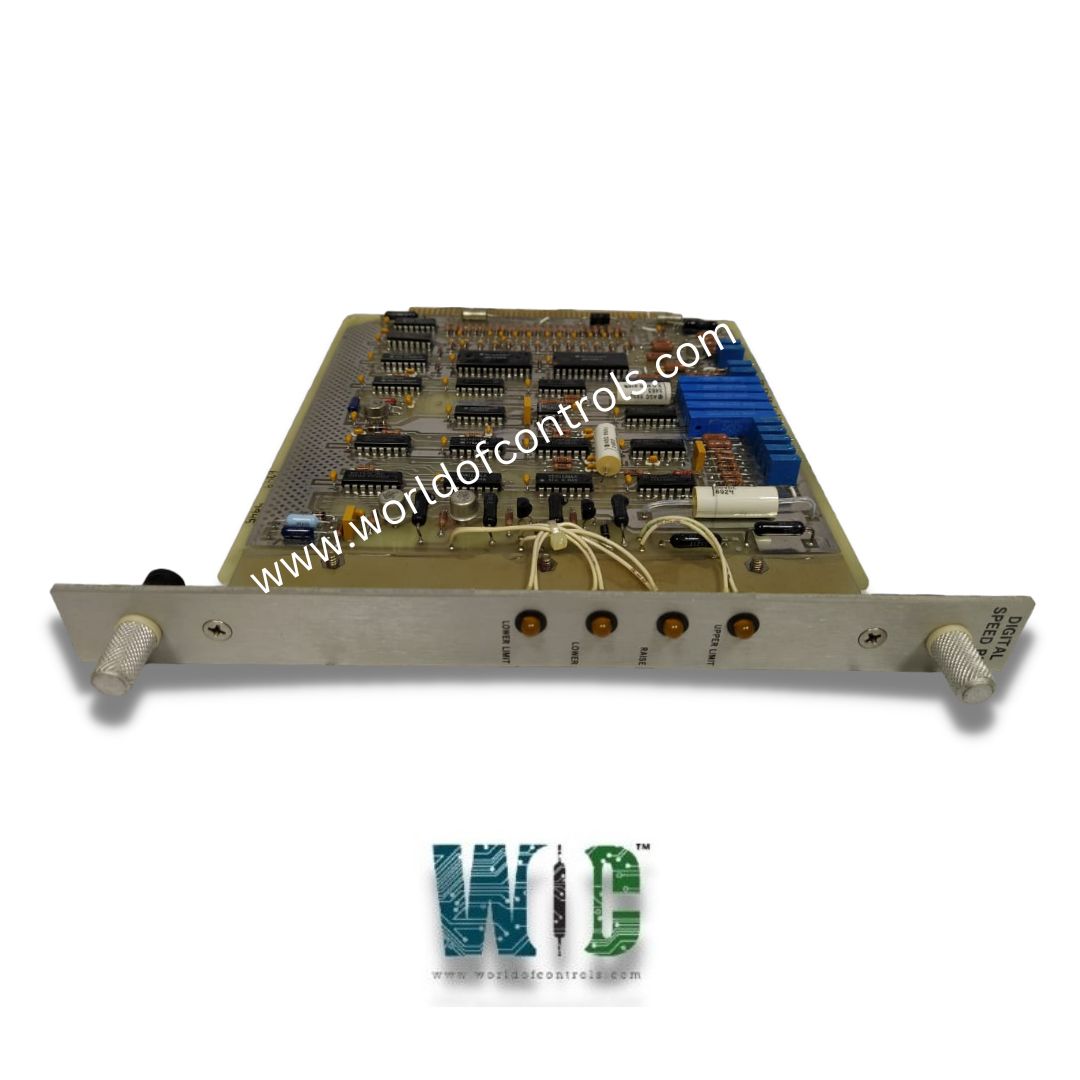
World Of Controls understands the criticality of your requirement and works towards reducing the lead time as much as possible.
5463-324 - Digital Speed Control Board is available in stock which ships the same day.
5463-324 - Digital Speed Control Board comes in UNUSED as well as REBUILT condition.
To avail our best deals for 5463-324 - Digital Speed Control Board, contact us and we will get back to you within 24 hours.
SPECIFICATIONS:
Part Number: 5463-324
Manufacturer: Woodward
Product Type: Digital Speed Control Board
Supply Voltage: 5 VDC
Power Consumption: 10�15 W
Outputs: Control signals to actuators
Communication Interface: DCS backplane
Communication Type: Deterministic
Input Signal Range: 0�5 VDC
Output Signal Range: 0�5 VDC
Electrical Isolation: High-level isolation between inputs
Mounting: Rack-mounted
Operating Temperature: -10�C to +50�C
Current Draw: 12 VDC at 650 mA
Repair: 3�7 Days
Availability: In Stock
Weight: 1.82 kg
Country of Origin: United States
The 5463-324 is a digital speed control module designed for Woodward turbine and engine governor systems, responsible for maintaining precise speed regulation under varying load conditions. It receives real-time speed feedback from sensors and compares it with the desired reference, using advanced digital control algorithms to generate accurate control outputs. This ensures stable operation, minimizes overshoot, and maintains optimal performance across all operating conditions.
The module communicates with other control system components via the DCS backplane or network interface, providing deterministic, low-latency data exchange. It also supports diagnostics and monitoring, allowing engineers to detect abnormal conditions, verify module health, and perform tuning. Built for industrial environments, the 5463-324 offers robust electrical isolation, EMI protection, and reliable performance in vibration-prone and electrically noisy applications, making it a critical component for overall system stability and turbine speed control.
COMMUNICATION & NETWORK INTERFACE
The module interfaces directly with the DCS II backplane or governor control network, providing high-speed, deterministic communication between CPUs, I/O modules, and supervisory systems. It supports real-time data exchange, ensuring that speed feedback, reference signals, and control outputs are transmitted with minimal latency to maintain precise turbine or engine speed regulation. The module is compatible with standard industrial protocols, including Modbus TCP for integration with SCADA or HMI systems, and allows configurable addressing for multi-subnet network architecture. Electrical isolation between communication lines and the system bus ensures reliable operation in electrically noisy industrial environments, while its high-speed processing enables synchronized, low-latency control across the entire network.
CONTROL ALGORITHMS
It employs advanced digital control algorithms to maintain precise turbine or engine speed under varying load conditions. It implements high-speed PID (Proportional-Integral-Derivative) and adaptive control routines, allowing rapid correction of speed deviations while minimizing overshoot and oscillations. The module also incorporates digital filtering and signal conditioning to eliminate noise from sensor inputs, ensuring accurate and stable control signals. These algorithms work in real time, providing deterministic, low-latency responses essential for maintaining system stability and coordinating with other control modules in the DCS network.
WHY BUY FROM WOC
World of Controls maintains the largest and most comprehensive inventory of Woodward Turbine Control System replacement parts, including unused, rebuilt, and refurbished modules, all supported by a reliable warranty to ensure optimal performance and longevity. In addition to supplying high-quality parts, our experienced engineers are equipped to repair and restore faulty boards, returning them to OEM specifications and minimizing operational downtime for turbines, engines, and industrial automation systems. Designed to support a wide range of control and monitoring applications, our solutions cover critical modules such as speed sensors, CPU boards, Ethernet switch modules, and final drivers. Our team is available 24/7 to provide expert guidance, technical support, and tailored recommendations for all your automation and OEM requirements. For inquiries about part availability, pricing, or repair services, our dedicated professionals are ready to assist via phone or email, providing fast, reliable, knowledgeable support to keep your systems running efficiently and safely.
What is the Woodward 5463-324?
It is a Digital Speed Control Board used in Woodward turbine and engine governor systems. It receives real-time speed feedback from sensors, compares it with a reference setpoint, and generates precise control outputs to actuators or fuel valves. The module implements high-speed digital control algorithms, including PID and adaptive routines, to maintain stable turbine or engine speed under varying load and transient conditions.
What is the primary function of the 5463-324?
The digital speed control module is designed to maintain precise turbine or engine speed. It receives real-time speed feedback and reference signals, computes control outputs using high-speed digital algorithms, and drives actuators or fuel valves. Its operation ensures low-latency, deterministic control critical for turbine stability. The module integrates seamlessly into DCS II and governor networks.
Which types of speed sensors are supported?
The module supports analog and digital speed sensors, including tachometers, proximity probes, and resolvers. It can process pulse, voltage, or current signals, with configurable input ranges such as 0-5 VDC or 4-20 mA. Signal conditioning ensures accurate readings under industrial noise conditions. Multiple sensors can be used redundantly for fault-tolerant operation.
What type of outputs does the module provide?
It generates analog or digital control outputs for actuators, fuel valves, or final control elements. Typical ranges include 0�5 VDC or 0�20 mA, and outputs are electrically isolated for reliability. Output signals are tightly coordinated with the control algorithm for precise speed regulation. Low-latency response ensures stability under varying load conditions.
How does it maintain deterministic performance?
The module uses high-speed digital processing and deterministic scheduling of input/output operations. It minimizes jitter and ensures microsecond-level timing precision for control loops. Network communication over the DCS backplane is synchronized to prevent timing conflicts. This guarantees stable speed control across CPUs, I/O modules, and actuators.