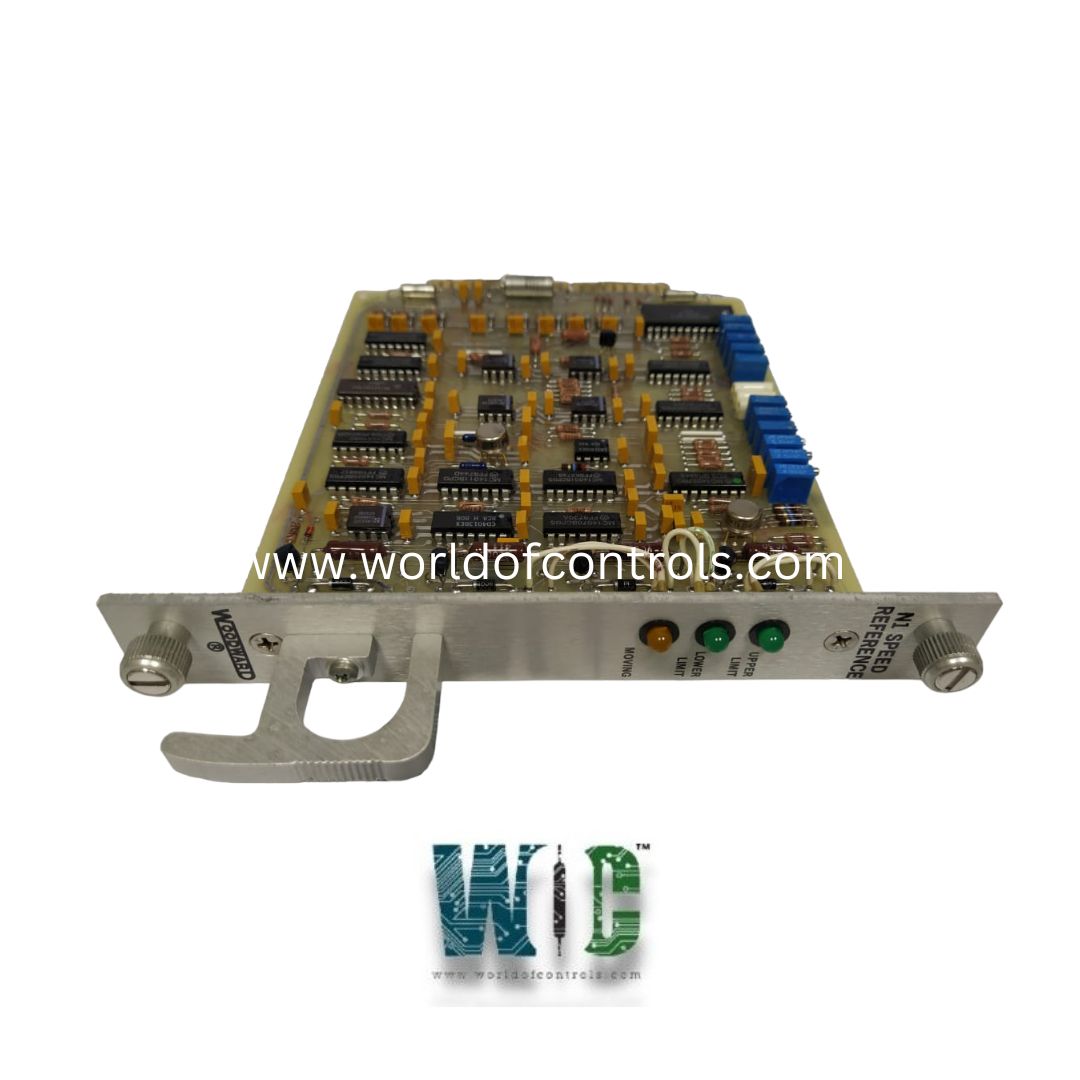
World Of Controls understands the criticality of your requirement and works towards reducing the lead time as much as possible.
5462-235 - N1 Speed Control Board is available in stock which ships the same day.
5462-235 - N1 Speed Control Board comes in UNUSED as well as REBUILT condition.
To avail our best deals for 5462-235 - N1 Speed Control Board, contact us and we will get back to you within 24 hours.
URL: https://www.worldofcontrols.com/5462-235 META TITLE Woodward 5462-235 - Buy, Repair, and Exchange From WOC META DESCRIPTION 5462-235 - N1 Speed Control Board available in UNUSED and REBUILT conditions. Request a Quote For 5462-235 Now!
TECHNICAL SPECIFICATIONS:
Part Number: 5462-235
Manufacturer: Woodward
Series: Legacy Turbine Control Systems
Product Type: N1 Speed Control Card / Board
Input Voltage: 24 VDC Nominal
Control Algorithm: Proportional-Integral-Derivative (PID) Speed Loop
Display Interface: Dedicated Multi-Character Front Panel Status Array
Safety Integration: Hardwired Emergency Stop Interface
Repair Time: 3-7 Days
Availability: In Stock / Worldwide Shipping
The 5462-235 is an N1 Speed Control Card designed and manufactured by Woodward to manage prime mover mechanics in legacy turbine control configurations. The board specializes in monitoring and regulating the primary spool or shaft speed, acting as a hardware-driven governor feedback loop. It processes real-time tachometer inputs from passive or active sensors and translates frequency variations into instantaneous fuel or steam demand corrections to maintain tight speed regulation under dynamic load shifts.
FREQUENCY SENSING & SIGNAL CONDITIONING
The raw signal generated by the turbine's speed sensor enters the card's front-end interface, where it is routed through an onboard analog conditioning matrix. This circuit uses adaptive threshold filtering to eliminate high-amplitude mechanical chatter and electrical background noise. Once cleaned, the sinusoids are squared into discrete logic pulses and passed to high-accuracy frequency-to-voltage converters or internal calculation registers, providing a real-time speed baseline.
DETERMINISTIC PID LOGIC & VALVE DRIVE DERIVATION
To eliminate steady-state tracking errors, the 5462-235 utilizes an optimized Proportional-Integral-Derivative (PID) processing loop. The card calculates the variance between the setpoint target and the actual $N_1$ feedback string, feeding the discrepancy into the tuning network. The output shifts dynamically, deriving a corrected control command that interfaces with external driver stages or proportional actuators to adjust valve positioning smoothly without inducing engine surge profiles.
WHY BUY FROM WOC
World of Controls specializes in critical parts lifecycle extension for legacy and obsolete Woodward governor assemblies. Every 5462-235 undergoes rigorous loop frequency simulation sweeps, thermal stability screening under heavy operational criteria, and full structural validation on dedicated hardware test fixtures. We maintain active inventory reserves to mitigate system downtime, backed by global express shipping and comprehensive warranties.
What is Woodward 5462-235?
The 5462-235 is a dedicated N1 Speed Control Card engineered by Woodward for legacy turbine regulation applications. It monitors primary spool velocity ($N_1$), running high-stability PID speed loops to modulate actuator positioning and prevent machine overspeed or underspeed instabilities.
What causes a solid red front panel FAULT LED on this control card?
A solid red FAULT LED indicates a hardware initialization failure or an active internal rail voltage drop. This condition typically occurs if the onboard logic checks fail during power-up or if the PID circuit detects an internal component breakdown.
What happens if the external emergency stop loop wired to the board goes open-circuit?
The card incorporates an overriding safety trip interlock. If the hardwired emergency stop circuit opens, the internal execution paths instantly drop current drive signals to zero, executing a rapid, fail-safe actuator shutdown to isolate the fuel or steam supply.
Why is shielding grounding critical for the input lines of the 5462-235 card?
Because speed monitoring relies on low-voltage AC pulses from a magnetic pickup, long unshielded lines easily pick up electromagnetic interference (EMI) from adjacent power cables. This noise can mimic actual speed pulses, confusing the card's wave-conditioning stages and causing erratic fuel hunting or false overspeed trips.