World Of Controls understands the criticality of your requirement and works towards reducing the lead time as much as possible.
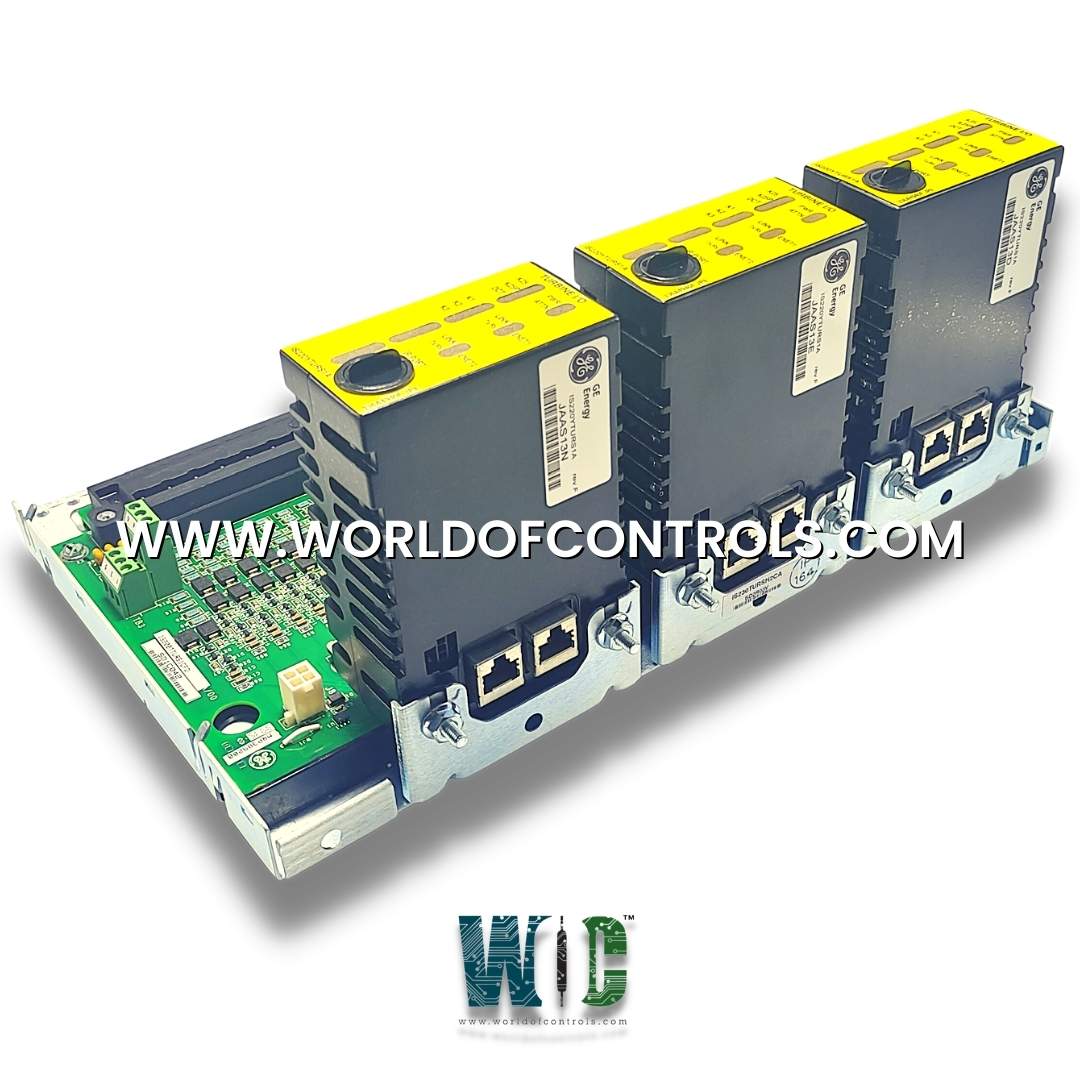
IS230TURSH2C - Turbine Specific Primary Trip Terminal Board is available in stock which ships the same day.
IS230TURSH2C - Turbine Specific Primary Trip Terminal Board comes in UNUSED as well as REBUILT condition.
To avail our best deals for IS230TURSH2C - Turbine Specific Primary Trip Terminal Board, contact us and we will get back to you within 24 hours.
TECHNICAL SPECIFICATIONS:
Part Number: IS230TURSH2C
Manufacturer: General Electric
Series: Mark VIe Speedtronic
Functional Designation: Turbine Specific Primary Trip Terminal Board (TURS)
Redundancy Compatibility: Simplex, Dual, and TMR (Triple Modular Redundant)
Passive Speed Inputs: 9 Magnetic Pickup (MPU) Channels
Active Speed Inputs: 3 Pulse Accumulator Channels
Primary Trip Outputs: 3 Solenoid Drive Circuits (2oo3 Voting)
Solenoid Current Rating: 4.0 A (Maximum Inrush per channel)
Speed Frequency Range: 2 Hz to 20,000 Hz
Input Filter Constant: 1 ms (Hardware-based attenuation)
Interface Topology: 37-Pin D-Subminiature Connectors (JR1, JS1, JT1)
Mounting Configuration: Base Mount or DIN-rail
Operating Temperature: -30 to 65 Degrees Celsius
Dimensions: 23.8 cm high x 17.8 cm wide
Availability: In Stock
FUNCTIONAL DESCRIPTION:
The IS230TURSH2C is a critical Turbine Specific Primary Trip Terminal Board within the Mark VIe control framework. It functions as the primary hardware interface for speed sensing and emergency trip actuation. The module is vital for turbine overspeed protection, providing high-integrity signal acquisition and deterministic execution of trip commands for heavy-duty gas and steam turbines.
MULTIVARIATE SPEED SENSING ARCHITECTURE
The TURS board accommodates a high density of speed sensors to ensure continuous monitoring under all operational states. It supports 9 passive magnetic pickup (MPU) inputs and 3 active pulse inputs. This configuration allows for independent speed measurement by the R, S, and T controllers in a TMR system. The board utilizes high-resolution frequency-to-digital conversion to provide precise RPM telemetry, which is essential for governing and overspeed logic.
PRIMARY TRIP SOLENOID ACTUATION
A primary function of the IS230TURSH2C is managing the turbine�s emergency trip fluid system. It drives 3 primary trip solenoids (ETM). In a TMR configuration, the solenoid drive signals from the three independent I/O packs are voted on the terminal board using a hardware-level 2-out-of-three voting mechanism. This ensures that a single component failure cannot cause a nuisance trip, nor can it prevent a legitimate emergency shutdown.
DETERMINISTIC OVERSPEED PROTECTION
The H2C variant is optimized for high-speed protective loops. It processes hardware-based overspeed detection independently of the main controller application code. This provides a sub-millisecond response time to overspeed conditions, triggering the trip solenoids before mechanical limits are exceeded. The board also supports the online testing of trip solenoids and speed sensors without necessitating a turbine shutdown.
GALVANIC ISOLATION AND NOISE ATTENUATION
To maintain signal purity across long cable runs from the turbine pedestal, the IS230TURSH2C incorporates comprehensive shielding and galvanic isolation. Every speed input channel is fortified with filtering circuitry to suppress electromagnetic interference (EMI) and high-frequency harmonics. This ensures that electrical noise from high-voltage equipment does not induce parasitic pulses that could compromise speed accuracy.
RUGGED TERMINATION INTERFACE
The board features high-density barrier-type terminal blocks for secure field wiring. Its compact design is tailored for mounting within the Mark VIe control cabinet, utilizing the JR1, JS1, and JT1 connectors to interface with the PTUR I/O packs. The physical layout is built to withstand the high vibration and thermal cycling inherent in power plant environments.
WHY BUY FROM WOC:
World of Controls is a specialized global authority in the lifecycle extension of GE Mark VIe ecosystems, providing the IS230TURSH2C in both UNUSED and REBUILT conditions to eliminate operational latency. Our quality-assurance protocol involves frequency-response calibration, solenoid driver load testing, and automated point-to-point continuity mapping. By partnering with WOC, you secure hardware for peak deterministic performance, reinforced by 24/7 technical consultation and accelerated global logistics.
What is the IS230TURSH2C?
It is a Turbine Primary Trip Terminal Board used in GE Mark VIe systems. It manages speed sensor inputs (MPU and active) and controls the emergency trip solenoids with hardware-level voting logic.
Does the TURS board support Triple Modular Redundancy?
Yes, the Primary Trip Terminal Board is for TMR systems, fanning out sensor signals to the R, S, and T I/O packs and voting the resulting trip commands across three redundant solenoids.
What is the difference between the passive and active speed inputs?
Passive inputs (MPU) generate voltage from the motion of the turbine gear, while active inputs require an external power supply to transmit pulse signals.
Can I test the trip solenoids while the turbine is running?
Yes, the TURS board supports individual solenoid testing. Because of the 2oo3 voting logic, a single solenoid can be de-energized for testing purposes without triggering a full turbine trip.