World Of Controls understands the criticality of your requirement and works towards reducing the lead time as much as possible.
IS230TEGSH2B - Simplex Turbine Emergency Trip Terminal Board is available in stock which ships the same day.
IS230TEGSH2B - Simplex Turbine Emergency Trip Terminal Board comes in UNUSED as well as REBUILT condition.
To avail our best deals for IS230TEGSH2B - Simplex Turbine Emergency Trip Terminal Board, contact us and we will get back to you within 24 hours.
TECHNICAL SPECIFICATIONS:
Part Number: IS230TEGSH2B
Manufacturer: General Electric
Series: Mark VIe
Functional Acronym: TEGS
Product Type: Turbine Emergency Trip Terminal Board
Hardware Revision: Group 2 Architecture, REV B (H2B)
Redundancy Configuration: Simplex (S-Type Interface)
I/O Pack Interface: One DC-62 pin connector matching a single primary protection or trip pack (e.g., PPRO)
Trip Control Loops: Controls primary positive-side emergency trip string solenoids
Circuit Board Protection: High-grade Conformal PCB Coating
Mounting Technology: DIN-rail surface mount module
Ambient Operating Temperature: -30°C to +65°C
Repair Lead Time: 3-5 Business Days
Availability: In Stock
Country of Origin: United States
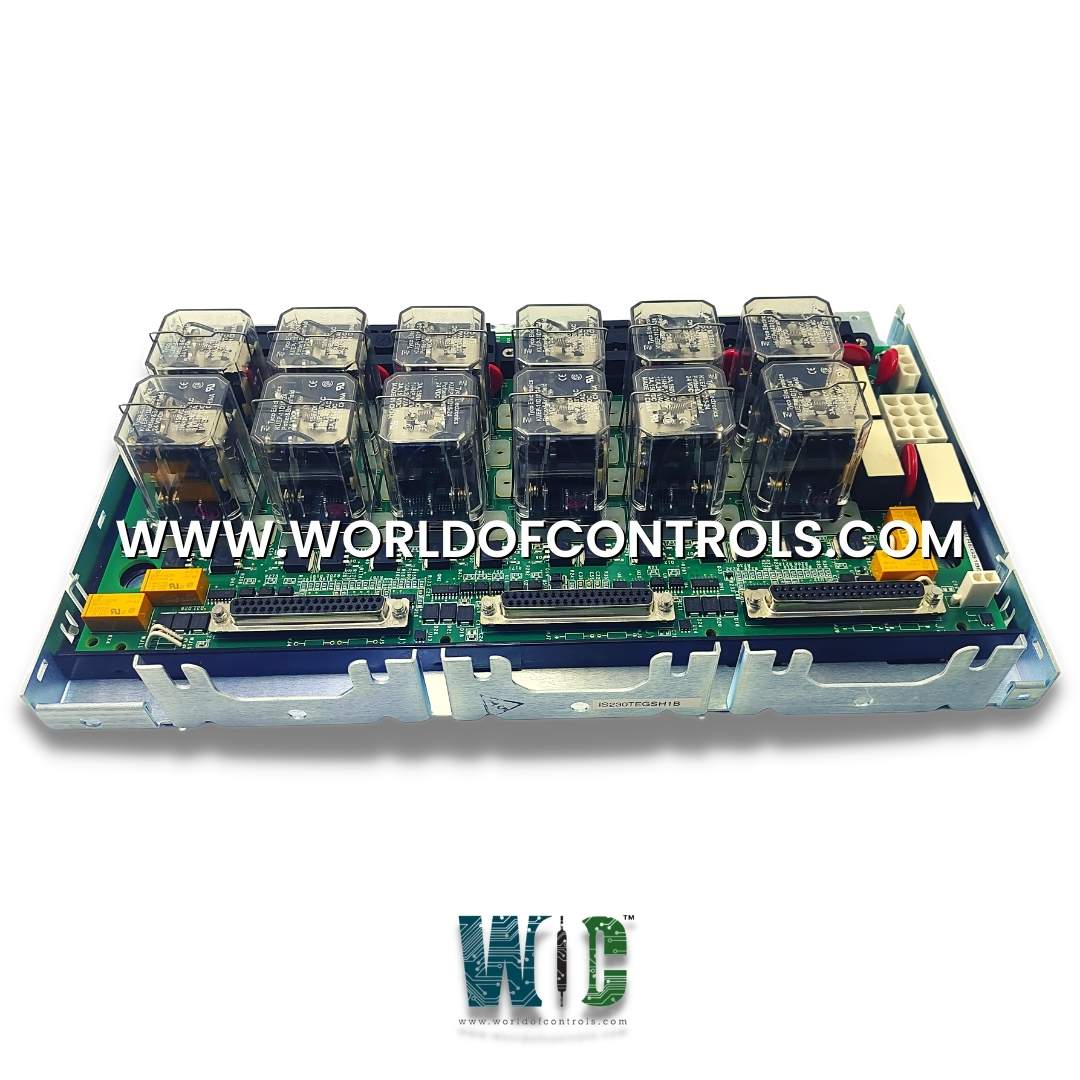
The IS230TEGSH2B is a Turbine Emergency Trip Terminal Board designed and manufactured by General Electric as part of the specialized Mark VIe control systems. Operating as a single-channel, DIN-rail-mounted module, this board serves as a core hardware component in the system’s primary safety layer. It acts as the physical landing point for emergency trip string components, interfacing protective relays directly with the system's processing cores to execute sudden fuel shutdowns during fatal system disruptions.
EMERGENCY TRIP STRING MATRIX
The primary circuit layer is structured to control and route the positive side of DC power distribution loops running to the primary steam or gas turbine trip solenoids. The board functions in structural synchronization with corresponding negative-side termination modules (such as the TRPG or paired safety cards). By coordinating high-speed switching across its on-board voting and economizing relay paths, the module ensures power to the main fuel trip valves drops instantaneously when a critical fault condition trips the loop safety monitors.
INTEGRATED HARDWIRED RECOGNITION & VOTING RELAYS
To satisfy the stringent safety-integrity demands of power generation facilities without compromising operational uptime, the assembly relies on a complex matrix of hardwired electromechanical interlocking relays.
COMPACT SIMPLEX TOPOLOGY & CONTROLLER ECOSYSTEM
The board features a single high-density DC-62 pin connector structured to receive a single localized processing core, typically a PPRO (Primary Protection) Input/Output pack.
Simplex Architecture: As a Simplex (S-Type) module, it routes all 24 field inputs and associated output lines into a singular processing channel. This makes it an ideal fit for non-redundant auxiliary sub-systems, mechanical drive control loops, or industrial process turbine networks where panel footprint optimization and hardware cost reduction are high priorities.
ToolboxST System Integration: The logic configuration, relay mapping, and sequence-of-events tracking are executed seamlessly within the unified GE ToolboxST software platform.
AUTOMATED ADVANCED DIAGNOSTICS & SCREENING
The circuit board layout incorporates a dedicated layer of passive and active voltage-sensing diagnostic sub-circuits that work in parallel with the main safety logic.
SYSTEM COATING & DIAGNOSTIC SCREENING
The module ensures high physical reliability inside unconditioned industrial control cabinets through deep diagnostic integration and rugged design standards. The entire printed circuit layout is insulated with a premium conformal PCB coating that prevents trace failures caused by moisture condensation, metallic dust accumulation, and localized chemical exposure. Built-in feedback diagnostics continually verify relay state configurations and contact health, routing real-time line-drop and circuit anomalies to the ToolboxST application interface.
WHY PARTNER WITH WORLD OF CONTROLS
World of Controls provides the industry's most dependable logistics and technical infrastructure for critical turbine control networks. We maintain an extensive inventory of genuine OEM replacement parts for GE Distributed control setups, minimizing operational downtime during emergency outages. Every item, from certified unused surplus to fully rebuilt industrial components, is subjected to strict simulation profiling in our advanced electronics lab and is supplied with a comprehensive product warranty. Our global engineering support network operates 24/7 to deliver troubleshooting advice, component replacement guidance, and component testing evaluations. Contact the WOC sales team directly via phone or email for current pricing, hardware availability, or repair quotes.
What is the GE IS230TEGSH2B?
It is a Simplex Turbine Emergency Trip Terminal Board designed for the Mark VIe control platform. It serves as a compact, DIN-rail-mounted interface that intercepts primary safety metrics and manages the positive-side DC voltage lines driving critical emergency trip solenoids.
What is the primary operational function of the GE Simplex Turbine Emergency Trip Terminal Board?
The board serves as a hardwired execution point for turbine emergency stop commands. It routes positive control voltage across localized safety relays to fuel stop solenoids; when overspeed, fire, or mechanical fault trips are triggered, it breaks the circuit instantly to close the fuel valves and drop the turbine.
Why are multi-relay matrix clusters integrated into the emergency trip architecture?
Multi-relay clusters are integrated to create secure, hardwired hardware voting paths across the safety loops. This internal design ensures that actual emergency tripping commands trigger an immediate response, while single bad sensor inputs or localized cable faults cannot cause a costly accidental plant trip.
How to diagnose an electrical fault or a relay coil drop on this terminal board?
The module relies on real-time diagnostic logic synced with the primary protection I/O pack. The onboard circuits continuously read line voltages and contact states, immediately flagging line breaks, short circuits, or stuck relay contacts as system alarms inside the ToolboxST software interface.
What are the differences between the Simplex TEGS and TMR-type emergency trip boards?
The TEGS board utilizes a Simplex configuration mated to a single I/O processing channel, making it ideal for non-redundant auxiliary protection layouts or standard mechanical drives. In contrast, TMR-style trip boards (like the TREG or TRPG series) host parallel multi-channel cabling arrays to hook up three separate processing packs for triple-redundant voter protection.