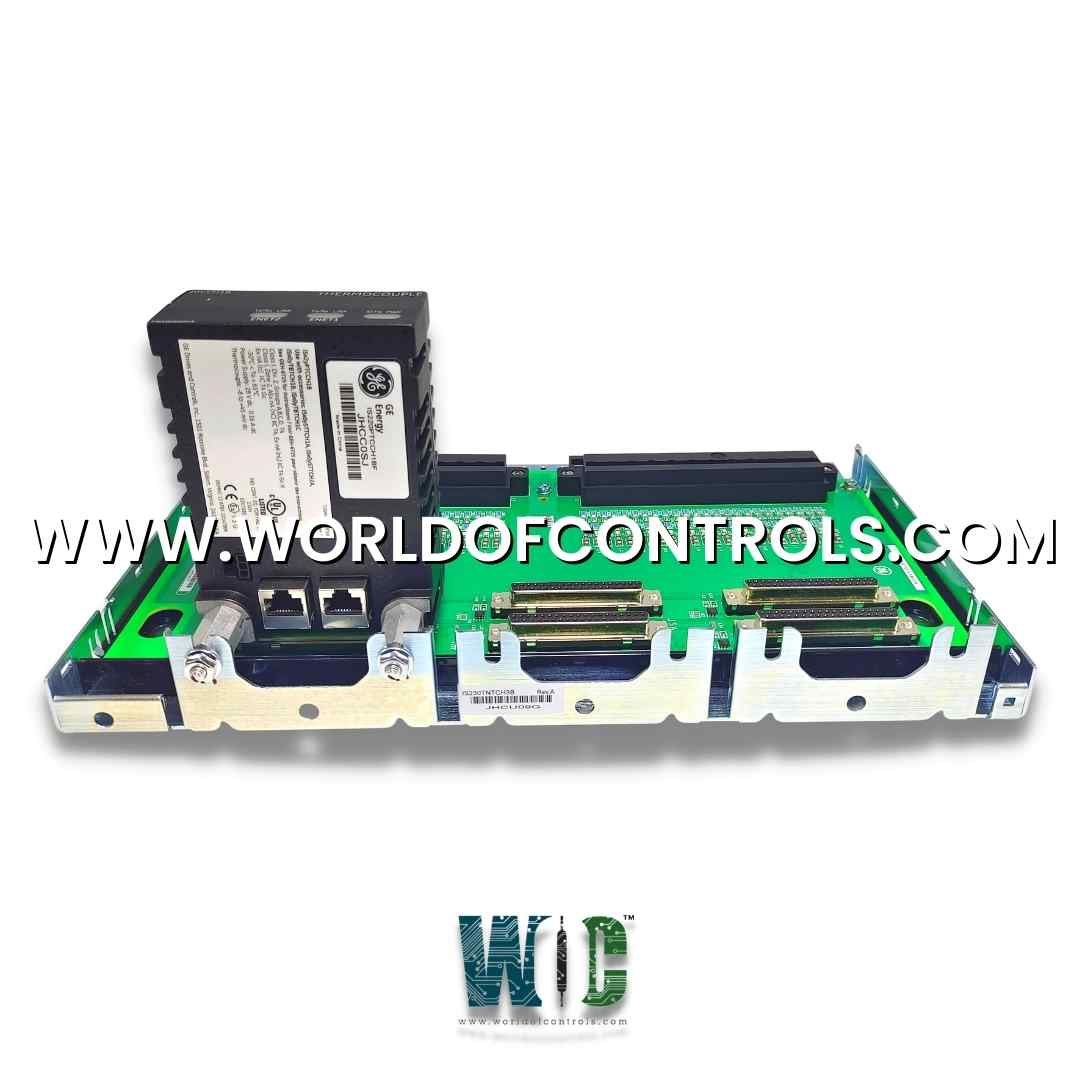
World Of Controls understands the criticality of your requirement and works towards reducing the lead time as much as possible.
IS230TBTCH3B - Simplex Thermocouple Input Assembly Module is available in stock which ships the same day.
IS230TBTCH3B - Simplex Thermocouple Input Assembly Module comes in UNUSED as well as REBUILT condition.
To avail our best deals for IS230TBTCH3B - Simplex Thermocouple Input Assembly Module, contact us and we will get back to you within 24 hours.
TECHNICAL SPECIFICATIONS
Part Number: IS230TBTCH3B
Manufacturer: General Electric (GE)
Series: Mark VIe
Functional Acronym: TBTC
Number of channels: 24 channels
Thermocouple types: E, J, K, S, T
Product Type: Simplex Thermocouple Input Assembly Module
Base Board Component: TBTCH1B Terminal Board
I/O Pack Interface: Equipped with one PTCC I/O pack
Redundancy Configuration: Simplex
Thermocouple Channels: Supports up to 24 channels
Compatible Thermocouple Types: J, K, T, E, N, R, S, and B
Cold Junction Compensation: Onboard cold junction reference tracking
Input Isolation Protection: High-level galvanic isolation channels
Form Factor / Mounting: DIN-rail mount module base block
Circuit Board Protection: High-grade Conformal PCB Coating
Ambient Operating Temperature: -30°C to +65°C- 22°F to +149° F
Relative Humidity Boundaries: 5% to 95% continuous profile, non-condensing
Repair Lead Time: 3-5 Business Days
Availability: In Stock
Country of Origin: United States
Manual: GEH-6721D
The IS230TBTCH3B is a Simplex Thermocouple Input Assembly Module designed and manufactured by General Electric for the high-performance Mark VIe Distributed Turbine Control System platform. The thermocouple terminal board TBTC accepts 24 type E, J, K, S, or T thermocouple inputs. These inputs are wired to two barrier-type blocks on the terminal board, and communication with the I/O processor is established through DC-type connectors. There are two types of terminal boards: TBTCHIC, which is used for simplex applications and has two DC-type connectors, and TBTCHIB, which is designed for TMR applications and has six DC-type connectors.
The VTCC processor works with the TBTC board, supporting both simplex and TMR configurations. A single TBTCHIC can be connected to the VTCC using two cables, while in TMR systems, the TBTCHIB connects to three VTCC boards using six cables. In Mark VIe systems, the PTCC I/O pack interfaces with the TBTC board and supports simplex, dual, and TMR configurations. In simplex mode, two PTCC packs plug into the TBTCHIC for a total of 24 inputs, whereas the TBTCHIB allows one to three PTCC packs to be connected, supporting various configurations with up to 12 available inputs.
INSTALLATION:
Thermocouples are wired directly to two I/O terminal blocks. These removable blocks are mounted on the terminal board and held down with two screws. Each block has 24 terminals accepting up to #12 AWG wires. A shield terminal strip attached to chassis ground is located on the left side of each terminal block. Mark VI systems are cabled from the board J-type connectors to the I/O processors in the VME rack. Mark VIe systems have I/O packs that plug into the board J-type connectors. The number of cables or I/O packs depends on the level of redundancy required.
OPERATION:
The 24 thermocouple inputs can be grounded or ungrounded. They can be located up to 300 m (984 ft) from the turbine control panel with a maximum two-way cable resistance of 450. High-frequency noise suppression and two cold junction reference devices are mounted on TBTC, as shown in the following figure. The analog- to-digital conversion is in the I/O processor, and the linearization for individual thermocouple types. In simplex systems using TBTCH1C, one VTCC is used in Mark VI systems. The Mark VIe system has two PTCC packs plugged onto the TBTC terminal board, obtaining 24 thermocouple inputs. For TMR systems using TBTCH1B, the thermocouple signals fan out to three J-connectors that either cable to, or connect to, the I/O processors. The Mark VI system accommodates 24 inputs; the Mark VIe system accommodates 12 inputs.
THERMOCOUPLE INPUTS:
Thermocouple inputs support a full-scale input range of -8.0 mV to + 45.0 mV. The following table shows typical input voltages for different thermocouple types versus the minimum and maximum temperature range. The CJ signals go into signal space and are available for monitoring. Normally, the average of the two is used. Acceptable limits are configured, and if a CJ goes outside the limit, a logic signal is set. A 1 °F error in the CJ compensation will cause a 1°F error in the thermocouple reading.
WHY PARTNER WITH WORLD OF CONTROLS
World of Controls specializes in supplying high-quality, warranty-backed OEM replacement parts, including unused surplus and professionally rebuilt components, for critical turbine control and industrial automation systems like the General Electric Mark VIe platform. To minimize customer downtime and ensure original equipment standard compliance, every component undergoes rigorous inspection, testing, and verification in an advanced electronics lab. Beyond parts distribution, the company delivers comprehensive, global support through 24/7 technical assistance, expert troubleshooting, component repair services, and rapid shipping, ensuring optimal efficiency and long-term reliability for critical industrial operations worldwide.
What is GE IS230TBTCH3B?
It is a GE Mark VIe Series thermocouple input assembly used for acquiring and conditioning multiple temperature signals from field thermocouples. It supports up to 24 input channels and is designed for turbine control and industrial monitoring applications. The module interfaces with the Mark VIe system through an I/O pack for signal processing. It is commonly used where accurate multi-point temperature measurement is required.
What signal range does it support?
The module handles low-level thermocouple millivolt signals typically ranging from about -8.0 mV to +45.0 mV, depending on sensor type. These signals represent temperature variations from connected field thermocouples. The range ensures compatibility with multiple industrial thermocouple types. Proper scaling and conversion are handled downstream in the I/O pack.
How is signal conversion handled?
Signal conversion from analog thermocouple inputs to digital data is performed in the PTCC I/O pack, not on the terminal board itself. The I/O pack processes raw millivolt signals and applies linearization based on thermocouple type. It also ensures accurate temperature translation before sending data to the controller. This architecture improves modularity and processing accuracy.
What is the function of the PTCC I/O pack in this setup?
The PTCC I/O pack receives inputs from the terminal assembly and performs signal conditioning, analog-to-digital conversion, and data communication. It also manages thermocouple linearization and calibration adjustments. The processed temperature data is then transmitted to the Mark VIe controller. This ensures accurate and stable temperature monitoring across all channels.
How is cold junction compensation implemented?
Cold junction compensation is achieved using onboard reference sensors mounted on the terminal assembly. These sensors measure ambient terminal temperature and correct thermocouple readings accordingly. The system typically uses averaged readings from dual CJ sensors for stability. This helps maintain measurement accuracy under varying environmental conditions.
What level of electrical isolation is provided?
Each thermocouple input channel is designed with galvanic isolation to protect against electrical noise and ground loop interference. This isolation helps maintain signal integrity in high-noise turbine environments. It also safeguards downstream electronics from transient voltage spikes. The design improves long-term reliability in industrial installations.