World Of Controls understands the criticality of your requirement and works towards reducing the lead time as much as possible.
IS230SNTRH4A - Turbine Protection Simplex DIN-Rail Module is available in stock which ships the same day.
IS230SNTRH4A - Turbine Protection Simplex DIN-Rail Module comes in UNUSED as well as REBUILT condition.
To avail our best deals for IS230SNTRH4A - Turbine Protection Simplex DIN-Rail Module, contact us and we will get back to you within 24 hours.
TECHNICAL SPECIFICATIONS
Part Number: IS230SNTRH4A
Manufacturer: General Electric
Series: Mark VIe
Functional Acronym: SNTR
Product Type: Primary Turbine Protection DIN-Rail Module
Hardware Revision: REV A
Redundancy Configuration: Simplex (S-Type)
I/O Pack Interface: One DC-62 pin connector matching a single PTURH1B pack
Mounting Technology: DIN-rail mount module
Circuit Board Protection: High-grade Conformal PCB Coating
Ambient Operating Temperature: -30°C to +65°C
Repair Lead Time: 3-5 Business Days
Availability: In Stock
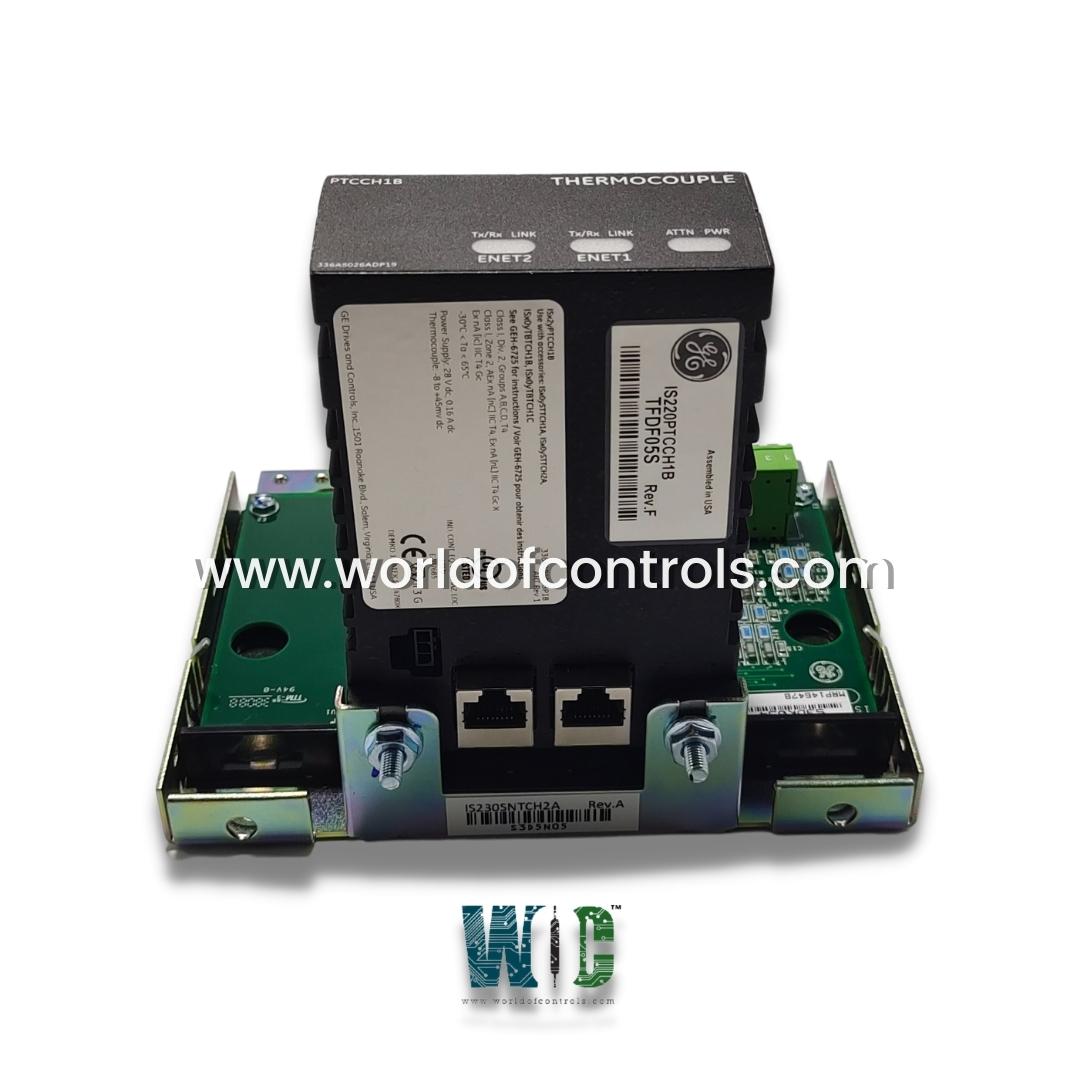
The IS230SNTRH4A is a Simplex Primary Turbine Protection Terminal Module designed and manufactured by General Electric for the Speedtronic Mark VIe control infrastructure. Operating as a single-channel, DIN-rail-mounted interface, this specialized card consolidates critical turbine protection signals and directly hosts a single PTURH1B Primary Turbine Protection I/O pack via a DC-62 pin connector. The modular form factor acts as a highly specialized interface, optimizing safety panel footprints while ensuring fast, deterministic monitoring of overspeed protection and auxiliary synchronization loops.
TURBINE FREQUENCY SCANNING & OVERSPEED PROTECTION
The board architecture is structurally optimized to capture and process raw speed waveforms from turbine shafts. It intercepts pulse-rate signals generated by active proximity probes or passive magnetic pickups (MPUs) reading a rotating toothed wheel. The hardware layer processes these raw alternating-current inputs, utilizing high-impedance filtering to clean signal noise and ensure precise zero-crossing detection. This accurate data stream is instantly channeled to the attached PTUR pack to provide immediate primary overspeed protection responses.
SYNCHRONIZATION AND VOLTAGE INTERFACING
Beyond rotational tracking, the module features specialized input pathways to coordinate automated generator-to-grid synchronization. It safely interfaces with Potential Transformers (PTs) to track phase, frequency, and wave amplitude parameters across the running electrical bus and the generator terminals. Built-in galvanic isolation transformers protect the logic circuits from common-mode electrical transients, allowing the Mark VIe synchronization algorithm to safely command main breaker closures without system risk.
HARDWARE INTEGRITY & DIAGNOSTICS
The assembly ensures sustained structural reliability in harsh industrial enclosures via integrated microcode linkages and rugged components. The entire board assembly is treated with a premium conformal coating to insulate surface traces against dust, corrosive gases, and humidity. Continuous monitoring logic scans field inputs for open-loop wire breaks or line drops, routing diagnostic alerts immediately to the ToolboxST software interface so maintenance personnel can act swiftly.
WHY PARTNER WITH WORLD OF CONTROLS
World of Controls provides the industry's most dependable logistics and technical infrastructure for critical turbine control networks. We maintain an extensive inventory of genuine OEM replacement parts for GE Distributed control setups, minimizing operational downtime during emergency outages. Every item, from certified unused surplus to fully rebuilt industrial components, is subjected to strict simulation profiling in our advanced electronics lab and is supplied with a comprehensive product warranty. Our global engineering support network operates 24/7 to deliver troubleshooting advice, component replacement guidance, and component testing evaluations. Contact the WOC sales team directly via phone or email for current pricing, hardware availability, or repair quotes.
What is the GE IS230SNTRH4A?
The GE IS230SNTRH4A is a Simplex Primary Turbine Protection Terminal Board designed for the Mark VIe control ecosystem. It serves as a DIN-rail-mounted physical interface that interfaces turbine speed pickups and synchronization loops with a single PTURH1B I/O pack.
What is the primary role of the SNTR card in turbine protection?
The card captures critical sensor waveforms, including mechanical overspeed data from magnetic pickups and electrical phase data from generator potential transformers. It conditions these raw AC waveforms and routes them directly to the PTUR processing pack for real-time safety monitoring and automatic emergency trip handling.
What specific processing pack mounts onto the IS230SNTRH4A?
This variant features a dedicated DC-62 pin connector structured to receive and interface with a single PTURH1B Primary Turbine Protection I/O pack.
How does the board handle speed tracking and noise reduction?
The board includes high-impedance onboard filtering networks that suppress physical line noise and contact bounce from active or passive shaft sensors. This guarantees clean zero-crossing detection parameters across variable gear tooth sizes, distinguishing true zero rotor RPM from an open line break.
Why does the board utilize a Simplex configuration instead of TMR?
The Simplex layout uses a single interface pack and communication channel, making it ideal for mechanical drives or auxiliary turbine applications where primary synchronization or overspeed safety features are required without the added space and cost of a full triple-redundant architecture.
How are faults and circuit line status monitored on this module?
Circuit parameters and loop safety characteristics are continually evaluated via automatic checks. Any detected failures, line drops, or open field conductors are immediately flagged and logged as system alarms within the ToolboxST configuration platform.