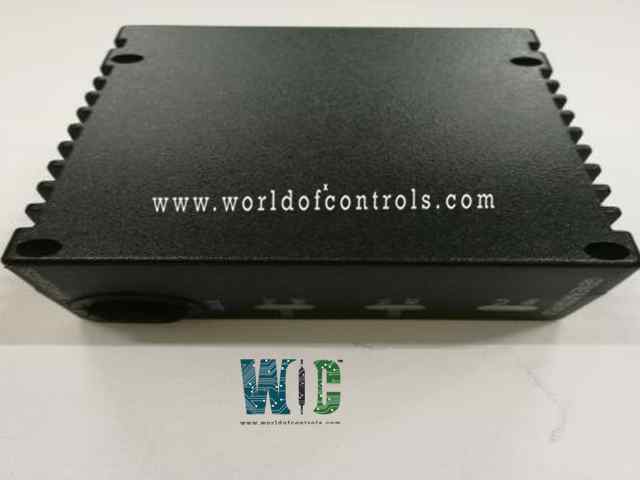
World Of Controls understands the criticality of your requirement and works towards reducing the lead time as much as possible.
IS220PGENH1A - Power Generation I/O Module is available in stock which ships the same day.
IS220PGENH1A - Power Generation I/O Module comes in UNUSED as well as REBUILT condition.
To avail our best deals for IS220PGENH1A - Power Generation I/O Module, contact us and we will get back to you within 24 hours.
SPECIFICATIONS:
Part Number: IS220PGENH1A
Manufacturer: General Electric (GE)
Series: Mark VIe
Product Type: Turbine Specific Power Generation I/O Module
Number of channels: 6 inputs
Microprocessor: Dual-core High-Speed Processor
Input Voltage: 28 V dc (Nominal)
Input converter resolution: 16-bit analog-to-digital converter
Communication: Dual 100 Mbps Ethernet (IONet)
Common mode voltage range: 5V
Inputs: PT and CT secondary signals
Sampling Rate: High-speed instantaneous waveform capture
Operating Temperature: -30 °C to +65 °C
Size: 8.26 cm high x 4.19 cm wide x 12.1 cm
Cooling: Convection cooled
Technology: Surface Mount
Availability: In Stock
Country of Origin: USA
Manual: GEH-6721G
The IS220PGENH1A is a Power Generation I/O Module designed and manufactured by General Electric for the Mark VIe control platform. The Mark VIe Turbine-Generator Monitor pack (PGENH1A) provides the electrical interface between one I/O Ethernet network and the TGNA turbine-generator terminal board. The pack contains a processor board common to all Mark VIe distributed I/O packs and an acquisition board. The pack uses 3 analog channels to monitor turbine mechanical power from voltage or 4-20 mA sensors. Each phase of the generator armature current is monitored using a current transformer input. Input to the pack is through dual RJ45 Ethernet connectors and a 3-pin power input. The PGEN supports single Ethernet networks for simplex or TMR applications. Output is through a DC-37 pin connector that connects directly with the associated terminal board connector. Visual diagnostics are provided through indicator LEDs.
OPERATION:
The processor board connects to an acquisition board specific to the I/O pack function. Upon application of input power, the soft-start circuit ramps up the voltage available on the processor board. The local power supplies are sequenced on, and the processor reset is removed. The processor completes self-test routines and then loads application code specific to the I/O pack type from flash memory. The application code reads board ID information to ensure the correct matching of application code, acquisition board, and terminal board. With a good match, the processor attempts to establish Ethernet communications, starting with a request for a network address.
The address request uses the industry-standard dynamic host configuration protocol (DHCP) and the unique identification read from the terminal board. After Ethernet initialization, the processor programs the on-board logic, runs the application, and enables the acquisition board to begin operation. The ToolboxST configuration of the PGEN does not allow the pack to operate redundantly from the two Ethernet inputs. The Ethernet ports on the processor auto- negotiate between 10 MB/s and 100 MB/s speed, and between half-duplex and full-duplex operation.
TURBINE-GENERATOR MONITORING HARDWARE
The PGEN application-specific hardware consists of an analog filter acquisition board (BPAIH3). The analog filter acquisition board provides the signal conditioning to center and amplify the signal to improve analog-to-digital resolution. The PGEN accepts analog input signals from the terminal board for three mechanical power sensors and three CT currents. The analog input section consists of an analog multiplexer block, several gain and scaling sections, and a 16-bit analog-to-digital converter (ADC).
The three analog mechanical power inputs can be individually configured as +-5 V, +/-10 V, or 4-20 mA scaled signals, depending on the input configuration. If configured as 4-20 mA signals, the three current inputs are brought through 250 burden resistors on the terminal board. This resistance generates a 5 V signal at 20 mA. The terminal board provides a 250 burden resistor when configured for current inputs, yielding a 5 V signal at 20 mA. These analog input signals are first passed through a passive, low-pass filter network with a pole at 75.15 Hz. Voltage signal feedback from calibration voltages is also sensed by the PGEN input section.
POWER LOAD UNBALANCE OVERSPEED CONTROL
The Power Load Unbalance (PLU) function monitors the difference between the per unit steam turbine power based on steam pressure and the per unit generator power based on the generator current. A PLU event occurs when the turbine per unit power is 40% greater than the generator power and the difference meets both a specified rate of change and a specified duration. When a PLU event is sensed, the steam turbine control valves (CVs) and Intercept valves (IVs) are closed to reduce the power. The PLU monitoring is performed by the IS220PGENH#A Iopack (PGEN) and the IS200TGNAH#A (TGNA) terminal board.
The PLU function supports either a TMR or Simplex configuration. The Mark VIe Digital Output IOpack, IS220PDOA, and the IS200TRLYH1B(Simplex, H1F TMR) (TRLY) or terminal board control the steam turbine CV and IV valves. The PGEN commands the state of the relays on the PDOA. The control of the relays in the PDOA is enhanced by a peer-to-peer multicast packet that provides a fast communication path. The fast communication path is in parallel with the normal packet-to-packet communication that is routed through the signal space using the controller to transfer relay commands. The multicast path is only used for the initiating command to the relays.
WHY BUY IS220PGENH1A FROM WOC:
World of Controls is a trusted supplier of GE Mark VIe power generation hardware, offering the PGENH1A in unused, surplus, and fully rebuilt conditions with strict quality assurance. Each unit is thoroughly tested using advanced electrical simulation systems to validate PT/CT measurement accuracy, analog signal processing, Ethernet communication stability, and synchronization logic performance under real operating conditions. Our refurbishment and inspection process ensures full functional reliability, correct system compatibility, and stable long-term operation in critical turbine environments. Backed by warranty coverage, fast global delivery, and 24/7 technical support, WOC provides dependable solutions that help maintain turbine efficiency, reduce downtime, and ensure secure generator control system performance.
What is the IS220PGENH1A?
It is a Power Generation I/O pack (PGEN) for the GE Mark VIe system. It is used to measure electrical parameters from the generator and the power bus, such as voltage, current, and frequency, which are vital for control and synchronization.
How does the PGEN help with generator synchronization?
The pack measures the phase angle, frequency, and voltage of both the generator and the utility bus. It sends this high-speed data to the Mark VIe controller, which then adjusts the turbine speed and excitation until both sources are perfectly matched for a safe breaker closure.
What terminal boards are typically used with the Power Generation I/O Module?
The PGEN pack is commonly paired with the TGNA terminal board. It can also be found in configurations with TGEN or STGEN boards, providing the necessary interface for high-voltage PT and CT secondary circuits.
How does the PGEN handle communication for PLU events?
To ensure the fastest possible response during a Power Load Unbalance event, the PGEN utilizes a peer-to-peer multicast packet. This provides a direct communication path to the output relays in parallel with standard controller-routed communication, ensuring rapid closure of turbine valves.