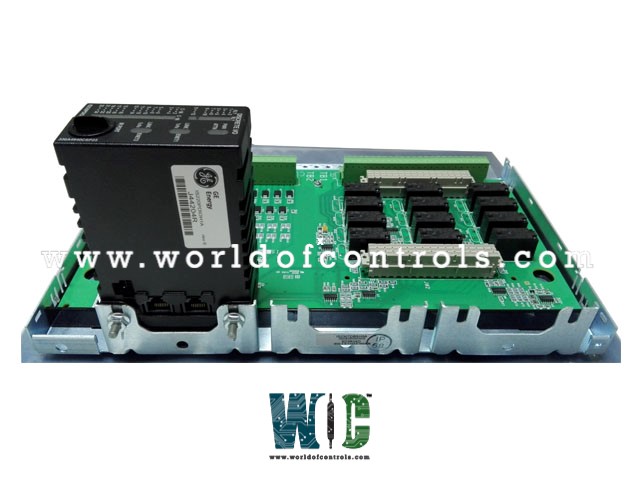
World Of Controls understands the criticality of your requirement and works towards reducing the lead time as much as possible.
IS230TDBTH6AA - Relay Output Terminal Board is available in stock which ships the same day.
IS230TDBTH6AA - Relay Output Terminal Board comes in UNUSED as well as REBUILT condition.
To avail our best deals for IS230TDBTH6AA - Relay Output Terminal Board, contact us and we will get back to you within 24 hours.
Part No.: IS230TDBTH6AA
Manufacturer: General Electric
Country of Manufacture: United States of America (USA)
Size: 17.8 cm wide x 33.02 cm high
Temperature: -30 to + 65oC
Technology: Surface-mount
Number of input channels: 24 dry contact
Input filter: Hardware filter, 4 ms
Product Type: Relay Output Terminal Board
Availability: In Stock
Series: Mark VIe
IS230TDBTH6AA is a Relay Output Terminal Board developed by GE. It is a part of Mark VIe control system. Designed for precision, durability, and scalability, this board provides signal processing and relay control functionalities that play a critical role in industrial automation and turbine control systems. It acts as an interface between the Mark VIe controller and field devices, ensuring reliable transmission and execution of control commands.
The TDBT board is capable of accommodating 24 group-isolated contact inputs, making it ideal for complex control configurations that require dependable signal isolation and flexibility. These inputs are powered by a nominal 24 V DC, 48 V DC, or 125 V DC wetting voltage, externally supplied to ensure stability and optimal performance under varying operating conditions.
Industrial environments often experience high levels of electromagnetic interference (EMI) and electrical noise, which can compromise system reliability. It addresses this challenge through advanced noise suppression technology integrated into its design. This ensures that all contact inputs remain immune to voltage surges, transients, and high-frequency noise.
By effectively filtering electrical disturbances, the board guarantees stable and accurate signal detection, even in harsh environments such as power generation plants, process industries, and heavy manufacturing facilities.
The board features 12 Form-C (SPDT) relay outputs, providing exceptional versatility in managing switching, control, and monitoring tasks. Each relay is engineered to deliver precise switching performance with minimal latency, ensuring accurate actuation of field devices.
For users requiring additional control capacity, the TDBT board supports expansion via an optional card, enabling system designers to scale relay functionality to match evolving process requirements. This modular approach enhances system customization, allowing tailored relay configurations for different industrial applications.
To support ease of installation and adaptability in various control environments,designed for both DIN-rail and flat-panel mounting. This flexible configuration allows the board to integrate smoothly into existing control panels or enclosures without requiring extensive modifications.
The compact layout and well-labeled terminal points simplify wiring, reduce installation time, and improve maintenance accessibility—critical for large-scale systems requiring minimal downtime.
Built with a focus on long-term operational reliability, the TDBT board ensures consistent performance under continuous operation. Its rugged design withstands industrial temperature ranges and high-vibration conditions, maintaining dependable connectivity between the Mark VIe controller and field devices.
The board’s scalable architecture allows seamless adaptation to expanding system requirements, making it a preferred choice for applications in industrial automation, turbine control, process management, and facility operations.
The WOC team is always available to help you with your Mark VIe requirements. For more information, please contact WOC.
What is IS230TDBTH6AA?
It is a Relay Output Terminal Board developed by GE under the Mark VIe series.
What type of wiring connections does the board use?
The board features two sets of 48 terminal blocks for wiring connections. These terminal blocks typically accommodate #18 AWG wires, ensuring secure and reliable connections.
Are the screw assignments for the terminal blocks standardized?
Yes, the screw assignments for both TB1 and TB2 terminals are identical to those found on the SRLY relay board and the STCI contact input terminal board. This standardization ensures compatibility and ease of installation across different board types.
How should shields be terminated when installing the board?
Shields, if present, should be terminated in a separate bracket. This practice minimizes interference and ensures proper grounding, maintaining signal integrity and system reliability.