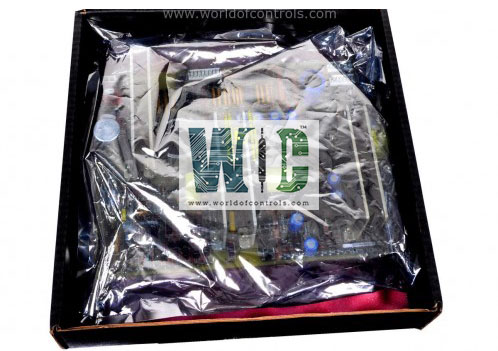
World Of Controls understands the criticality of your requirement and works towards reducing the lead time as much as possible.
IS230STAIH4A - Simplex Analog Input Terminal Board is available in stock which ships the same day.
IS230STAIH4A - Simplex Analog Input Terminal Board comes in UNUSED as well as REBUILT condition.
To avail our best deals for IS230STAIH4A - Simplex Analog Input Terminal Board, contact us and we will get back to you within 24 hours.
TECHNICAL SPECIFICATIONS:
Part Number: IS230STAIH4A
Manufacturer: General Electric (GE)
Series: Mark VIe
Product Type: Simplex Analog Input Terminal Board
Board Form Factor: Simplex Direct-Mount Terminal Board
Number of Channels: 10 Analog Inputs (Supports 4-20 mA, ±10 V DC, ±5 V DC)
Analog Inputs Supported: 4–20 mA
Transmitter Power Supply: Integrated 24 V DC Power Distribution per Channel
Noise Suppression: Active RC Filtering
Terminal Block Type: Two Barrier-Type Screw Terminal Blocks (24 Terminals Total)
Connectors: 1 × 37-Pin D-Sub Connector (JR1) for I/O Pack Interface (PAIH)
Conformal Coating: Yes
Operating Temperature: -30°C to +65°C
Storage Temperature: -40°C to +85°C
Relative Humidity: 5% to 95% Non-Condensing
Availability: In Stock
Repair Lead Time: 3–7 Days
Country of Origin: United States
Manual Reference: GEH-6721_Vol_II
The IS230STAIH4A is a Simplex Analog Input Terminal Board designed and manufactured by General Electric as part of the Mark VIe Series used in Speedtronic turbine control and distributed automation systems. The Analog I/O pack (PAIC) provides the electrical interface between one or two I/O Ethernet networks and an analog input terminal board. The PAIC contains a BPPx processor board and an acquisition board specific to the analog input function. The I/O pack can handle up to 10 analog inputs, the first eight of which can be configured as ±5 V or ±10 V inputs, or 4-20 mA current loop inputs. The last two inputs may be configured as ±1 mA or 4-20 mA current inputs.
The load terminal resistors for current loop inputs are located on the terminal board, and voltage is sensed across these resistors by the PAIC. The PAICH1 also includes support for two 0-20 mA current loop outputs. The PAICH2 includes extra hardware to support 0-200 mA current on the first output. Input to the I/O pack is through dual RJ-45 Ethernet connectors and a three-pin power input. Output is through a DC-37 pin connector that connects directly with the associated terminal board connector. Indicator LEDs provide visual diagnostics.
COMPATIBILITY:
The PAIC is compatible with the analog input terminal board (TBAIHIC), and the STAI board, but not the DIN rail-mounted DTAI board. The PAIC is only compatible with the HIC version of TBAI and will report a board compatibility problem with any of the earlier revisions. No physical damage will result if a PAIC is powered up on an older board in error.
INSTALLATION:
OPERATION:
The processor application code contains all the logic necessary to allow the pack to operate from one or two Ethernet inputs. When operated from two Ethernet inputs, both network paths are active all the time. A failure of either network will not result in any disturbance to the I/O pack operation, and the failure will be indicated through the working network connection. This arrangement is more tolerant of faults than a classic hot-backup system where the second port is only used after a primary port failure is detected. The Ethernet ports on the processor auto-negotiate between 10 MB/s and 100 MB/s speed, and between half-duplex and full-duplex operation. An industry-standard infrared serial communications port is provided on the processor board. Accessible through the pack front, this port provides diagnostic information on the pack status and the ability to program the pack when both Ethernet connections fail. It is possible to communicate with this port using most notebook computers and most hand-held Personal Digital Assistants (PDA).
WHY BUY FROM WOC
World of Controls maintains a comprehensive global stock of OEM replacement parts for GE Mark VIe control systems. The Simplex Analog Input Terminal Board is available in UNUSED surplus and professionally REBUILT conditions, covered by complete warranty protection. Each board undergoes rigorous inspection and channel verification testing against original manufacturer specifications to confirm measurement accuracy, transmitter power delivery, channel isolation, and physical continuity before shipment. We also provide professional repair, exchange, and technical support services to help minimize plant downtime and ensure smooth operation of your industrial assets. Contact our team to confirm current availability, request a competitive quote, or arrange quick delivery options.
What is the GE IS230STAIH4A?
The GE IS230STAIH4A is a Simplex Analog Input Terminal Board used in GE Mark VIe control systems. It interfaces up to 10 analog field inputs, such as 4–20 mA transmitters or voltage signals, with the system's PAIH Analog I/O pack for processing and monitoring across turbine and plant control loops.
Which I/O pack connects to the terminal board?
The IS230STAIH4A is primarily designed to interface with the PAIH (Analog I/O Pack) via its onboard 37-pin D-sub connector (JR1), which can mount directly onto the board or connect via a shielded cable assembly.
Does the IS230STAIH4A supply loop power to field transmitters?
Yes. The terminal board provides 24 V DC power distribution outputs across its channels to power 2-wire and 3-wire field transmitters directly from the control system.
What is the difference between simplex and redundant STAI board variants?
Simplex STAI board variants like the STAIH4A feature a single 37-pin connector (JR1) for single-pack I/O connection, whereas redundant variants (such as TTAI or RTAI) feature three connectors (JR1, JS1, JT1) to support Triple Modular Redundant (TMR) architectures.
Can World of Controls test or repair my existing IS230STAIH4A board?
Yes. World of Controls offers complete diagnostic testing, component-level repair, and re-certification services for GE Mark VIe terminal boards. Contact us to coordinate repair evaluation, turnaround timelines, and exchange options.