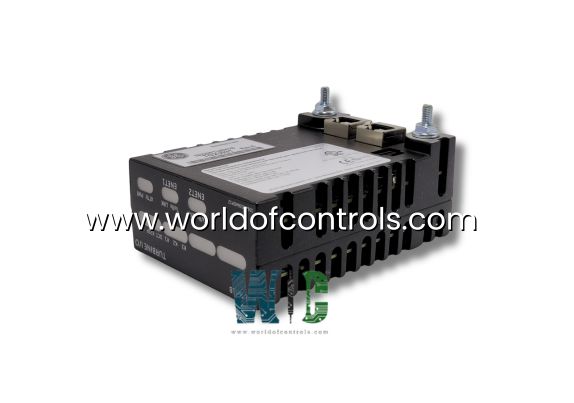
World Of Controls understands the criticality of your requirement and works towards reducing the lead time as much as possible.
IS220PTURH1B, REV A - Turbine Specific Primary Trip I/O Pack is available in stock which ships the same day.
IS220PTURH1B, REV A - Turbine Specific Primary Trip I/O Pack comes in UNUSED as well as REBUILT condition.
To avail our best deals for IS220PTURH1B, REV A - Turbine Specific Primary Trip I/O Pack, contact us and we will get back to you within 24 hours.
TECHNICAL SPECIFICATIONS:
Part Number: IS220PTURH1B, REV A
Manufacturer: General Electric (GE)
Product Series: Mark VIe
Product Type: Turbine Specific Primary Trip I/O Pack
Primary Application: Turbine control, primary trip, speed monitoring, voltage monitoring, and automatic synchronizing
Processor: Onboard high-speed processor with analog acquisition subsystem
System Architecture: Simplex and Triple Modular Redundant (TMR)
Nominal Input Voltage: 28.0 V DC
Operating Voltage Range: 27.4–28.6 V DC
Maximum Current Consumption: 0.41 A DC continuous
Speed Inputs: 4 magnetic pickup (MPU) or active speed sensor inputs
Speed Input Range: -15 V DC to +15 V DC
Passive Pickup Frequency Range: 2–20,000 Hz
Voltage Detection Input Range: 16–140 V DC
E-Stop Input Voltage Range: 18–140 V DC
E-Stop Power Output: 28 V DC open circuit
Contact Output Rating: 24–28 V DC active range
Maximum Contact Load: 7 A DC continuous
Network Interface: Dual redundant Ethernet interfaces
Ethernet Ports: 2 × RJ-45
Ethernet Standard: 10Base-T / 100Base-TX
Terminal Board Compatibility: TTURH1C
Main I/O Connector: DC-62 pin connector
Diagnostic Interface: Front-panel infrared (IR) diagnostic port
Status Indication: Front-panel diagnostic LEDs
Circuit Board Protection: Premium conformal coating
Operating Temperature: -30°C to +65°C (-22°F to +149°F)
Application: GE Mark VIe distributed turbine control systems
Repair Lead Time: 3–5 business days
Availability: In Stock / Repair & Exchange Available
Condition Options: Unused / Rebuilt
Country of Origin: United States
The IS220PTURH1B, REV A is a Turbine Specific Primary Trip I/O Pack designed and manufactured by General Electric for the Distributed Mark VIe control Systems. The Turbine Specific Primary Trip (PTUR) I/O pack provides the electrical interface between one or two I/O Ethernet networks and a turbine control terminal board. The PTUR contains a processor board common to the distributed I/O packs, a board specific to the turbine control function, and an analog acquisition daughterboard. The I/O pack plugs into the TTURH1C terminal board and handles four speed sensor inputs, bus and generator voltage inputs, shaft voltage and current signals, eight flame sensors, and outputs to the main breaker. Input to the pack is through dual RJ-45 Ethernet connectors and a three-pin power input. Output is through a DC-62 pin connector that connects directly with the associated terminal board connector. Visual diagnostics are provided through indicator LEDs.
ANALOG INPUT HARDWARE:
In simplex applications, up to four pulse rate signals may be used to measure turbine speed. The PTUR I/O pack contains circuits to convert pulse rate inputs to digital speed. Generator and bus voltages are brought into PTUR for automatic synchronizing in conjunction with the turbine controller and GE excitation system. TTUR has permissive generator synchronizing relays and controls the main breaker relay coil 52G. Shaft voltage is picked up with brushes and monitored along with the current to the machine case. PTUR alarms high voltages and tests the integrity and continuity of the circuitry.
In TMR applications, there are separate sets of four speed inputs for each PTUR, R, S, and T. All other inputs fan to the three PTUR I/O packs. Control signals from R, S, and T are voted before they actuate permissive relays K25 and K25P. Relay K25A is controlled by the PPRO. All three relays have two normally open contacts in series with the breaker close coil.
SPEED PICKUPS:
An interface is provided for four passive, magnetic speed inputs with a frequency range of 2 to 20,000 Hz. Using passive pickups on a sixty-tooth wheel, circuit sensitivity allows detection of 2-RPM turning gear speed to determine if the turbine is stopped (zero speed). If automatic turning gear engagement is provided in the turbine control, this signal initiates turning gear operation.
Pulse rate inputs can be configured for a variety of applications. When using the configuration parameter PRType, flow type is used for flow divider fuel flow measurements. Speed type is used for normal single-shaft turbines. Speed_High type provides an extended speed range above the standard speed type. Speed_LM type is designed for LM applications. Speed_HSNG type is used for applications where compensation for inconsistent tooth spacing on the speed wheel is desired. This pulse rate type will map the spacing of the teeth on the speed wheel to remove this periodic variation from speed measurements.
AUTOMATIC SYNCHRONIZING:
All synchronizing connections are located on the TTUR terminal board. The generator and bus voltages are provided by two single-phase potential transformers (PTs) with a fused secondary output supplying a nominal 115 V rms. The PTs are external to the TTUR, and it is the secondary output of these PTs that ties to the PT inputs of the TTUR. Measurement accuracy between the zero crossing for the bus and generator voltage circuits is 1 degree. Turbine speed is matched against the bus frequency. The generator and bus voltages are matched by adjusting the generator field excitation voltage from commands sent between the turbine controller and the excitation controller over the Unit Data Highway (UDH). A command is given to close the breaker when all permissions are satisfied. The breaker is predicted to close within the calculated phase or slip window. Feedback of the actual breaker closing time is provided by a 52G/a contact from the generator breaker (not an auxiliary relay) to update the database.
WHY PARTNER WITH WORLD OF CONTROLS:
WOC maintains an extensive inventory of OEM replacement parts for GE Distributed Mark VIe control systems, enabling customers to source critical components quickly and minimize equipment downtime. We supply unused and professionally rebuilt boards and provide specialized repair and refurbishment services to restore faulty boards to reliable operating condition, backed by warranty coverage for added confidence. With an experienced technical team available 24/7, we provide responsive support for OEM components, replacements, and automation-related requirements. Whether you need pricing, availability, replacement parts, or technical assistance, our team is ready to provide fast, reliable, and personalized support to keep your control systems operating efficiently.
What is the GE IS220PTURH1B, REV A?
The GE IS220PTURH1B, REV A is a Turbine Specific Primary Trip (PTUR) I/O Pack used in GE Speedtronic Mark VIe turbine control systems. It provides the electrical and communication interface between the TTUR terminal board and the control system for turbine speed, voltage, shaft monitoring, flame sensing, and primary trip-related functions.
Which terminal board is compatible with the Turbine Specific Primary Trip (PTUR) I/O Pack?
The IS220PTURH1B, REV A is designed to plug directly into the GE TTURH1C terminal board. The terminal board provides the field-level connections for the PTUR I/O pack, while the pack performs signal processing, monitoring, and communication functions.
What type of speed inputs does the Turbine Specific Primary Trip (PTUR) I/O Pack Support?
The PTURH1B, REV A I/O pack supports four magnetic pickup (MPU) or active speed sensor inputs. Passive magnetic pickup inputs can operate across a frequency range of approximately 2 to 20,000 Hz, allowing the module to detect turbine speed over a broad operating range.
How does the PTURH1B, REV A I/O Pack Measure Turbine Speed?
The PTURH1B, REV A converts the pulse rate from turbine speed pickups into digital speed information using its onboard signal-processing circuitry. The measured speed can be used for turbine monitoring, control functions, and determining conditions such as zero speed and turning-gear operation.