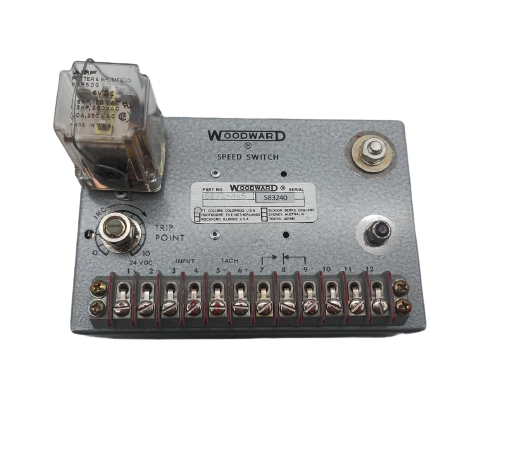
World Of Controls understands the criticality of your requirement and works towards reducing the lead time as much as possible.
8271-492 - Chassis-Mounted Digital Speed Switch is available in stock which ships the same day.
8271-492 - Chassis-Mounted Digital Speed Switch comes in UNUSED as well as REBUILT condition.
To avail our best deals for 8271-492 - Chassis-Mounted Digital Speed Switch, contact us and we will get back to you within 24 hours.
TECHNICAL SPECIFICATIONS:
Part Number: 8271-492
Manufacturer: Woodward
Product Type: Digital Speed Switch
Input Voltage Supply: 18–32 VDC (24 VDC Nominal)
Input Channels: 1 Dedicated Magnetic Pickup (MPU) Frequency Loop
Frequency Operating Range: 10 Hz to 10,000 Hz
Relay Interface Outputs: High-Capacity Form C (SPDT) Contacts, Latching
Contact Power Rating: 5 A at 28 VDC / 115 VAC (Resistive)
Programming Interface: Integrated Multi-Turn Potentiometers & Coarse Dip-Switch Blocks
Enclosure Type: Chassis / Panel Mount Sheet Steel Frame
Operating Temperature Range: -40°C to +70°C (-40°F to +158°F)
Relative Humidity Threshold: 95% Non-condensing
Response Switching Time: Under 50 milliseconds
Repair Time: 3-5 Days
Availability: In Stock
Weight: 0.95 kg (2.09 lbs)
Country of Origin: United States
The Woodward 8271-492 is a Chassis-Mounted Digital Speed Switch designed and manufactured to safeguard prime movers, industrial engines, and mechanical turbines against catastrophic rotational faults. Operating completely independently of the primary governor loop, this autonomous module acts as a hardwired, fail-safe safety system. It continuously reads high-frequency analog AC pulse trains generated by a gear-mounted magnetic pickup (MPU) sensor to trigger instant protective machinery trips whenever operating thresholds are violated.
HIGH-ACCURACY FREQUENCY INPUT CONDITIONING
The 8271-492 front-end interface is engineered with a high-impedance, isolated single-input channel dedicated to passive magnetic pickup tracking. The incoming sinusoidal AC voltage waves generated by the gear teeth are routed into specialized zero-crossing detection circuits and Schmitt triggers to output clean square-wave digital frequency signals. This hardware conditioning suppresses electrical noise, high-voltage transients, and common-mode interference running through parallel engine room lines.
FREQUENCY-TO-DIGITAL LOGIC & PROTECTIVE TRIPPING
The digital pulse stream is directly decoded by frequency-to-digital processing gates, where machine speed is measured against user-defined trip margins. The board contains isolated, high-reliability Form C relays configured to swing contacts within 50 milliseconds of an overspeed or underspeed event. When the input frequency crosses the hardwired setpoint, the switch instantly drops or energizes the relay network to isolate mechanical fuel loops, engage air shutoff valves, or broadcast a master hardware trip to the centralized diagnostic system.
WHY BUY FROM WOC
World of Controls specializes in lifecycle support and direct component replacement for critical legacy Woodward hardware. Every certified 8271-492 speed switch undergoes rigorous multi-channel frequency simulation sweeps up to 10 kHz, dry contact relay validation under inductive and resistive loads, and thermal chamber stability testing to ensure setpoints do not drift in extreme environments. We maintain extensive stock availability in UNUSED and REBUILT conditions to eliminate client downtime.
What is the Woodward 8271-492?
The 8271-492 is a Chassis-Mounted Digital Speed Switch built by Woodward to protect turbines and engines from critical overspeed or underspeed conditions. It works independently of the main governor loop, processing frequency pulses from a passive magnetic pickup sensor to flag rotation faults. If a calibrated threshold is breached, its internal hardware triggers a protective trip sequence using heavy-duty onboard relays.
How does the 8271- 492 architecture differ from multi-channel speed switches?
The 8271-492 isolates its tracking and frequency calculation logic entirely onto one dedicated MPU signal loop and its matched relay block. Unlike multi-channel models that handle broad alarm arrays, this single-channel focus eliminates line crosstalk or signal degradation risks. It provides a pure, direct line of hardware protection for a singular safety trip baseline.
How is the frequency window scaled?
The initial coarse configuration is managed via a binary dip-switch block located on the circuit board to match your equipment's operating frequency window. Once this baseline multiplier is selected, operators use high-resolution, multi-turn potentiometers to fine-tune the exact trip point. Technicians typically hook up a signal generator to simulate targeted frequencies during this calibration phase.
Are the 8271-492 trip relays latching or non-latching?
The module utilizes a fail-safe latching layout that locks the Form C contact relays into a fault state immediately when speed margins are violated. The relay will remain locked down even if the machine rapidly slows down or comes to a complete halt. System operation can only resume after an operator cycles power to the board or closes an external reset switch circuit.
What is the purpose of the built-in test points?
Front-accessible test terminals allow plant operators to safely verify the speed switch functionality without forcing an engine shutdown. Introducing a calibrated reference pulse or engaging the test selector drops the unit into a simulated overspeed state. This validates that the logic gates and outputs react perfectly within the specified 50-millisecond response limit.