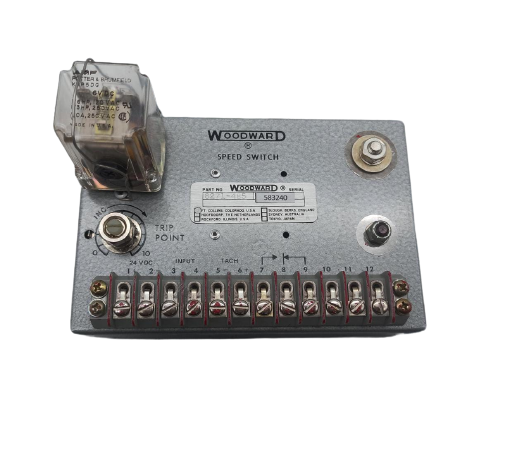
World Of Controls understands the criticality of your requirement and works towards reducing the lead time as much as possible.
8271-485 - Woodward Two-Channel Digital Speed Switch is available in stock which ships the same day.
8271-485 - Woodward Two-Channel Digital Speed Switch comes in UNUSED as well as REBUILT condition.
To avail our best deals for 8271-485 - Woodward Two-Channel Digital Speed Switch, contact us and we will get back to you within 24 hours.
TECHNICAL SPECIFICATIONS:
Part Number: 8271-485
Manufacturer: Woodward
Product Type: Two-Channel Digital Speed Switch
Input Voltage Supply: 18–32 VDC (24 VDC Nominal)
Input Channels: 2 Independent Magnetic Pickup (MPU) Channels
Frequency Range: 10 Hz to 10,000 Hz
Relay Outputs: 2 Form C (SPDT) Contacts, dry-type
Contact Rating: 5 A at 28 VDC / 115 VAC (Resistive)
Programming Interface: Onboard Dip-Switches and Rotary Potentiometers
Enclosure Type: Chassis/Panel Mount Sheet Steel Bracket
Operating Temperature Range: -40°C to +70°C (-40°F to +158°F)
Relative Humidity Threshold: 95% Non-condensing
Vibration Resistance: 4G Operational Curve
Repair Time: 3-5 Days
Availability: In Stock
Weight: 0.95 kg (2.09 lbs)
Country of Origin: United States
The Woodward 8271-485 is a chassis-mounted Two-Channel Digital Speed Switch built to protect prime movers, industrial engines, and steam turbines from catastrophic speed faults. It functions as an autonomous, hardware-level overspeed and underspeed protection system that operates completely independently of the primary governor loop. By continuously evaluating high-frequency pulses from engine-mounted magnetic pickup (MPU) sensors, it provides fail-safe protective switching when rotational speeds cross critical safe operating margins.
DUAL MPU INPUT CONDITIONING
The circuit architecture features two fully isolated, high-impedance input channels designed to interface with standard passive magnetic pickup sensors. Incoming sinusoidal AC voltage waveforms generated by gear teeth pass through internal zero-crossing detection circuits and Schmitt triggers, which convert raw analog waveforms into clean square-wave frequency pulses. This robust front-end conditioning strips out electromagnetic interference and low-amplitude harmonic signal noise caused by adjacent starter motors or high-voltage lines.
FREQUENCY-TO-DIGITAL EVALUATION & FAULT SWITCHING
The conditioned square waves pass directly into specialized frequency-to-digital processing logic, where the exact speed profile is cross-examined with user-defined setpoints. The board houses independent Form C industrial relays assigned to each channel, allowing operators to dedicate one channel to an overspeed alarm/trip sequence and the second channel to an underspeed crank-termination baseline. If a channel's pulse train frequency crosses the hardwired setpoint threshold, the respective relay instantly changes state in under 50 milliseconds to isolate fuel valves or trip the main breaker.
WHY BUY FROM WOC
World of Controls delivers certified, fully tested legacy hardware extensions for critical power setups. Every 8271-485 speed switch undergoes specialized multi-channel frequency sweep testing up to 10 kHz, contact resistance validation on all dry-type relay outputs under load, and comprehensive thermal cycling to verify setpoint stability under severe field environments. We maintain ready stock configurations in both UNUSED and REBUILT options to minimize your unexpected system downtime.
FREQUENTLY ASKED QUESTIONS FOR 8271-485:
What is the Woodward 8271-485?
The 8271-485 is a two-channel safety module that monitors machinery rotation speed via magnetic pickup inputs to protect against overspeed or underspeed conditions. Operating completely separate from the primary governor, it features onboard conditioning circuits and independent Form C relays that trip instantly if speed thresholds are breached.
How do you calibrate the speed setpoints on this module?
Setpoints are adjusted using onboard multi-turn rotary potentiometers and dip-switch arrays to scale the target frequency range. Technicians can inject a known reference frequency from a signal generator into the MPU terminals and adjust the pots until the corresponding channel relay trips.
What happens to the module if a magnetic pickup sensor wire breaks?
The 8271-485 includes built-in open-circuit detection that monitors the electrical integrity of the sensor loops. If an MPU input line snaps or loses continuity, the module registers a zero-speed state, trips the fault logic, and safeties the assigned channel to prevent an unmonitored overspeed run.
Can the two channels be programmed with different speed thresholds?
Yes, both channels are fully independent and can be configured for entirely different speed targets and functions. Typically, Channel 1 is calibrated for high-frequency overspeed shutdown protection, while Channel 2 is set for lower-frequency crank termination or underspeed alarms.