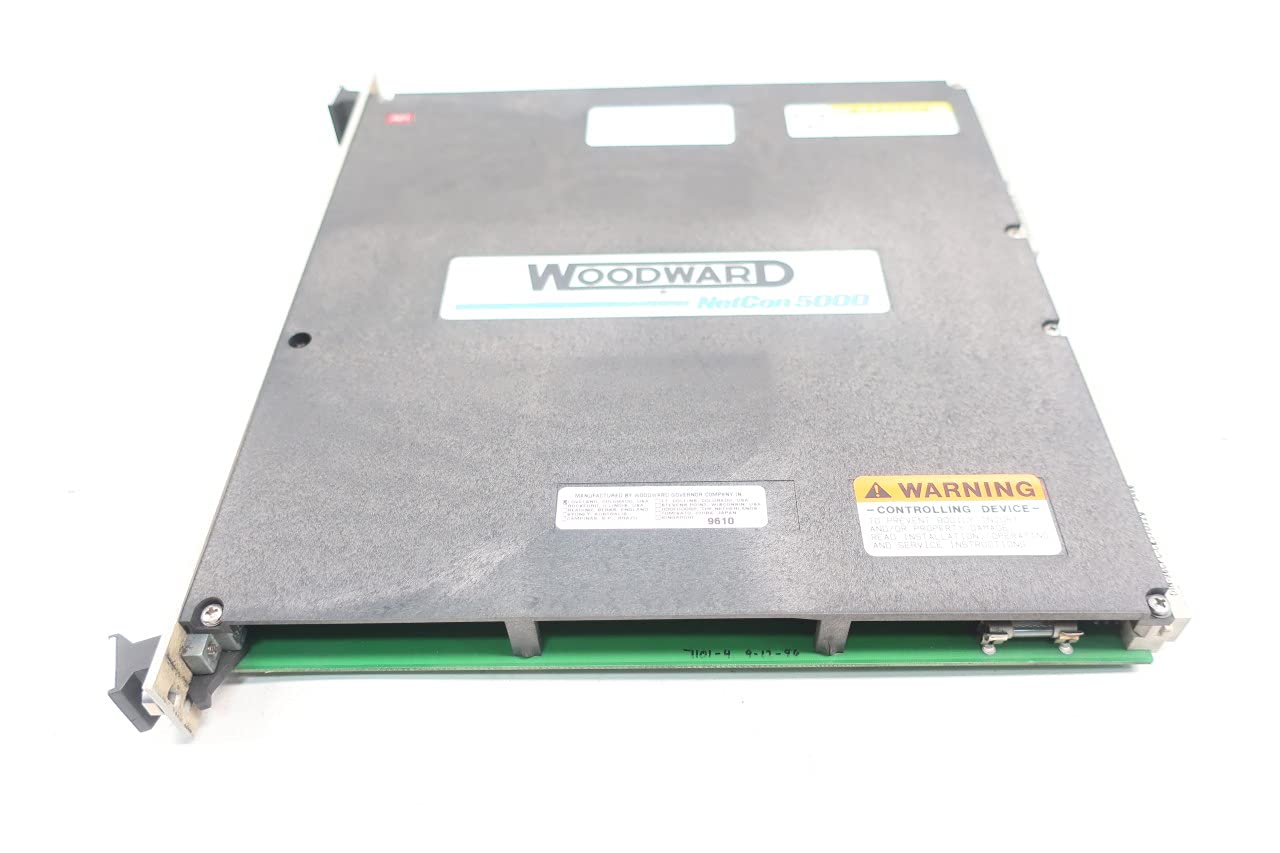
World Of Controls understands the criticality of your requirement and works towards reducing the lead time as much as possible.
5464-836 - Speed High-Density Module is available in stock which ships the same day.
5464-836 - Speed High-Density Module comes in UNUSED as well as REBUILT condition.
To avail our best deals for 5464-836 - Speed High-Density Module, contact us and we will get back to you within 24 hours.
SPECIFICATIONS:
Part Number: 5464-836
Manufacturer: Woodward
Series: MicroNet / MicroNet Plus Series
Product Type: High-Density Speed Module
Input Channels: 4 Independent Channels
Sensor Compatibility: Passive MPU / Active Proximity Probes / Optical Transducers
Frequency Sensing Range: 1 Hz to 50 kHz
Processing Resolution: 0.01 Hz
Control Backplane: VMEbus Architecture
Signal Isolation: 500 V RMS Channel-to-Bus & Channel-to-Channel
Power Consumption: 7.5 W
Form Factor: VME Plug-In Card
Conformal Coating: Yes
Operating Temperature: -40°C to +85°C
System Compatibility: MicroNet & MicroNet Plus Platforms
Availability: In Stock
Repair Lead Time: 3–7 Days
Country of Origin: United States
The 5464-836 is a High-Density Speed Module manufactured by Woodward for MicroNet and MicroNet Plus turbine control platforms. Slotted directly into standard VME chassis slots, the module provides high-speed processing of rotational pulse trains from magnetic pickups (MPUs) or proximity probes to deliver precise turbine speed governing, acceleration tracking, and over-speed protection.
HIGH-PRECISION SPEED ACQUISITION & ACCELERATION TRACKING:
The primary function of the 5464-836 is acquisition and real-time processing of high-frequency speed pulse signals across multiple independent channels. The board converts raw AC transducer pulse trains into high-resolution rotational velocity (RPM) and rate-of-change (acceleration/deceleration) values. These processed signals are passed across the VME backplane to central CPU governor loops for dynamic fuel management and transient load response.
MULTI-CHANNEL TRANSDUCER INTERFACING & FREQUENCY MEASUREMENT:
The module accommodates multiple high-density input channels capable of reading signals from passive magnetic pickups (MPUs), active proximity probes, and optical speed sensors. Onboard counter-timer circuitry continuously evaluates high-frequency pulse intervals, enabling sub-millisecond calculation of shaft speed across wide operating ranges—from low-speed turning gear rotation to ultra-high-speed turbine operation.
SIGNAL CONDITIONING & OVERSPEED PROTECTION:
To ensure reliable speed detection in high-vibration and electrically noisy turbomachinery environments, each input channel incorporates active hardware filtering and optical channel isolation. The onboard logic continuously evaluates tooth-pass timing and signal continuity, detecting broken pickup wires or missing gear tooth pulses to prevent false trips or overspeed conditions during rapid turbine acceleration.
HARDWARE DIAGNOSTICS & FAULT SAFEGUARDING:
The module integrates continuous diagnostic hardware that monitors pickup power integrity, threshold voltages, and signal bounds. If an open circuit, shorted transducer coil, or invalid acceleration spike is detected on a speed channel, the module immediately flags a fault across the VME backplane to trigger configured backup sensing logic or initiate automated trip protection.
WHY BUY FROM WOC
World of Controls maintains the industry's largest inventory of genuine OEM replacement components exclusively for Woodward control systems and turbomachinery governors. To minimize critical plant downtime, we provide both UNUSED surplus and fully REBUILT circuit boards, field terminal modules, and driver cards—each backed by comprehensive warranty protection. Every reconditioned component, including the Woodward 5464-836, undergoes rigorous multi-point inspection, terminal continuity verification, and functional bench-testing by our experienced technical team before dispatch. In addition to direct parts supply, our facility offers complete diagnostic repair and unit exchange services with rapid turnaround times for your damaged Woodward hardware. Our dedicated team of automation specialists is available 24/7 to assist with technical selection, live stock verification, and emergency component sourcing for your control panels. Contact us today via phone or email to request pricing, confirm inventory, or arrange fast worldwide shipping.
What is Woodward 5464-836?
The Woodward 5464-836 is a High-Density Speed Module designed for MicroNet and MicroNet Plus turbine control systems. It processes speed signals from supported rotational speed sensors and provides high-resolution speed data to the control system. The module is installed as a VME plug-in card within the applicable control chassis.
How does the module handle multiple speed inputs?
The module provides four independent speed input channels that can acquire rotational pulse signals from compatible sensors. Each channel processes its incoming signal separately, allowing the control system to monitor multiple speed sensing points or redundant measurements. This architecture supports applications where independent speed information is required for governing and protection.
What happens if a speed sensor signal is lost?
A loss of pulses can result in a speed input diagnostic or an invalid speed value being reported to the control system. The actual response depends on the configured MicroNet application, including any redundancy, voting, alarm, or trip logic implemented by the turbine control program. Field wiring and sensor operation should be checked before determining that the electronic module has failed.
How can excessive electrical noise affect speed measurement?
Electrical interference can introduce unwanted pulses, distort signal transitions, or cause unstable frequency measurements. This may result in fluctuating speed values or intermittent speed channel faults. Proper sensor wiring, shielding, grounding, cable routing, and signal conditioning are important for maintaining reliable pulse detection in turbine control environments.
What should be checked if the speed reading is unstable?
First inspect the associated sensor, sensing target, wiring, connectors, and signal quality. Check whether the instability occurs on one input or multiple channels, as this can help distinguish a field-side problem from a module-level issue. If the incoming signal is stable and within the expected specifications but the reported speed remains erratic, the module should be evaluated through appropriate diagnostic or bench-testing procedures.
Can a failed channel affect turbine protection?
Yes, depending on how the control application is configured. Speed channels may be incorporated into governing, alarm, redundancy, or overspeed protection logic, so an input fault can influence the system response. The control application's configured voting and fallback strategy should be reviewed before replacing or bypassing any speed input.