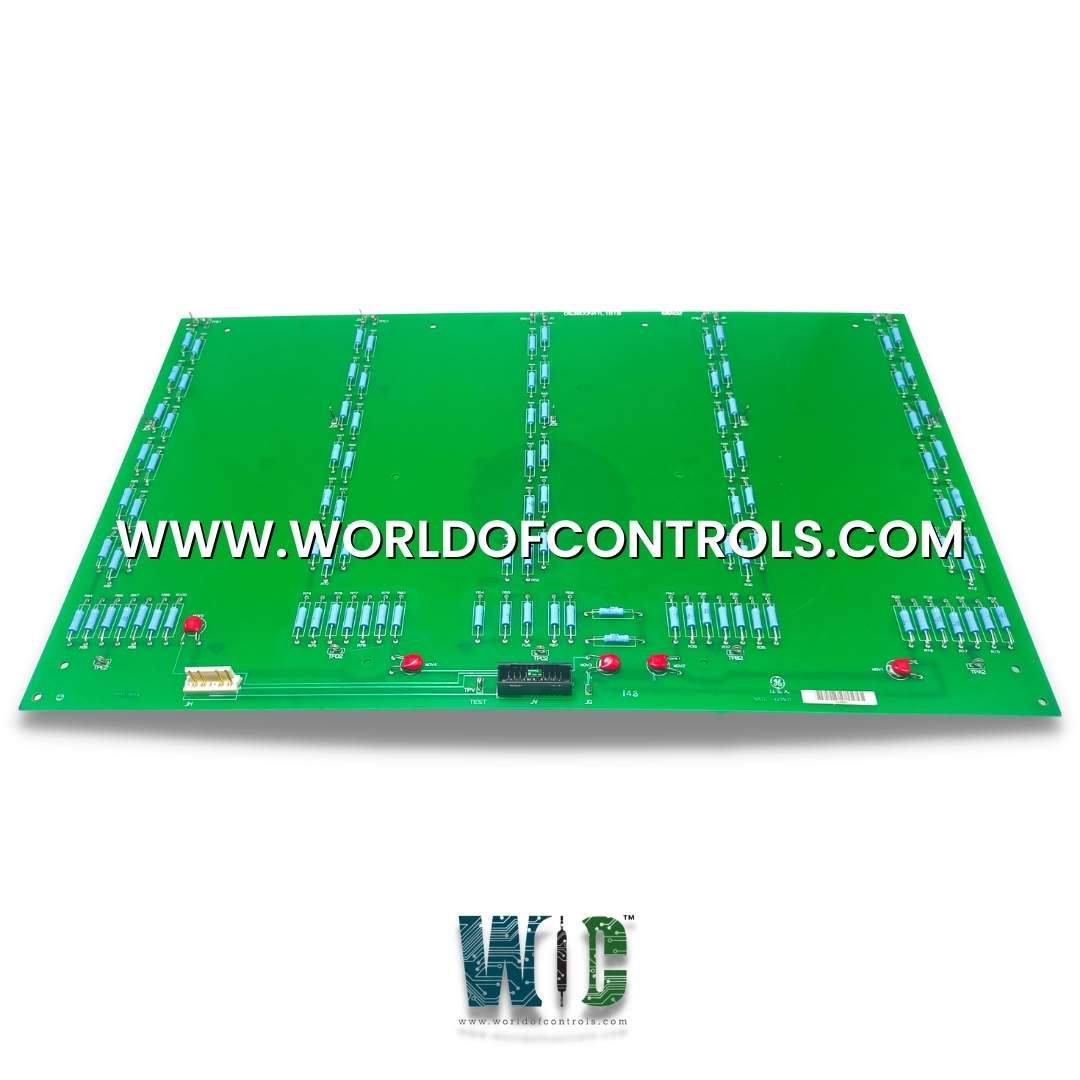
World Of Controls understands the criticality of your requirement and works towards reducing the lead time as much as possible.
DS3800NATL - Attenuator Board is available in stock which ships the same day.
DS3800NATL - Attenuator Board comes in UNUSED as well as REBUILT condition.
To avail our best deals for DS3800NATL - Attenuator Board, contact us and we will get back to you within 24 hours.
SPECIFICATIONS:
Part No: DS3800NATL
Manufacturer: General Electric
Series: Mark IV
Product Type: Attenuator Board
Low Level input: -0.5 min, 0.8 V max
High Level input: 2.0 min, 5.25 V max
Control Signals: TTL/CMOS compatible
Interface Modes: parallel/serial
Input Supply Voltage: +12.0 to +15.0V
Humidity: MIL-STD-202F
Vibration: MIL-STD-202F
Dimensions: 13.528 x 8.466 x 3.820
Operating Temperature: -20�Deg to +70 Deg C
Weight: 5 kg
Country of Origin: USA
Availability: In Stock
FUNCTIONAL DESCRIPTION:
DS3800NATL is an Attenuator Board manufactured and designed by General Electric and is part of the Mark IV Series used in GE Speedtronic gas turbine control systems. These models are designed to simplify the control and integration of these devices into subsystem and bench applications. These intelligent attenuators offer the same long, reliable operation with exceptional accuracy and repeatability as with our other 150 Series Programmable Attenuators. They provide programmable adjustments of RF signal levels in precise steps of 1 dB, 5 dB, 10 dB, or with custom steps available. Each attenuator consists of a cascaded assembly of switched attenuator cells and an internal TTL interface. The attenuator elements located in the attenuator cell are created by a thin-film process which provides exceptional long-term stability, low power and temperature coefficients. This series of step attenuators uses a reed switching structure that provides rapid switching together with low insertion loss.
BUILT-IN DRIVER CIRCUITRY:
These programmable attenuators feature an internal microcontroller-based driver that provides a TTL-level digital interface for controlling the attenuator relays. This card simplifies operation and interfacing requirements while providing greatly enhanced flexibility over past designs. User-selectable modes of operation include both parallel and serial buses. The parallel mode provides simple one-bit-per-relay on/off control with internal pull-ups, primarily for single attenuator applications. This mode allows the attenuator to be controlled via various methods, such as a TTL-level digital output port or mechanical toggle switches.
The device bus provides a two-wire serial bus structure and protocol for connecting several devices to a single host control interface, suitable for larger systems and sub-system applications. The driver interface contains non-volatile configuration memory to hold a wide variety of attenuator and driver-dependent parameters, including serial number, attenuator cell dB values, relay configurations, and switching requirements, all accessible via the digital interface. This frees the system designer from low-level details, allowing faster integration. In either operational mode, the microcontroller enters an idle condition during periods of inactivity, turning off all on-board clocks, reducing EMI concerns, and lowering power consumption. On-board regulation for the digital circuitry allows the programmable attenuator to operate from a single input supply voltage.
PROGRAMMABLE ATTENUATOR/SWITCH CONTROLLER:
The Model 8210A Programmable Attenuator/Switch Controller provides a flexible, low-cost solution for the operation of programmable step attenuators and other electromechanical devices under computer control. Designed to interface to Spectrum Control / Weinschel's intelligent programmable attenuators, the 8210A represents a new concept in device control applications for bench test and subsystem designs. The 8210A provides a high-level interface from various industry standard communications interfaces, including IEEE-488 and RS232/RS422/RS485, to the programmable attenuator's serial Driver Interface Bus.
WOC provides the largest inventory of OEM replacement parts for GE Speedtronic Control Systems, offering both unused and professionally refurbished boards that are fully tested and backed by a reliable warranty. In addition to supplying high-quality components, we deliver expert repair services for faulty or underperforming boards, restoring them to optimal functionality with precision and reliability. Our experienced team of engineers and technicians is available 24/7 to provide technical support, troubleshooting, and guidance, ensuring that your systems remain operational with minimal downtime. With fast delivery, comprehensive solutions, and unmatched expertise in industrial automation, WOC is your trusted partner for maintaining, upgrading, and repairing GE Speedtronic control systems. For inquiries about pricing, availability, or repair services, contact us via phone or email, and let us help you keep your operations running smoothly and efficiently.
What is the DS3800NATL?
The DS3800NATL is a programmable attenuator board from General Electric�s Mark IV Series. It is used to precisely control RF signal levels in GE Speedtronic gas turbine control systems and other subsystems. The board ensures high accuracy, stability, and rapid switching.
What are its input and control requirements?
It accepts low-level inputs of -0.5 to 0.8 V and high-level inputs of 2.0 to 5.25 V. Control signals are TTL/CMOS compatible, and it supports both parallel and serial interface modes. This allows flexible integration in single or multi-device systems.
What interface options does the optional 8210A controller provide?
The 8210A controller connects to the attenuator via the serial Driver Interface Bus. It supports standard communications interfaces such as IEEE-488, RS232, RS422, and RS485, enabling easy integration with computers or automated test systems.
What is the accuracy and repeatability of attenuation?
The attenuator provides high-precision attenuation with minimal deviation from programmed values. Repeatability is guaranteed over millions of cycles due to the stable thin-film elements and reliable reed switch design. Users can expect consistent performance in RF signal control.