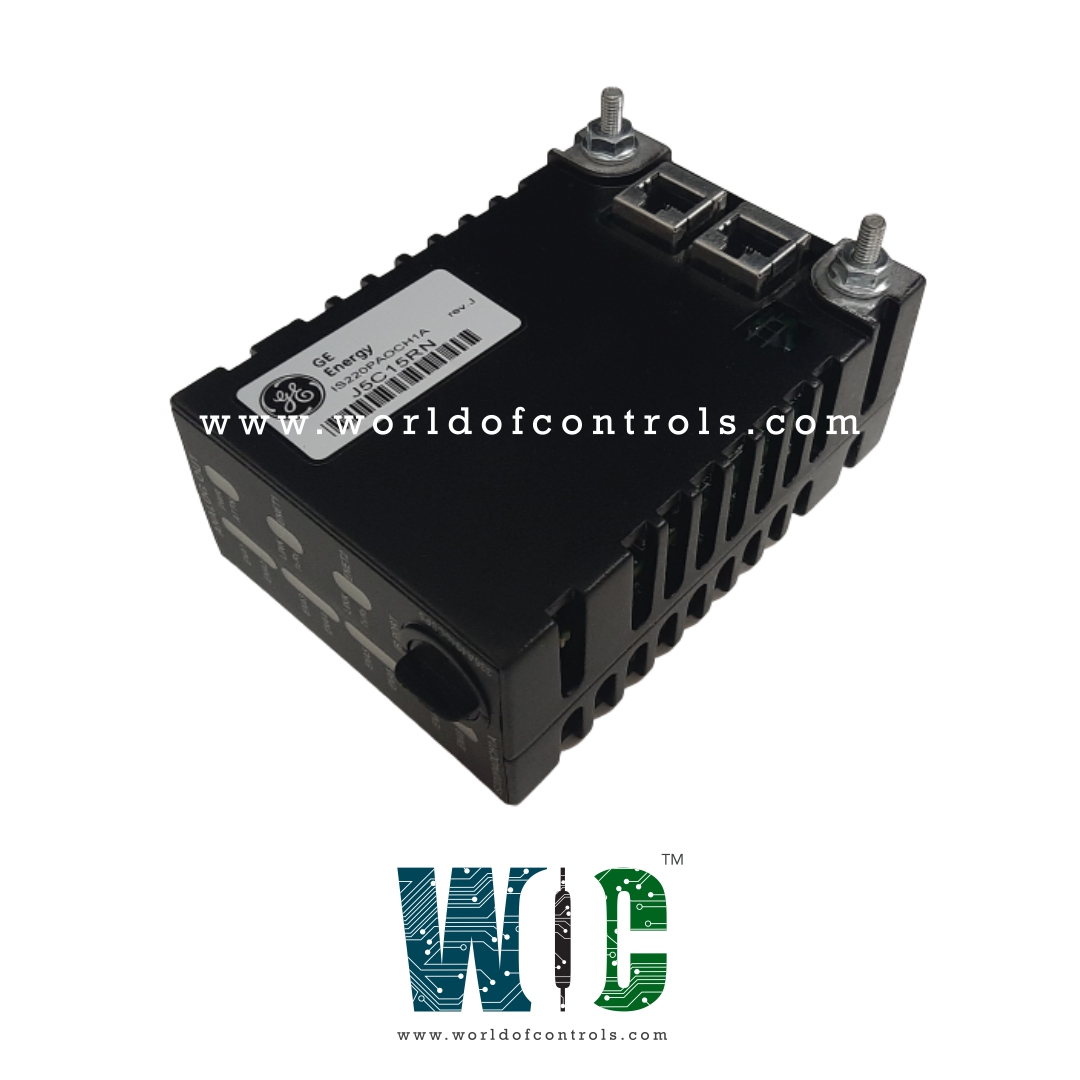
World Of Controls understands the criticality of your requirement and works towards reducing the lead time as much as possible.
IS220PAOCH1A, REV J - Analog Output Module is available in stock which ships the same day.
IS220PAOCH1A, REV J - Analog Output Module comes in UNUSED as well as REBUILT condition.
To avail our best deals for IS220PAOCH1A, REV J - Analog Output Module, contact us and we will get back to you within 24 hours.
SPECIFICATIONS:
Part No: IS220PAOCH1A, REV J
Manufacturer: General Electric
Function: PAOC Analog Output Module
Series: Mark VIe
Number of Channels: 8
Input voltage: 125 V
Analog outputs 0-20 mA,
Input Span: 1 - 5 Vdc
Input Converter Resolution: 16-bit A/D Converter
Common Mode Voltage Range: 5 V
Scan Time: 5 ms
Total Output: 400 W
Frame rate: 100 Hz
Total Output Power: 400 W
Output Voltages: +5, ±12, ±15, ±28 V DC
Temperature: -30° to +65°C
Technology: Surface Mount
Size: 8.26 cm high x 4.19 cm
Availability: In Stock
Technology: Surface Mount
Country of Origin: USA
Manual: GEH-6721D
IS220PAOCH1A, REV J is a PAOC Analog Output Module designed and manufactured by General Electric as part of the Mark VIe Series used in GE Distributed Turbine Control Systems. The PAOC serves as the electrical interface between one or two I/O Ethernet networks and an analog output terminal board. It includes a processor board common to all Mark VIe distributed I/O packs and a specialized acquisition board pair for analog output functions. The pack supports up to eight simplex 0-20 mA current loop outputs and features an analog-to-digital converter for current feedback. Inputs are received via dual RJ45 Ethernet connectors and a three-pin power input, while outputs are transmitted through a DC-37 pin connector linked to the terminal board. Visual diagnostics are provided by indicator LEDs, with local diagnostics accessible via an infrared port.
COMPATIBILITY:
The PAOCH1A is compatible with the TBAOH1C analog output terminal board and the STAO board, but not with the DIN-rail-mounted DTAO board. Although the PAOC can be mounted on TBAOH1A or TBAOH1B terminal boards, it will not achieve full analog signal accuracy due to circuit differences in these earlier revisions. Therefore, compatibility is limited to the H1C version of the TBAO board. If mistakenly powered on an older board, the PAOC will report a compatibility issue, but no physical damage will occur. Control mode refers to the number of I/O packs used in a signal path:
INSTALLATION:
OPERATION:
The processor board interfaces with an acquisition board tailored to the I/O pack's function. When input power is applied, the soft-start circuit gradually increases the voltage to the processor board. Local power supplies activate sequentially, and the processor exits its reset state. It then performs self-tests and loads application code specific to the I/O pack type from flash memory. The code verifies compatibility by reading board ID information to confirm alignment between the application code, acquisition board, and terminal board.
Once verified, the processor initiates Ethernet communication by requesting a network address using the standard DHCP protocol and unique terminal board identification. After Ethernet setup, the processor configures the on-board logic, executes the application, and activates the acquisition board for operation. The processor application code enables the pack to function with one or two Ethernet inputs. When using two inputs, both network paths remain continuously active, ensuring uninterrupted operation even if one network fails.
Any failure is reported via the functioning network connection, offering greater fault tolerance compared to traditional hot-backup systems, where the secondary port activates only after a primary port failure. The Ethernet ports support auto-negotiation, adjusting to 10 MB/s or 100 MB/s speeds and switching between half-duplex and full-duplex modes as needed.
WOC maintains an extensive inventory of OEM replacement parts for GE Distributed Mark VIe control systems, enabling customers to source critical components quickly and minimize equipment downtime. We supply unused and professionally rebuilt boards and provide specialized repair and refurbishment services to restore faulty boards to reliable operating condition, backed by warranty coverage for added confidence. With an experienced technical team available 24/7, we provide responsive support for OEM components, replacements, and automation-related requirements. Whether you need pricing, availability, replacement parts, or technical assistance, our team is ready to provide fast, reliable, and personalized support to keep your control systems operating efficiently.
What is GE IS220PAOCH1A, REV J?
The GE IS220PAOCH1A, REV J is a PAOC Analog Output I/O Pack designed for the GE Mark VIe Distributed Control System. It provides the interface between the IONet network and compatible analog output terminal boards.
Which terminal boards are compatible with the PAOCH1A?
The PAOCH1A is compatible with the TBAOH1C terminal board and the STAO board but is not compatible with the DIN-rail-mounted DTAO board. It can also be physically mounted on TBAOH1A or TBAOH1B boards but will not provide full analog signal accuracy.
How does the PAOC handle dual Ethernet connections?
When dual Ethernet connections are used, both network paths remain active simultaneously. This ensures continuous operation even if one network fails, with the failure reported via the working network.
What type of connector connects the PAOCH1A to the terminal board?
The PAOCH1A connects to its associated terminal board through a DC-37-pin connector. Ethernet communication uses dual RJ-45 connectors, while power is supplied through a three-pin connector.